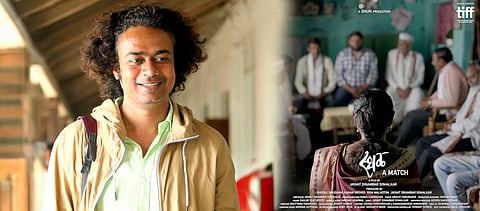


Jayant Digambar Somalkar left Chandrapur for Mumbai in 2007, armed with an engineering degree and no clear blueprint for the future. It would take years of writing comedy for television, animation gigs, and a self-imposed film education before he found his voice as a filmmaker.
Nearly two decades later, Somalkar’s debut feature, Sthal (A Match), did what few Indian independent films manage—becoming the only Indian selection in the Discovery Programme at the 2023 Toronto International Film Festival (TIFF).
Shot in his home village of Dongargaon in Maharashtra with a cast of non-actors, Sthal unfolds in a familiar setting: a middle-class family, a matchmaking ritual, a young woman under scrutiny. The tragedy of Savita's life slowly morphs into a comedy if you pay attention to the details.
In this conversation with The Hollywood Reporter India, Somalkar speaks about the challenges of shooting in his own village, the space for Marathi cinema, and his ability to find humour in heartbreak.
The conversation has been translated and edited for clarity:
Sthal had its your world premiere at TIFF in 2023—that’s a huge milestone for any filmmaker, especially for an independent Marathi filmmaker. How did that happen?
When we finished the film, we knew we had made something good, but I wasn’t sure if I should submit it to festivals. A close friend of ours saw the film and immediately asked why I wasn’t submitting it to international festivals. I had initially planned to send it to MAMI, but she pushed me to try for international platforms. By that time, TIFF’s deadline had already passed, but she insisted I email them, explaining the situation. Fortunately, they granted me a deadline waiver, and I submitted the film. Just two days later, I got an email from the South Asia programming team asking for more details. I sent everything over, but I didn’t expect much. Then, I got another email: We really like your film. Is your world premiere available? I was in complete shock—I genuinely thought it was a spam email! I never expected that Sthal would get selected. But it was real, and TIFF became our launchpad.
Festivals open doors—they provide networking opportunities, visibility, and sometimes even funding. Did the festival circuit lead to any concrete opportunities for you? And if so, why did it take so long for the film to secure an Indian theatrical release?
Definitely. Selection at TIFF gave the film visibility and credibility. Sthal is a small Marathi film, and honestly, if it hadn’t been picked by TIFF, it would have gotten lost in the crowd. The festival run gave it momentum, and winning the NETPAC Award helped even more. But, unfortunately, just because a film does well at festivals doesn’t mean it will get a theatrical release in India. There’s a perception here that ‘festival films’ are slow, niche, or ‘artsy’—even when that’s not the case.
Another challenge was that Sthal had no big stars, no major production house backing it, and no well-known director attached. In India, if your film doesn’t have these things, theatrical distribution becomes difficult. After TIFF, we received calls from several major studios, all praising the film. But no one was committing to a release. It dragged on for months—perhaps their existing slates didn’t have space for a film like ours, or maybe it just wasn’t a priority from a business standpoint.
Eventually, we realised that if we wanted Sthal to reach theaters, we had to do it ourselves. We had many discussions with distributors, but most were hesitant. That’s when Sachin Pilgaonkar came in—he had seen Sthal at a festival in California and really loved it. He asked me about my release plans and said, "If you need help, let me know." At the time, all our talks with distributors were leading nowhere, so I reached out to him. He had previously distributed a Marathi film himself, so he understood the challenges. He watched Sthal again and told me, "I believe in this film—I think it can work in theaters." So not only did he agree to support the release, but he also came on board as a presenter. His backing made a huge difference because he was invested in ensuring the film actually reached audiences, not just in handling the technicalities of distribution.
Even with that support, releasing a film like Sthal theatrically is tough. In India, bringing audiences to the cinema—especially for an independent film—is the biggest challenge. We know Sthal is a strong film and cinephiles will appreciate it, but getting the general public to buy tickets and show up in theaters is an uphill battle. Thanks to Sachin’s support, we’re at least getting a wider reach. Let’s see how things unfold.
It’s a huge deal for an independent film to secure a theatrical release in the current climate. Theatrical attendance is unpredictable—audiences are hesitant, and box-office numbers are uncertain. For a long time, Indian cinema was Bollywood-centric. Now, we talk a lot about 'pan-Indian' cinema, but most of that momentum is coming from the South. Why isn’t Marathi cinema experiencing the same breakthrough? Is the language barrier truly breaking, or are we still struggling to market regional films nationally?
It’s unfortunate, but Marathi films haven’t had the same pan-Indian trajectory. The reality is that audiences who have the choice between a Marathi film and a Hindi film usually opt for the latter. It’s not that Marathi films aren’t good—we have some incredible storytelling—but the perception of mainstream entertainment is still heavily tilted toward Hindi cinema.
Post-COVID, this isn’t just a Marathi industry issue; most film industries have struggled. If you look at big pan-Indian successes, the last major Marathi hit with cross-regional appeal was Sairat. Even Baipan Bhari Deva performed well, but that was within Maharashtra—it didn’t travel the way South Indian films have.
For a film to work pan-India, it needs a universal subject, but it also requires strong initial support from its home state. If the local audience embraces a film, it has a better chance of expanding its reach. South Indian films have cracked this formula—whether it’s Pushpa or Kantara, they first became massive hits in their own states before crossing over. Another factor is production scale and storytelling style—many South films have high production values, action-packed narratives, and mass appeal, which makes them more accessible to wider audiences.
For Marathi cinema to break through, we need two things: local audiences to champion our films and an ecosystem that supports their theatrical run. Right now, one of our biggest struggles is exhibition—Marathi films often get afternoon slots, which are non-strategic. Who is coming to watch a film at 12:30 PM on a weekday? On top of that, if a Marathi film doesn’t perform exceptionally well in its first three days, it gets pulled from theaters. That’s a huge issue because word-of-mouth takes time to build.
This creates a vicious cycle—Marathi films don’t get enough time to perform, which affects box office numbers, which in turn impacts budgets for future productions. If budgets remain low, production quality doesn’t improve, and that limits the potential for a film to have a national reach.
That’s something we’re concerned about with Sthal as well. The film is getting good shows in theaters, but if footfalls don’t pick up quickly, it could be removed before it even has a chance to grow. Theater owners have a business to run, and if they see empty seats, they’ll replace the film with something else. We’re hoping that audiences give Sthal the time it needs to find its audience. Every film has its own journey, and we’re just grateful that ours is finally reaching cinemas.
Tell us about shooting with non-actors and filming on location. When you don’t have the space to move the camera as freely as you would on a set, that must bring certain challenges, right?
Yes, absolutely. Working with non-actors has its own set of challenges. Some of them had never faced a camera before. The biggest reason I decided to work with them was to maintain authenticity. I wanted the film to have a natural look and feel, so shooting in the village was a given. When I was writing, I already had a specific village in mind, one I had known since childhood. The culture, the people, the atmosphere—it was all organic, which made the decision to shoot on location even stronger.
The house where we shot the film isn't mine anymore, but it used to be my family home, and I was actually born there. So there was a personal connection, but at the same time, it wasn’t a typical shooting location with the space you’d ideally need. There was barely any room to move around, and setting up lights was tricky. However, that constraint also added to the realism. The challenge was figuring out how to shoot in such a restricted space while maintaining the right cinematic feel. But when I discussed it with my DOP, he was completely on board.
For me, the biggest thing in a film is location—it’s almost a character in itself. You can’t compromise on that. The only real issues we faced were logistical. The village had never experienced a film shoot before, so nobody knew what to expect. For example, capturing sound was a huge challenge because there was a railway track right outside the village. Every ten minutes, a train would pass by, forcing us to stop shooting. This meant we had to wrap things up in fewer days, with longer shooting hours.
Even the village’s daily activities became obstacles. When we called for silence, people would try to cooperate, but it took them a few days to truly understand what was going on. One incident I remember vividly—there was a woman washing clothes nearby, rhythmically beating them against a stone; the moment she heard "Silence, please!" she froze, and as soon as I called "Cut," she immediately resumed her work. These kinds of moments happened often.
There was also a bhajan session every evening at 7 PM. I requested them to delay it for a few days, and they kindly agreed. The villagers were incredibly supportive, and without them, this shoot would have been impossible. But at the same time, they were taken aback by the duration of the shoot. Initially, they thought we’d be there for two hours and leave. But when we arrived at 6 AM and stayed till 7 PM, some of them grew frustrated. One of the homeowners, by the fourth day, said, “I can’t do this anymore.” I had already shot for three or four days at his place, so it put me in a tough spot. But then he softened and said, "Beta, you’re one of us, so I’ll allow it. If it were anyone else, I’d have refused."
One of the toughest days of the shoot was when a small fire broke out near our base camp on the third day. Thankfully, it wasn’t serious, but it made me realise how sensitive shooting in my own village was. If anything had gone wrong, I would have felt personally responsible. Unlike a rented film set, this was a real home with real people living in it.
Then there was the challenge of working with non-actors. At first, everyone was excited. But once they realised they had to shoot for 10 to 12 hours a day, fatigue set in. My AD’s main job was to keep everyone in place because people would suddenly remember chores—someone had to go to the fields, someone had to run the flour mill. Lilabai, who played Savita’s mother, actually runs a small flour mill in the village, so she’d say, “I need to go, my customers are waiting.”
What I found interesting was how serious they became once the actual shoot began. Initially, they were thrilled about being in front of the camera, but once they saw the big setup, they got nervous. In wide shots, their performances were often better because they weren’t as aware of the camera. But over time, they became more confident. Lilabai, though, had a unique challenge—she would burst into laughter at the wrong moments. Even during emotional scenes, she would giggle, and it was tough to get her to stop. If you watch the film closely, you’ll notice I sometimes had her cover her face with her saree to hide her laughter. Despite all these challenges, the performances we got were incredibly raw and real.
Something that stands out in the film is the unexpected comedic moments. There’s one scene where people keep shifting the table every time Savita has to bow down to touch their feet—it’s subtle but very funny...
Even though the film is about a serious subject, I’ve always believed in finding humour in everyday moments. My writing naturally leans towards satire. The humour in the film isn’t forced; it comes from real-life observations. When you watch the film, you’ll see that people in these situations often say and do unintentionally funny things. It’s not about inserting punchlines, but letting the humour emerge from the scene itself.
Do you think using satire makes festival films more palatable? There’s a common perception that indie films are slow and depressing. Was making it satirical a conscious decision?
It wasn’t exactly a conscious decision. It’s just how I see the world. My sense of humour is dry and observational, and that naturally reflects in my writing. I don’t set out thinking, “Let’s make this funny.” It just happens. Even in serious situations, there are small moments of humour. That’s how life is, right?
The humour in the film feels very organic. But when working with non-actors, did they improvise, or did you have to guide them?
It was a mix of both. Some moments were scripted, while others came about naturally on set. For example, the table-shifting scene—it wasn’t in the script. The actor naturally moved the table because there wasn’t enough space to bow properly. It was such a real, instinctive action that we decided to keep it. That’s the beauty of shooting in a real location with real people—sometimes, the best moments happen organically.