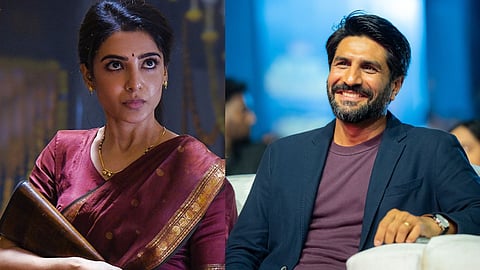


Samantha Ruth Prabhu detailed the delicate, incredibly satisfying road to Maa Inti Bangaaram's success in a recent note on Instagram. "Why would anyone watch a heroine film?" she wrote, recalling a passing comment from an exhibitor before release. Turns out a lot of people.
The film, created by Raj Nidimoru and directed by Nandini Reddy, went on to make history at the box office, becoming the highest-grossing female-led film in Telugu, entering the ₹100 crore club. The film not only sees the actress fight the bad guys, but also get into it in a sari. As the actress puts it, all it takes is a chance, a sentiment that Himank Duvvuru, producing partner at Samantha's Tralala Moving Pictures, deeply aligns with.
"A lot of times what happens is, even before a movie releases, more so for female-led films, you don't end up giving it a chance," he tells The Hollywood Reporter India in an exclusive conversation. "To break that perception gave us a certain amount of joy." Duvvuru, through the banner's slate, doesn't just want to emulate A24's model of boutique, standout films; it wants to be the next A24.
How does it feel to have backed a subversive yet equally commercial film that's also gone on to make a dent at the box office?
I don't think it's sunk in yet. To have your second film [2025 horror comedy Subham being their first] led by Samantha, who is coming in with a film after three years...I think all of us need to just pat ourselves on the back and just sort of enjoy the moment for now. But the enormity of it and the effect that it will have isn't just on us, but for female-led films and the way that they can be done and what it holds for the future. I don't think that we've comprehended that yet.
In an Instagram post celebrating the film's success, Samantha spoke about the trade's hesitation when it comes to backing female-led films. How do you view MIB's performance in the context of that ecosystem?
A lot of times what happens is, even before a movie releases, more so for female-led films, you don't end up giving it a chance. You're already thinking it'll do ₹30 or ₹40 crore. And to break that perception gave us a certain amount of joy.
More than that, I think it solidified our belief. Because when we were making the film, we were very clear that we were making a commercial entertainer for families. So while for a lot of people in the trade, it might have been a surprise, but as a producer, I'm not really surprised at hitting this number because I knew it would be very close to this number. There was some pressure from some distributors saying, 'Why don't you look at increasing the ticket price for the first week?' We wanted to keep it accessible to everyone.
What was that journey like?
It was challenging to put a cost to investors and producers as to the way we were making this film, the kind of technicians we got on board, the way that it was being made. It was extremely challenging until January, when we released the teaser, and people took notice of the film. It was challenging in terms of just trying to raise funds. There were days when we were going to shoot, and I was scrambling to ensure that there was money in the account to pay the unit. Yeah, all sorts of things. It's all worth it. But all of us have stepped up and pulled through. Not a day was delayed or cancelled despite challenges, so that was a big achievement for us.
Could you take us through the challenges of mounting a female-centric film and the conversations with exhibitors in this regard?
I think it comes in two steps. One is when you're putting it together, and second is once you've made it and you're exploring the film. So, when you're putting it together, the challenge comes in the form of raising capital and people asking, 'Why would you put so much money on a female-centric film?' with no context. We were really fortunate enough to find a bunch of people who supported us and who believed in the film that we were trying to make.
Samantha is a huge star here, so despite that, if you're facing these challenges, I can only imagine what the other producers might be facing. Second is action. People ask, 'How will you do action in a saree?' These [questions] put some doubt in your head. The number of doubts people put in your mind when you're making a female-led film, as compared to a male-led film, is a lot. But Samantha went all out. To watch her do action in a saree, with that much ease and technicality, is incredible.
The next challenge is expansion. What are the kind of openings do you expect? What is the number? How are you going to sort of recover? You want to make sure that your sales are done fast enough and early enough so that you're protected. Even there, they really lowball you (laughs). There's a lot of patience involved. A lot of belief that Samantha and Raj had in me to ensure that the right deals are structured. You keep fighting for it, and you stick to your guns.
There was no queue of suitors to buy the film. I'm sure there'll be a queue of suitors for our next film. We had to create our own queue and create demand for it and create interest in it. That was an enjoyable part of the whole experience to see what would get buyers interested. It's important to excite them as much as the audience first.
What was it like working with Raj and Samantha? We know the film was very consciously produced on a tight budget.
We've been working on various things together now, including the Chennai Super Champs in the World Pickleball League. Our relationship evolved from me being her agent to us becoming business partners, because we've always had this common goal of maximising value, and that's where this mutual respect comes from. It's been a great journey with both of them. Raj is the creative force, and it is an open and democratic platform.
Could you tell us about Tralala's upcoming slate and your approach for the banner going forward?
We want to be an efficient, exciting new-age boutique production house that's doing quirky yet commercial movies for everyone. We want women to be part of every ancillary aspect of filmmaking. There's a large proportion of women technicians on our sets. We want to keep it highly disciplined, which is why there's always continuity in most of our core team. There's a certain way in which we shoot. We definitely shoot, I would say, 80-90% more than what a typical movie would shoot in a particular period.
That happens because you go in knowing what to shoot. Raj already has the edit in his mind. So we try not to shoot anything extra. We have a writer's room where we're constantly churning out scripts. Over the next two years, you can expect five films coming from our slate.
We've always looked at A24 as a great model. They're about 14 years old, and the way they've built out their graph from their first film to now producing Marty Supreme, Backrooms, and The Invite. Theirs is a phenomenal story. It's efficient filmmaking and just picking the right stories, working with people long term. There's continuity in their teams. Usually production teams come and go, and every time they come, you're creating a new, you know, you're creating a new sort of structure. With continuity, that's not the case.
Would you say you'd want Tralala to be the A24 of the South?
We want it to be the A24 (smiles). Be it in the South, in India or globally. We want to be remembered as a production house that gives people films that will always be remembered. More than the numbers, we want people to come and tell us our film changed a lot of things in, say, ten years. RGV's Kshanam Kshanam was a movie that changed a lot of things 25 years ago. We want to create such films and leave a mark that stays.