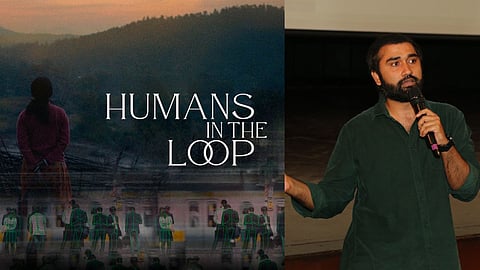


When Aranya Sahay’s Humans In The Loop premiered at the MAMI Mumbai Film Festival in October 2024, not many people turned up for the screening. “Nobody knew about the film, and it was a small theater. Ramesh Sippy was there, unprompted, but that’s about it,” Sahay tells THR India.
There is always a skew in the MAMI line-up towards the international films which arrive having gathered a cloud of buzz and reviews, or Indian films which premiered at festivals like Berlin, Cannes, Venice, or Toronto.
Humans In The Loop arrived without such fanfare.
By the third screening at the festival, however, swelling word of mouth trembled through the cinephilic grapevine, with Chalchitra Talks, the film recommendation platform, even making a quick video about it, calling it the festival’s “accidental discovery”.
Almost a year later, September 5th onwards, backed by producer-director Kiran Rao, the film will be getting a limited commercial release—a destiny only a miniscule number of independent films are allowed. Humans In The Loop, then, typifies the resilience of a film’s journey from an obscure screening at a local film festival to a country-wide theatrical release.
A gentle film in the distinctive square-ish 1.55:1 aspect ratio, it follows an Adivasi woman, a single mother, Nehma (Sonal Madhushankar) who begins working as an AI data labeler to make ends meet. While teaching the technology how to identify objects, differentiate pests from plants, she learns something vital about parenting, too.
Inspired by a longform article by journalist Karishma Mehrotra, Human Touch, and developed as part of the Storiculture Impact Fellowship—that supports socially relevant storytelling—in collaboration with the Museum of Imagined Futures, which focuses on the intersection of technology and society, the film has one eye on its story and the other on its message, both braided as though one, inseparable voice. Outreach is in the DNA of the story—what Sahay calls a “nice film”, as in one that isn’t polemical about its stance on AI, amenable to both sides of the aisle.
After MAMI, Sahay and his producer Mathivanan Rajendran were browsing through the reviews that people posted online, on Instagram, tagging the filmmaker, “If 300 people came, around 100 were writing these personal essays as Instagram posts—not just stories. If that was the conversion ratio then Mathivanan and my job was now to continuously show the film.”
The film showed at the International Film Festival of Kerala (IFFK), among other film festivals in Chandigarh, Bangalore, and Bhubaneswar, and was picked up by the Indian Film Festival of Los Angeles (IFFLA) where it won The Grand Jury Prize for Best Feature and the New York Indian Film Festival where it won Best Debut Film.
But an independent film in India cannot thrive by merely dotting the film festival circuit, for as Sahay notes, “they are few and far between”. He had to build the momentum of his film outside and alongside the film festival journey. “This was a film without a star, or a star director, or a well known producer. The film had to become the talking point,” Sahay notes.
He and Rajendran furiously wrote emails to foundations, cultural centers, and universities across the country, “India has been structured in a way where you can show films around not by paying a lot of money, where a traveling filmmaker can go and show a film.”
The film was screened at cultural centers and foundations—Bangalore International Centre, India; International Centre and Habitat Centre in Delhi; G5A Foundation for Contemporary Culture; Jaipur Centre for Art; Alliance Française, Kolkata—as well as exclusive clubs like Soho House in Mumbai and the Rotary Club in Bangalore. “There is also a significant role that film programmers and film critics have played in this journey—it is part of the distribution and impact work of the film,” Sahay notes.
Sahay also showed his film at universities across the country, from National Film Archive of India, Pune (NFAI) to Satyajit Ray Film & Television Institute, Kolkata (SRFTI), from Ashoka and JNU to IIM Calcutta. Taking his film abroad, the film was screened at the Indie Meme & Austin AI Alliance in Texas and the Digital Studies Institute at the University of Michigan. Sahay has screened the film in over thirty spaces—each one secreting its own barrage of Instagram posts and reviews, which pushes the film along till the next screening.
“The thing that really helped was that Aranya would be present at all the screenings. At the Bangalore International Centre, for example, he invited an AI expert to be in conversation with him. This also excites people to show up,” Rajendran tells THR India. Sahay is of the opinion that the independent filmmaker needs to be part of the film’s outreach, “There has to be the writer-director in tandem with producers fully designing the outreach message, working together on the distribution—we can’t work in silos. Everyone has to do everything.”
It was at one of the community screenings, at Whistling Woods in Mumbai, that the film caught the attention of Kiran Rao, who decided to push it along the last mile towards its commercial release. Rao and ethnographic filmmaker Biju Toppo have come onboard as Executive Producers. Storiculture even mobilised an impact distribution fund to finance the film’s distribution together with Sahay.
September 5th onwards, Humans In The Loops will be screening across India—starting in Mumbai. This would be followed by screenings in Delhi, Kolkata, Bangalore, Trivandrum, Chennai, and Jaipur, September 12th onwards.
Rajendran notes that the intention of developing such a model of distributing independent films is “built to scale. We want to build a network of decentralised micro-communities who we can tap into at any single given point and release a film. But we still need to see how the monetisation of this looks like in the future.”
For Sahay, the journey doesn’t end with the commercial release. He is gearing up for more community screenings in tandem with and post its release. People in tech have shown considerable interest. The film will also be screened where it was shot—Sarugarhi Village in Jharkhand—and at the Dharti Aaba Film Festival in Tribal Research Institute. “I also want to show it to the government. I am really interested in showing this film to the President of India—that is the end goal.”