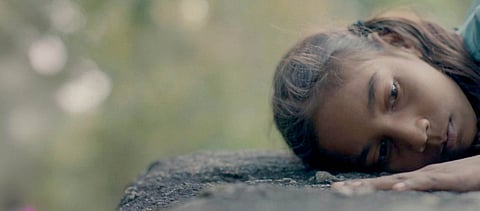


A great concept can be a curse. Take the one-liner of Humans in the Loop, for instance. An Adivasi single mother named Nehma (Sonal Madhushankar) starts working as a ‘data labeller,’ a job that requires her to train AI models to recognise the world in pictures and videos. This one-liner alone is so fertile — so ripe with cultural parables and documentary minimalism — that it’s hard to imagine a fictional film that expands on it. What can a feature-length story express that isn’t already implicit?
Think of the themes wired into the concept itself. A disenfranchised woman — bereft of social and personal identity — spends her days identifying and legitimising life on a computer screen. The mother of a 12-year-old girl and 1-year-old infant is hired to treat AI as a child. A profession that thrives on binary labels is outsourced to people whose plurality transcends labels; humans are instructed to think like machines in order to instruct machines to act like humans. A marginalised Indian’s social conditioning is at odds with a job that formalises societal bias; she must teach an algorithm to differentiate between things. Unlike the thousands of images and videos she goes through every day, Nehma isn’t even afforded the dignity of being a data point. And then there’s the title, which alludes to the closed-loop relationship between humans and technology; one ‘programs’ the other and vice versa, forever.
Most film-makers might have rested on the multitudes of this premise. The movie itself might have felt incidental, like a medium to platform all those blatant metaphors. But Aranya Sahay crafts a thoughtful, curious and wonderfully observed narrative that marries the language of storytelling with the grammar of living. The texture matters. Nehma has returned to her ancestral village after a bitter divorce; this new job — a necessity to retain custody of her kids — awakens the dormant humanity in her. Every other picture triggers a memory from her past, back when she used to be a dreamy little girl who saw herself in shy porcupines and dark caves. Her strained relationship with her daughter, Dhaanu (Ridhima Singh), enriches the texture: Nehma teaches the AI model as if it’s Dhaanu, passing on a lived-in gaze that bypasses textbook conditioning. Nehma resents her ex-husband for ‘poisoning’ the girl with patriarchal views and accusatory parenting. Each of the women hired at the center sees the world through an upper-caste man’s eyes, but Nehma’s circumstances equip her to challenge this process.
Every moment has a spiritual sibling; every scene bristles with both corresponding meaning and feeling. Not all the subtext is subtle, but it also can’t afford to be. For example, Nehma’s infant takes his first steps, a milestone that diffuses the tension between mother and daughter. The next day, Nehma’s supervisor (Gita Guha) shows her a pictorial representation of the good work she’s doing: her AI model is developing, evolving and beginning to walk. Later on, Nehma is scolded for not categorising a caterpillar as a “pest”; she argues that they aren’t pests because they eat only the rotten parts of leaves and aid the ecosystem. This scene is preceded by a sullen Dhaanu — who’s been a pest for her mother thus far — making a new friend at school; it’s followed by Dhaanu being reduced to a tribal classmate by her friend’s mother. For someone her age, she’s the younger version of a butterfly, but for the time-hardened elders, she’s an untouchable pest.
The film-making stages conflicts and resolutions without losing sight of the message. The camera often frames Nehma as if it’s processing her for (e)motion and looking for labels; she is a subject of scrutiny rather than an object to caption. The score is somehow both synthetic and evocative; it’s at once tech-forward and traditional, making it sound like a modern quest for belonging. The writing is lyrical and neat. Nehma yearns to blend in but she’s designed to stand out. The mother-daughter story feeds Nehma’s struggle to infuse artificial intelligence with natural identity; a faulty image search for ‘tribal Indian women’ becomes a poignant device to connect the specific with the universal. Ridhima Singh’s Dhanu sounds a bit urban, but this stems from the girl’s past in a city, her father’s influence, as well as Dhanu’s robotic moulding by a society rigged against her. Her voice emerges and softens as she morphs into her mother’s daughter. Her transformation seems too written, yet it’s the nature of the gentle beast.
Sonal Madhushankar’s performance brings to mind Amruta Subhash in Killa (2015); it’s so inward that it revises the DNA of a you-go-girl cliche. She plays Nehma with the quiet guilt and awakening of a working-class nanny who notices the irony of having to neglect her own to care for a stranger’s children. At one point, she is so triggered by a day of imparting herself to a machine that she comes home and takes Dhanu into the hills for real-world lessons; she explains root vegetables (because roots are nourishment), animals (‘rodents’ with quills) and the ecological balance of a setting that had once democratised her identity. It’s a luminous little scene because Nehma slowly goes from labeller to nurturer. Her memory is neither random-access nor limited. She is not training something so much as shaping someone. After all, for those who fight erasure, it’s hard to tell the ink of thinking from the cursive of dreaming.