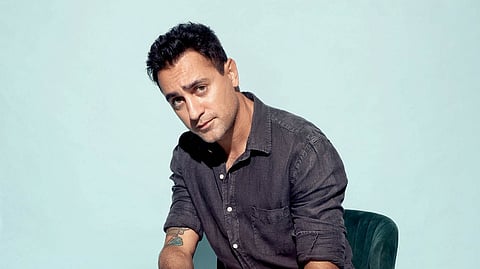


Every time an actor admits to something utterly ordinary in an interview — like putting ghee on their paratha or skipping the gym for a week — the interviewer then gasps audibly, and a headline about how refreshingly ‘human’ they are, soon follows.
From the moment Imran Khan drives himself to The Hollywood Reporter India’s office on a rainy afternoon in Mumbai, it’s fairly clear that the performance of relatability isn’t just a performance.
After circling the neighbourhood for 20 minutes in search of parking, he squeezes his Volkswagen Polo into a rogue spot in the basement. Once upstairs, he mentions that he’s come straight from the gym. For nearly 17 years, he trained in his uncle Aamir Khan’s garage-turned-gym, but since the building went into redevelopment, he’s been working out at a public one instead.
His approach to wellness has changed over the years, too. In his 20s and early 30s, it was about optimisation: supplements, creatine, glutamine and building a ‘macho’ physique. Today, at 42, his focus is on longevity, mobility and mental wellbeing.
The Turning Point
Khan describes fame as a strange cocktail that’s easy to get hooked on. What’s challenging then is to maintain humanity, normalcy, and sanity in an environment that’s primed to send one out of their mind.
“As an actor, people treat you as greater than or less than human,” he says. “But never just human.”
That’s part of why he took a decade-long break from the movies.
“Who am I?” he asks. “If not the actor, the box office ranking, the scale of the paycheque, who am I to someone who doesn’t follow Bollywood?”
The quintessential ‘chocolate boy of Bollywood’ still has countless fans telling him they love him, thanks to a string of films such as Delhi Belly (2011), Ek Main Aur Ekk Tu (2012), and I Hate Luv Storys (2010).
Growing up, he watched closely as his uncles (Aamir and Mansoor Khan) and his grandfather approached their craft, and the way that the public and the media responded to that and to the individual. “When I was 10 years old, I would write stories, get five of my friends together, take Mansoor uncle’s handy cam and make movies. But as we became professionals, I was on sets where nobody liked each other or the movie that we were making. You’re earning crores of rupees and you’re miserable,” Khan says, of the moment that was his turning point.
The Aftermath
Walking away from the industry was not easy. Many questioned his decision, unable to understand why he would walk away from such lucrative opportunities.
“I had an ecosystem of people around me who had a vested interest in keeping the machine moving,” he says. “You’re living on massive external validation and massive external trolling, while being surrounded by a group of people who are too scared to tell you the truth.”
But Khan believes that’s because people no longer understand the concept of having ‘enough’, and that the pursuit of money has pushed all other considerations to the side.
He continues, “Modern society by and large, internet culture and social media encourage us to maintain a façade, and it can reward you for a great one. But now, we have a generation that has grown up online and are starting to see the pitfalls. The validation is hollow, and you start to see the pressure of holding up that façade.”
Once he decided to take a break from working, he realised he didn’t have to hold that up either, so he simply deleted the Instagram app from his phone, and for the next couple of years, his account lay dead.
His return to social media was unexpected. A fan commented on actor Zeenat Aman’s post asking when Khan would make his comeback. He replied jokingly: “Chalo Aditi, let’s leave this one to the internet… 1M likes, and I’ll make it happen.”
Suddenly, his inbox was flooded with fans asking, ‘Where are you? What happened? Where did you go?’
For years, Khan says, he had measured his career almost entirely through external markers — box-office numbers, industry perception, success as defined by everyone else. What changed was hearing directly from people who had quietly carried his films with them.
Imran’s Wellness and Travel Diary
What's in your wellness kit?
My metaphorical wellness kit involves sleep and hydration. These are non-negotiables. The physiological one involves fish oil, multivitamins, retinol and hydrating serums.
What are your travel essentials?
My little electronics kit with a universal adapter and all the cables. Also, an eye mask for sleeping.
What’s your workout routine?
It involves a lot of complaining, negotiating and bargaining.
What does your weekend reset look like?
My farmhouse is just outside the city. We have an animal shelter there for dogs and cats, and I have built my own little cabin in the woods.
What’s the best wellness advice you’ve ever received?
It sounds really obvious, but “live in your body”. You're always in your body, but to what extent are you living and being in the present moment?