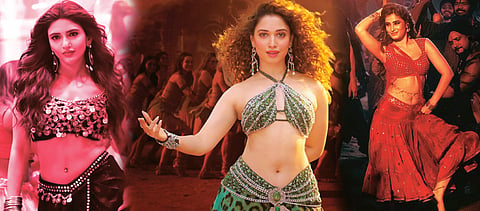


Indian cinema isn’t what it used to be, with new faces, modern narratives and stand-alone songs. But if there’s one thing that remains almost frozen in time, it’s the quintessential ‘special' or 'item' number. Draped in a flowy skirt and tiny blouse, a woman dances with abandon while men watch in eager fascination. She’s objectified, certainly, but also confidently defies the male gaze.
And in 2025, debutant actor Rasha Thadani’s ‘Uyi Amma’ from Azaad (2025) is the latest to revive the essence of cult classics like Katrina Kaif’s ‘Sheila Ki Jawani’ and Malaika Arora's ‘Munni Badnaam’.
Choreographer Caesar Gonsalves, part of the legendary Bosco-Caesar duo, reflects, “They have always been part and parcel of Indian films. ‘Nimbooda' and ‘Jumma Chumma’ by [choreographers] Saroj [Khan] Ji and Chinni Prakash remain iconic,” he says.
As the ones behind Vicky Kaushal's recent hits like ‘Tauba Tauba’, ‘Mauja Hi Mauja’ and ‘Gallan Goodiyan’, they’re experts on the subject. Gonsalves points out that the main difference today is that these kind of numbers are no longer part of the narrative, but added at the end for promotional purposes.
On the other hand, Brinda Gopal, the choreographer behind ‘Thoodhu Varuma’ in Kaakha Kaakha (2003), and who has worked on projects such as Kaatru Veliyidai and the Ponniyin Selvan duology, believes that the difference now lies in the editing process. “The cameras and lenses have become much better now. Back then, we had to do a lot of short shots but now, we can roll the camera continuously,” she reveals. As for dance moves, it all depends on the actor.
And speaking of, actor Tamannaah Bhatia, who’s been praised for her performances in songs like ‘Kaavaalaa’ and ‘Aaj Ki Raat’ reveals that her own affinity towards the movies came through song and dance. “It transcends age,” she says.
The Hollywood Reporter India sits down with the three to explore the evolution of item number choreography, the influence of the female gaze, and the future of this cinema staple.
“Kids, uncles and women of all ages gave me such a unanimous response for ‘Aaj Ki Raat.’ Some mothers told me, their children only eat food when the song’s playing on TV! That's what song and dance does. It unifies people and makes community watching an enjoyable process,” Tamannaah Bhatia explains with a smile, though she’s noticed a critical change in the making of the same.
“In terms of choreography, there is [Instagram’s] vertical format in the equation now,” she says, adding that back in the day, hook steps were created unintentionally, which isn't the case anymore. “I think choreographers are thinking from the standpoint of social engagement because songs reach out to a larger demographic.”
Gonsalves agrees, though he isn’t too pleased about the same. “People choreographing for Reels think they have become super dancers!” he adds with a laugh. “Legends like Saroj-ji didn’t have a million followers, didn't they?”
He notes that while Martis and him have been choreographing for the Hindi film industry for 25 years now, adding social media to the mix has made their job harder. “The signature step should look difficult yet be doable. But we don’t focus on what might go viral; we focus on the narrative,” he quips, saying that have an innate understanding of what the audience likes and stick to the director’s vision.
Gonsalves reflects on the shooting process of item numbers before the era of social media reels. “It was simple. We worked on the costumes, the look, the set, everything. The artist rehearsed, and then we shot. It was a straightforward process.”
Brinda Gopal is in full agreement with Gonsalves, adding that choreographing today with Reels in mind is stressful. “I cannot choreograph like that. I never thought ‘Darling Dambakku’ [from the Tamil film Maan Karate (2014)] would become a hit, but it did. Back then, there were no Reels, so we just choreographed what felt right. Now, people want more simple, repeatable steps. Still, I just focus on what feels right when I hear the music,” she explains, revealing that she’s happy that social media has changed people’s previously negative perception about dance songs in general.
Just as dance songs shed their derogatory connotation, so did the term ‘item girl’.
Tamannaah Bhatia recalls shooting for ’Aaj Ki Raat’ right after ‘Kaavaalaa’. “I call these ‘special numbers’ because it's about how women look at women. For me, the idea of being sexy is to be the epitome of your gender; that is something to celebrate. The gaze is everything. If the gaze is derogatory, then it'll look like it's to be ashamed of. But if the gaze is to celebrate, then it makes us feel good about our bodies.”
Being able to channel a character through the dance is what she admits she really enjoyed. “We spent 15 to 20 days rehearsing 'Aaj Ki Raat’, but [choreographer] Vijay [Ganguly] sir choreographed the steps on me, instead of doing it on assistants, to make sure that it looked good on my body.”
Gopal jumps on Bhatia’s train of thought by underlining the fact that it must be sexy, yet not vulgar. “The process is still the same. Even back in 2008, we did songs with big actresses like Katrina Kaif, Bipasha Basu and Sameera Reddy. The narrative has not changed, but the way women are shot today has definitely changed. Aesthetically, we are more conscious now. It has to be done tastefully,” she says, adding that sometimes, despite their best efforts, the angles or shots may make it look different than they intended.
Similarly, the background dancers have a big role to play in the same. Bhatia looked back on how particular choreographer Ganguly was, even about the moves and clothing of the background dancers, while Gopal ensured that the background dancers cover up for any weakness that the actor has.
Gopal adds that she doesn’t choreograph keeping only the female gaze in mind. “The main thing is the [brief] that the director gives according to the situation.” And one director, who knows a lot about dance in particular, is Mani Ratnam. “Mani sir gives a different style to choreographing the songs. It’s challenging but he gives us a lot of freedom; it makes you want to give it your best,” says Gopal.
As someone who choreographs across industries, she also notes one essential point of difference. While item numbers in Hindi films underline the hook step and focus on the style, the ones in Telugu are more intense, dance-heavy performances — a trait that she really appreciates.
As item numbers evolve with social media and the female gaze, their essence remains the same: a bold, unapologetic celebration of women that commands attention and leaves a lasting impression.