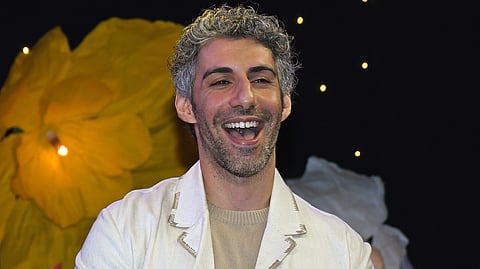


You can tell by the way Jim Sarbh speaks about his upcoming series Made in India: A Titan Story (in which his co-actor is Naseeruddin Shah) just how much he adores being part of it. As the actor shares his process of filming the show, his sense of security in the character he plays, his relationships with those he shared the screen, and the research that went behind the script is palpable.
In this period drama based on the true story of the making of India’s first world-class watch brand, Titan, Sarbh plays the role of Xerxes Desai and Shah plays JRD Tata.
When asked what it was like building that chemistry on screen for their first project together, Sarbh says, “I already had a camaraderie with him; I just never got to see it fulfilled earlier on stage or screen. Now I've got that... and I want more.”
Whether it be a visionary nuclear scientist in Rocket Boys, or a money hungry, ruthless billionaire in Kuberaa, Sarbh has the ability to make many vastly different personalities completely his own. It is perhaps his understanding of nuanced personalities and worlds that draw him to play emotionally complex roles — and why, in his eyes, each character carries the same emotional weight and importance.
In an exclusive interview with The Hollywood Reporter India, Sarbh talks about his long-standing camaraderie with Shah, how he prepared for his role as Xerxes Desai, and his hope for the industry to develop more nuanced characters.
What about playing Xerxes Desai stood out to you?
The hook is that it's an exciting, interesting story of a person who had this belief in an idea, never let that belief die and instead managed to convince everybody around him to work towards that belief, bringing something that hasn't been done yet into existence.
I always find those stories so fascinating, where somebody has the kind of tenacity to deal with any setback that may come their way. Even though it's something to be solved, it's a challenge to rise to; it isn't something to cower from or be afraid of.
There's a great scene in the show where he [Xerxes Desai] talks about how they are encouraged to try and to fail. It shouldn't be looked at as, ‘Why isn't the person getting it right?’ It's that you've been ambitious and you've tried something that is complicated, that has so many layers, that it is a more complicated take on the moment than what might be just correct.
How did you prepare for this role? Did you have a list of dos and don’ts of how to play Xerxes?
I trusted the source material. I know how passionate Sunil Bohra [the producer] was from the beginning. You could see that he loved the material, and the idea of the Tatas and Titan. You could just sense his passion and his genuine admiration for the process and for the story he wanted to tell. They also went to the factory and interviewed a lot of the people who used to work with Xerxes, so I got to watch some of those recordings.
There was nothing online really to see of him apart from a couple of pictures, so it's not like I could hear his voice or anything like that. I trusted the research that has gone into this project. Because I have played a similar visionary in the past (Homi J. Bhabha in Rocket Boys), I didn't want it to be the same. We tried to consider what are the key differences here. I don't know if I've managed to achieve it or not, but I was hoping for this character to be a lot gentler, a lot simpler.
Do you relate to his character on a personal level?
I have a thoroughness over some things — the things I can control at least. A lot of being in the film industry is also accepting that a lot is out of your control and you'll have to do your best or adapt to whatever that situation may be. So, I have to let go of my thoroughness sometimes. Otherwise, I go crazy.
It is amazing how sometimes you get a project like this where it [trust] just happens. I think the captain of the ship kind of decides everything and how everything is going to flow. Sunil found Robbie Grewal, the director, who wound up being our captain; the team he put together in general was a team of very passionate people who really believed in the source material.
From the cinematography to the production design to the costumes to the editing to the fact that we were allowed to use so many old Hindi songs to create that nostalgic feel, they were all so streamlined. They were all so on the same page. It was a rough three months in terms of time spent on the project, but everyone was happy to be there and still striving till the very last day.
This is your first project with Naseeruddin Shah. How did you strike that chemistry with him on-screen? What conversations did you have off-screen to facilitate that?
I've known him for several years and we've had many conversations, so it's not like we needed anything special in this particular case to bring out our camaraderie. We'd been in a rehearsal process the year before and shooting for King Lear... which unfortunately never came to light.
Aside from that, I've met him after so many plays, sat and chatted with him through the evenings.
Imtiaz Ali told THR India about the time Diljit Dosanjh got scared when Ali asked Naseeruddin Shah for a second take while filming Main Vaapas Aaunga, because of Shah’s powerful presence and hold. What was he like while shooting for this movie?
He’s so prepared. He comes with everything so worked out that he actually does not need many takes. He's ready to go from the first take unless it's a complicated shot where it's a lot of walking and stopping. That's the only time we needed rehearsals or a couple of takes.
What I like about that is it pushes you to be just as prepared because you don’t want to warm up to the scene by the fifth take. And by then, he’s done all the good stuff already. I thoroughly enjoy a co-actor who is prepared, listens intently, always gives you something to work with, and takes whatever you've done and fits it into how he's going to respond. Of course, I'm talking about a legend.
More than that, there's that little magic that happens where you go with an impulse to do something, how readily he accepts that impulse and potentially changes the scene even though we haven't discussed it before. He's alive to all those things. So, it's wonderful working with somebody who just notices everything you do.
You studied psychology before you got into theatre. How has that guided the way you view characters?
It helps to a certain extent. I believe in the written word being crucial; the blueprint for your character should be baked into the script. It shouldn't be something that you're having to do so much work to achieve outside of what is written.
That was absolutely the case over here. The character was baked into the script already. It [psychology] helps in understanding motivation. But I think what helps more than that is just the observation of people in general and having a theatrical training to a certain extent. A more interesting approach to a character is not, ‘I have the thought and then I have the line.’ But the line is the thought.
Sometimes you say what you say and then you realise that it is a representation of your thoughts afterwards. I think that is a more exciting way to approach a script. So maybe you do the thinking beforehand; you do the thinking during rehearsal and the workshopping. But in the moment, you just try to be the line.
Are there characters you intentionally reject playing?
I just want to do scripts I love now. I don't think it's any particular type of character. I want to do a script that I really love or I want to work with a director who I like.
I also like the room more now than I did when I was younger. I think when you're younger, there's a bit more ambition, and as you get a bit older, it's like, ‘No, I want the whole process to be nice. I want to enjoy it. I want to enjoy the people I come into work with.'
In an earlier interview, you had spoken about there being many copycat films in the industry. Do you still feel that? Does that alter your motivation to play certain characters or select certain scripts?
I think copycat films still continue. I have been very lucky to act in many projects that I've loved, and I hope to continue doing it. I hope to get interesting, vibrant, fantastic characters that show a lot of shades that aren't purely this or that. I hope we develop more nuance in our characters in general — that not all good people are always good, and not all bad people are always bad. It's a complicated world we live in where there is no clear truth.
You’ve played many emotionally heavy characters. Do you find it easier now to bounce back from that?
This idea that some characters are more emotionally heavy and deep than others is a complete myth in my opinion.
There may be people who are more educated, articulate, who can represent the depths of their emotions in a way that is more accessible to other people. But everyone is equally deep and equally layered. It's just how those layers express themselves that becomes the interesting thing. Some people don't know how to deal with humiliation, so it turns to anger very fast. But that doesn't mean the humiliation isn't there somewhere deep inside them.
If you watch anybody closely, you'll see that there's so many emotions flitting across their face at any given point during the day in a situation. Sometimes they put on a clear facade of not caring about those emotions intentionally. Sometimes that's just what life has done to them.
I don't think Xerxes Desai is any less deeper than some of the other characters I may have played in the past, so that people would write off him as a one-dimensional villain.