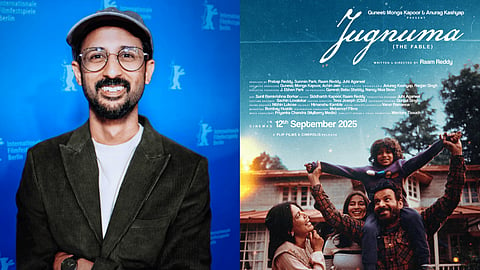


Raam Reddy made a smashing directorial debut with the 2016 comedy-drama Thithi, with non-professional actors from the villages of Karnataka. After a sensational global film festival run of collecting numerous awards, including winning the National Film Award for Best Feature Film in Kannada, Reddy quietly went back to mounting the world of his next: Jugnuma, a movie set in the mountains, about a man, a family, some secrets, and a lot of mysterious fire.
Set in the late 80s, the magical realism drama is headlined by Manoj Bajpayee as Dev, a man who discovers mysteriously burnt trees in his sprawling estate of fruit orchards nestled in the Indian Himalayas. Also starring Deepak Dobriyal, Priyanka Bose and Tillotma Shome, Jugnuma has Guneet Monga Kapoor and Anurag Kashyap attached as executive producers. The film will be released this Friday.
In an interview with The Hollywood Reporter India, Reddy talks about why he took so long to return with his second feature, the casting of Bajpayee, and the effect of Gangs of Wasseypur on him.
Edited excerpts:
A lot of people are surprised that your second feature is in Hindi. Did the language come in because of the casting of Manoj Bajapyee?
No. I have made about 12 short films in different languages, including Telugu and Czech, when I studied in Prague. My mother tongue is Telugu, but my debut feature was in Kannada. I grew up in Bangalore, which is so multilingual, and I am familiar with Tamil and have many Malayali friends. Then, I studied in Delhi, where I spoke Hindi, and I live in Mumbai! So for me, it's actually really exciting to work across languages. For me, the world comes first, and the language follows.
But could Jugnuma have been a Telugu film? Yeah, potentially. Suppose we shot it in the mountains there. But we chose to shoot it in the Himalayas, where the authentic language of that sociopolitical world was largely Hindi. So it was an authenticity decision that came at the script level. And then, of course, Manoj was by far the best person I could have imagined to play the role.
Did you have other actors in mind for Manoj's role?
I thought Manoj was the most transformative actor in the country after I saw Gangs of Wasseypur! As Sardar Khan, he was simply outstanding, and I remember all the violent scenes as well (laughs). I was a young student of cinema when I watched the film and I thought it was just insane. So when I was writing Jugnuma, I always felt that it had to be Manoj because I believe I need characters to be transformative enough to create realism. So that way, he was the one that I really wanted.
I must say that I cast him because of my admiration for him as an actor, his craft, control, and mastery. But after we met and got to know each other, we realised that we had a much deeper connection. We are both meditators. We believe in inner journeys. The character Dev is going through that inner journey and Manoj has previously said in interviews as well that he really felt this character because of where he was in his life at that moment and what Dev was going through; there was a certain synergy. We fell for each other as collaborators.
Why did it take you so long to make your second feature?
You need to dig deep for stories and I have always been a little bit of a purist, where I've wanted to do something that hasn't been done before in some ways. Even with Thithi, we wanted to make the film with non-professional actors with a 160-page screenplay. After that film, I wanted to again attempt something that would stand on its own two feet.
How did the magical-realism bit come in?
I am a fan of the magic realism genre in literature. It is such a brave genre and I thought, how can I translate my own magic realism style into cinema? That was the starting point. Now, when you're trying to do something like that, it takes time within the realm of cinema to pull that off. I started with these loose intentions and slowly constructed things bit by bit. That's where the ambition to shoot this on film also came. We did nine tests to get this right and it takes time. Unlike a digital camera test, we had to shoot on film, send it, then get it back and then shoot it again. This would take up weeks. So the development of this project was like a slow, organic building of a mountain. It took some time to get it right.
Was this the immediate project that you had in mind after Thithi or were there other ideas you were toying with?
No, this was the one that I wanted to do. I wasn't juggling any other ideas; I usually just focus on one thing. So I went and lived in the mountains before I wrote the entire screenplay. I roamed around all of Uttarakhand for a few months in 2017. I like to get inspiration from life. I don't know if that sounds a bit cliché, but the attempt is to try to filter what you are seeing and feeling through your artistic soul. So I went without a clear narrative. I wanted to see what the mountains gave me. I wanted to see what that world would offer, with the added interest of spending time in the Himalayas!
So you had a basic one-line idea with you before you went to the mountains?
When I went there, I knew I wanted it to be set in magical realism. I knew I wanted it to be suspense-mystery driven. Thithi was more comedy and I knew I wanted this to be a period, with an ensemble cast. I knew these things, but not exactly what the story would be. I also knew that I wanted it to be something to do with fire. So that was a narrative starting point because the first time I ever went to the mountains, I actually went and I fought a forest fire with locals! That incident stayed with me.
The general notion in the industry is that the genre of magical realism is not as accessible to the audience. Did you have this in mind while writing?
I don't think purely about the audience, but I think about the narrative. But I like to watch something that hooks me, otherwise, I get restless. So as a creator, I needed it to be a story that would hook me. Even Thithi was very narrative-driven, with a story that connected things. So even with Jugnuma, my endeavour was how to universalise this genre narratively, while staying true to my own inner artist. I definitely wanted the magicalism to be accessible, but also exciting.