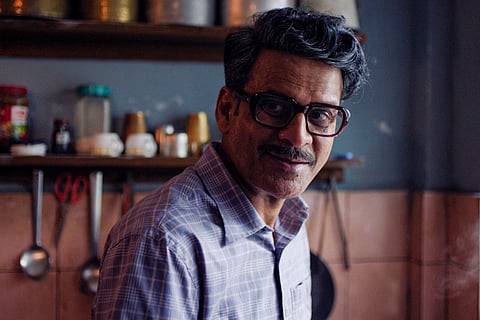


Since Aligarh (2016), a film about a professor persecuted for his sexuality, Manoj Bajpayee has played elderly gents of varying shades of greyness. These are soft, slow performances the actor seems to relish. (Fun fact: Bajpayee himself is 57, four years younger to the Khans). His latest creation in this line is Masterji, a retired school teacher living in a co-operative housing society in the eastern suburbs of Mumbai. The building is in shambles, redevelopment is inevitable, and most of the other tenants are eyeing their pot of gold. The only real holdout is Masterji. Why won't he sell?
Directed by US-based filmmaker Ben Rekhi and written by Sooni Taraporevala, Bajpayee's new film adapts Aravind Adiga's 2011 novel Last Man In Tower. It's a highly compact, no-frills retelling, taking as its central conflict what the book riffs off and magnifies: a battle of wills between the old-school sentimentality and stubbornness of Masterji and the capitalist ambition of real estate man Shah (Boman Irani).
As the deep-pocketed Shah politely propositions the tenants, including the feisty Mrs Puri (Divya Dutta), Masterji rallies his neighbours to reason. This is the third Adiga novel to be adapted for screens, after The White Tiger and Selection Day, and the first to get a theatrical release in India.
Bajpayee says it was Rahul V. Chittella, the director of Gulmohar (2023), who introduced him to Rekhi (the filmmaker’s credits include Waterborne and The Ashram). They started corresponding and finally met at the Indian Film Festival of New York. "Ben was there in every city of the US that I visited,” Bajpayee shares. “He's a true-blue LA/Hollywood guy. He was very persistent and wasn't going to leave me alone."
Backed by Rana Daggubati's Spirit Media, Last Man in Tower was shot in real locations in Mumbai, and, more importantly, is in ordinary Hindi —unlike the last Adiga adaptation, Netflix's The White Tiger, where everyone spoke nearly verbatim English. Juhi Chaturvedi, known for Piku and Gulabo Sitabo, has penned the dialogue for Rekhi's film. The overall vibe is closer to a film like Serious Men (2020), another adaptation of a famous Mumbai novel in English, than the grimy razzle-dazzle of The White Tiger.
"Ben is half-Indian and he is familiar with the realities of Mumbai," Bajpayee says. "I was confident we were making something authentic."
Another aspect of the book that the film stays largely faithful to is the ambiguity of the characters' actions. With his thick-rimmed glasses and ugly umbrella, Masterji — a Nehruvian relic taking on greedy builders and corporates — is described by his own son as an "old wall that refuses to fall". He is emphatically not the film's hero. Neither are Shah or Mrs Puri the simplest approximations of villains.
"Everyone has their own truths," says Divya Datta. "When we were shooting, I would often side with Masterji because he is idealistic. But then I would also resonate with Mrs Puri's side. She has a genuine need that drives her to make some difficult choices. The beauty of human relationships is that they are never black-and-white. They're deeply layered, complex and ambiguous."
Both Bajpayee and Dutta arrived in Mumbai in the early 1990s. Whereas Bajpayee, fresh off Bandit Queen, shared a room with Saurabh Shukla in a chawl in DN Nagar, Datta got her start in a comfortable apartment tower in Juhu. Yet, despite the contrasting vantage points, both recall a city warmed by a genuine sense of community.
"Not even a slight hint of the earlier days remains," Bajpayee laments. "I still remember the family that lived next door to me. Their child was always in our room. We would all queue up to make calls at the PCO booth downstairs. There was a feeling of goodness and trust between people. Even the film industry was more homely and welcoming than it is today."
"We used to have such lovely house parties," Dutta remembers. "Where did those go?"
Dutta calls the crumbling apartment building in the film — named Vishram (Repose) Society — a ‘metaphor’ for a city that is losing its shape. What does that do to its people? Adiga researched and wrote his book at a time when the redevelopment boom was beginning to transform the topography of Mumbai; today, it's an incontestable fact of life, as settled as cement. In fact, according to a new report, housing sales from redevelopment ventures have surpassed new projects in the city. Over 1,000 redevelopment projects have been launched since the first year of the pandemic.
"I don’t think it's an anxiety anymore," Bajpayee observes dryly. "Most people I know are quite gung-ho about redevelopment, because they are going to get bigger FSI (Floor Space Index) and better amenities. But what they are going to miss is the community experience. They are going to miss the less congested lanes..."
Last Man in Tower releases in theatres on September 11.