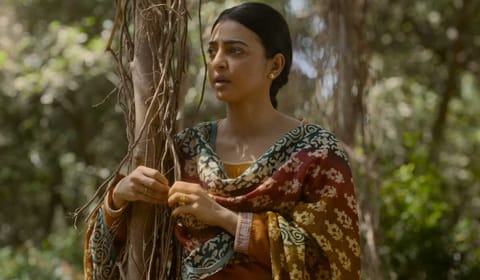


Radhika Apte speaks with a clarity and volatility that rarely coexist in the same breath, one moment clinically precise, the next brimming with combustible frustration.
The actor speaks with The Hollywood Reporter India to discuss Saali Mohabbat on ZEE5, Tisca Chopra’s directorial debut, a film that leans into the unruly sentiment and tangled intimacy of classic melodrama. Yet almost instantly the conversation widens and spills into a far more urgent terrain, touching on the precarious state of Indian theatres, the suffocating churn of the content economy, and her disquieting suspicion that the industry she has belonged to for years may no longer know how to hold an actor like her.
What begins on relatively steady ground shifts rapidly. Apte starts by explaining that she agreed to the film because, “Tisca is mad in the best possible way and the script had this unhinged emotionality I’ve been craving. You know Tisca and I didn't agree on Smita's character? Our rationales were very different and that was very exciting,” she says.
Apte speaks of Chopra’s intuitive sensitivity as a performer who has now stepped behind the camera, of a narrative world designed to accommodate a wide range of feelings and colours, and of the relief of stepping into characters whose emotions are not engineered into neat arcs. Her attention pivots sharply to what she sees as the increasingly distorted theatrical landscape. “Honestly, have you seen what’s happening in theatres today? It’s chaos, it’s noise, it’s like the only films that survive are the ones screaming the loudest," she says.
There is irony and fatigue in her tone, softened by the faintest trace of amusement. “I finally found time to sit down and watch something on streaming; I saw the Top 10 list and suddenly it hit me that there is no room for me anymore, not in that Top 10 at least. Not that they would ever be offered to me, but even if they were... I would not do them,” says Apte.
She defends the film she has made precisely because it sidesteps the sensory overload that has come to dominate the mainstream. “There’s no gimmick, no unnecessary gore, it’s just messy, human, layered...which apparently is too much to ask for these days,” she says, the remark sharpened by a level gaze that suggests the frustration is long-standing.
Apte also addresses the near disappearance of mid-budget dramas, the erosion of nuanced romances, the retreat of politically daring comedies, the sidelining of distinctive auteur voices.
Even within this critique, her return to Saali Mohabbat introduces a different register. The earlier agitation softens into something more contemplative. “At the heart of it, Saali Mohabbat reaffirms that there's place for the kind of stories I want to tell. They are complex, they are nuanced but they are not violent and gory,” she said. Especially at a time where so much of the industry appears uncertain of its own future, Apte’s voice remains startlingly sure.