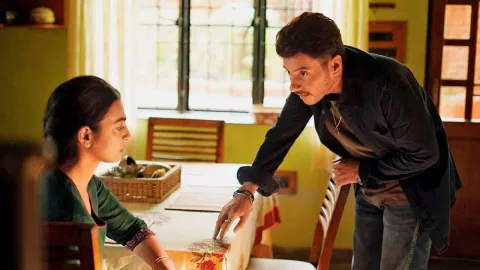


A small-town woman, Kavita (Radhika Apte), feels out of place at a South Delhi party. It’s a rainy day; she looks at a tree outside the window. Her husband’s friends are snooty and patronising. He has a roving eye. She catches him making out with one of the guests. She then gathers the high-society gang around her and starts to narrate a story in an earthy accent that makes them smirk. But the smirks don’t last long. Her “fiction” revolves around a housewife named Smita (Apte), a previous version of herself that they don’t know about. It goes thus. When Smita’s provocative cousin Shalini (Sauraseni Maitra) visits, her loan-riddled husband Pankaj (Anshumaan Pushkar) falls for the younger woman and the two start a torrid affair in the house behind Smita’s back. That’s not all, Shalini two-times Pankaj with a crooked cop named Ratan (Divyenndu); she’s stringing along two horndogs because why not. Needless to say, a heartbroken Smita is not pleased. And when a seemingly docile homemaker trapped in a setting full of predators and cheaters is not pleased, darkness is always around the corner.
Saali Mohabbat is the sort of eerie domestic thriller that thrives on texture, gender subversions and atmospherics. The sullen Kavita gains confidence as she continues to toy with the oblivious upper-class guests; she uses their language — gossip — to deliver a wicked message to her husband. But the unpredictability of the film is predictable. It could be because Saali Mohabbat, actor Tisca Chopra’s feature-length directorial debut, shares much in common with two popular shorts written by her. Back in the heyday of Hindi short films on YouTube, it was the viral Chutney (2016) that broke the glass ceiling. It featured a story within a story; a sinister-sounding housewife (Chopra with creepy prosthetics) casually narrates an auto-fictional tale to intimidate a younger woman who flirted with her husband. Churri (2017), too, featured a wife playing mindgames to deflate her husband’s mistress. The ‘playful’ patterns of infidelity, the weaponisation of female subservience and the woman-scorned gaze continue with this film — a thematic hybrid of the shorts, and the third part of an unofficial revenge trilogy. So perhaps it’s not as potent as it should be; you expect the unexpected, you anticipate Smita’s turn, you see the ghosts before they appear.
That’s not to say Saali Mohabbat is forgettable. It has visual ambition — an aesthetic that reveals careful thought in the shot-making and staging — that one has already come to associate with Manish Malhotra’s Stage5 productions (the recent Gustaakh Ishq was hard to look away from). It’s a rare thing in the age of homogenised imagery and flat lightwork, especially when the premise is the point. For instance, the film opens with a tracking shot that goes from the monsoon clouds to a tree to its snaking roots below back up to a window that Kavita is looking out of. It’s not an empty gimmick, because trees and flowers are the central metaphors of the story (akin to Chutney). It’s a bit overused after a point, but Smita’s journey makes sure to excavate the domesticity of activities like gardening, cooking and cleaning. Apte doesn’t pitch the character too high, and while it’s tempting to conclude that it’s too easy a role for her, so much of her body language influences the way we perceive the drama. We know what’s coming, but at no point is there some magical transformation — as tends to be the case with abrupt femme-fatale characters. The toll of the guilt shows, and Smita may be upset, but she’s not suddenly heartless. A grief permeates through her, even as the film loses itself a bit in a tropey loop of a cat-and-mouse investigation where the cop tries to nail his prime suspect. Teaching the ‘villains’ a lesson doesn’t mean she loses the ability to feel. The music in the film is eclectic, too, but it’s a pity that the catchy title track is only used in the end credits.
Just as in the short films, I did find the character of the ‘seductress’ too simplistic. Perhaps the point is to show the younger woman as a porn-core male fantasy, but the antagonisation of someone like Shalini (to highlight the innocence of Smita) is almost lazy — it’s like she doesn’t exist beyond her deceptions and desires. It’s the female version of the Harshvardhan Rane-played casanova in Haseen Dillruba, where the third wheel is not allowed to have shades beyond their role as a sultry homewrecker. It’s more entertaining to watch, of course, but the protagonist doesn’t really need such crutches to justify her moral choices. It’s one of the few missteps in a story that needlessly becomes plotty when the characters themselves are plotty enough. It’s a crafty and occasionally clever portrait of love in the time of patriarchy. But Saali Mohabbat has this short-film-coded habit of unfolding in punchlines rather than moments. It’s why the title sounds less like an indignation of love and more like the one that got away. A bit like the film itself.