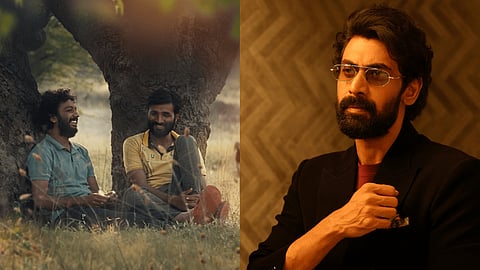


Between 2015 and 2017, when Rana Daggubati broke out pan-India with the mighty Baahubali franchise, few could have predicted that a decade later, the actor would also be pivoting to something more intimate: distributing acclaimed indie titles, from the Cannes Grand Prix winner All We Imagine as Light last year, to now putting his strength behind Sabar Bonda, that won World Cinema Grand Jury Prize Dramatic at the 2025 Sundance Film Festival. Suddenly, Daggubati is being looked at as the potential 'Baahubali' of indie film distribution in a country that loves stars and spectacle.
Filmmaker Rohan Parashuram Kanawade's Sabar Bonda, which became the first Marathi-language film ever to premiere at Sundance, will get an Indian release on September 19 by Daggubati's Spirit Media, with filmmakers Nagraj Manjule, Nikkhil Advani, Vikramaditya Motwane, and actor Saie Tamhankar attached as executive producers.
In an interview with The Hollywood Reporter India, Daggubati spoke about the learnings from distributing Payal Kapadia's All We Imagine As Light, how he wants to build a slate of indie movies, and why the inconsistency of Indian film festivals is a problem.
Edited excerpts:
Most people didn't expect you to be at it on the distribution front and release your second film so soon. Is there a slate that you want to build?
(Laughs) Yes! The idea was that we have places and distribution for mainstream, so how then do we institutionalise alternative cinema? It doesn't matter whether it is a Malayalam, Marathi, or Telugu film. There is an audience out there, but no one is tapping into that. Unless you build a community, you wouldn't know how to reach out to them again and again. Many people have done one-offs, but the problem is that you might be successful in that one moment, but that data doesn't trickle down to the next.
Why does commercial cinema still strive? Because there is data on somebody's success that can be replicated. Why is Telugu cinema having a bright field day in a pan-India moment? Because there was a Baahubali, which broke the norms of what Telugu films can do in Mumbai. Post that, there was a wave of films from all across such as KGF, Kanatara and Pushpa, that the whole country enjoyed. They could borrow from each other's success and data. Here, unless we do it consistently, we won't be able to get to that level that we want to. We are fighting a 50-year head start! We have to really find a grounding.
From a distributor's point of view, what was the learning from All We Imagine As Light that is helping you now with Sabar Bonda?
We always believed that there was an audience for 'alternative' cinema, we just didn't know where that audience was. When we were putting All We Imagine as Light in cinemas, we were pretty sure where in South India the audience was because we had done films that were indie, which had done well at the box-office. But outside of that, we had no data. There were very films that had been released in this format.
For us, the first one was a total trial and error. We went with a limited screen count, around 120 screens. What we started to understand was that this was much deeper than just cities. If four different cinemas run in a city like Mumbai, there will be one area that does well, and the others don't do as well.
So that signals you that the audience for these films lives in this area, or there are two areas in a city where the response can be better. So that was the first data point. It is not about releasing it on five screens in a city; it is about releasing it on the two or three correct screens in the city.
Also, the right shows at the right time....
Yes, but the location was a far bigger deterrent than we ever thought it would be. There was also an audience that started requesting the film. Usually, people do a wide release, where some people watch it, some don't. But here, because of the limited release that we did, there was an audience in Pune and Bhubaneswar that wanted a show near them. Every time we listed a show, it would go full over the weekend.
What it led to was — unlike a classic commercial film that has a two- to four-week solid run — All We Imagine As Light had a seven-week run! It needed to be in cinemas for a longer period of time, because word of mouth becomes your biggest publicity tool. As more people discover your film, they will want to watch it, and for that it needs to be in cinemas. Globally, you have a year of different film festivals where your films travel and it finally opens in cinemas. But here you don't have that time or enough venues to showcase these kinds of cinemas.
What is also true is that, whether it is All We Imagine As Light or Sabar Bonda, these films will affect you years later the same way they did during the first screening, because they are so truthful and honest. That doesn't always happen. You might have loved a film in the '90s, but today you can't sit through it!
The conversation that keeps coming up is the lack of dedicated infrastructure for indie films to get a dignified release. They shouldn't be slotted in the 11 PM or early morning shows. Is that a concern as well?
In a country like India, we will always wish for many things. We are really under-screened regarding the number of people there are. America and China, which have a thriving cinema culture as well, have more screens. But the cinemas that we have now are operating on 20-25 per cent occupancy, which means 60-70 per cent of the time they are empty.
There is oddness everywhere. Our strength and weaknesses lies in the fact that we don't share our common ideas as one industry. What I mean is, there will be something in the south of India that doesn't get translated in Mumbai, or a trend in Marathi cinema that doesn't get translated in south. Learning is the first step to knowing how a film has performed; knowledge is important so that a film gets discovered by a large number of people.
With Sabar Bonda, we are at a better place than All We Imagine As Light, because we have data, and the success of that film has created a network to back films like these. We only went with pure theatrical releases for both films. The idea is to go to the audience and they will tell you what the films are. The minute they react, the OTTs also start responding. Would it be good if we had more infrastructure? Definitely so, but our policies are also state-led, so it can get difficult for someone at the center to make a policy for across the board... Policies are made in Delhi, but films are made in Mumbai, Hyderabad, and Chennai. The situation is getting better but let me also tell you that I am not a big believer in grants.
Why so?
Because the day the grant goes, the ecosystem also disappears. That's a greater threat, and I have seen that happen in the past; We have had great festivals which I used to attend when I was younger, but they just stopped because a government or a corporation decided that they had no budget that year, and suddenly the ecosystem collapsed. When that happened, a whole bunch of filmmakers and films came to a halt.
If a film wins at Sundance, it helps with North American sales and distribution. Cannes glory leads to Academy Award attention. In the Indian context, I am assuming that if MAMI existed today, a film like Sabar Bonda would have benefited greatly because of the thriving community and the platform it offered. Does the lack of this damage the indie ecosystem?
I think there is no consistency. MAMI was there, before that, we had a travelling film festival that eventually found a home in Goa. Every state has some festivals, but the mainstream doesn't talk to them; the media for mainstream and film festivals are largely different. The channels don't meet. As these gaps are bridged, the audience will start coming back quickly. The audience wants to be moved by something new every time they enter a familiar cinema hall. It is on us; we keep giving them the same stuff. It's like the industry saying, 'You liked action films? OK, watch more of it!'
But how do you decide which film to put your might behind from a distribution point of view, because there would be so many titles coming to you?
The intent of the filmmaker and the subject matter. Anybody can make any kind of film... I am sure Rohan will make a great action film one day, but Sabar Bonda is a film that only he can make because it comes from a deeply personal space. There is his truth behind it. Even if someone had given me this script and I had hunted a director for it, I know it wouldn't have been made this way, because honesty becomes our top priority. Right now, it is a small team of eight, and we keep watching and reviewing films. The idea is to eventually build a jury-type system for this. Through this, you can get insights into each other's culture and cinema.