

In the years since India’s digital and streaming boom — cheap data, smartphones in every pocket, algorithms mapping every mood — hulking gramophones have long been cast aside. As discographies were compressed into invisible files, music became weightless. What once demanded space, resources and care could now be summoned in seconds. Naturally, the logic of convenience prevailed.
Yet the records did not disappear entirely. In a country obsessed with instant access, some listeners continue to opt for friction, against all common sense.
Wax On
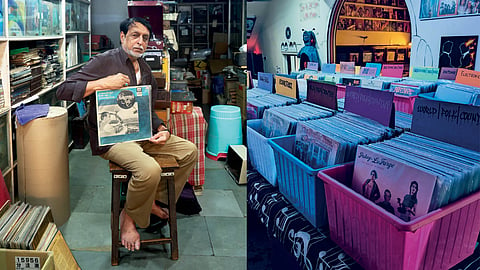
Tucked amid the sprawl of Mumbai’s Chor Bazaar is Haji Ebrahim Record Shop, where time seems to stop. The space is narrow and dim, lit by white, fluorescent tube lights. The air carries the dry scent of ageing cardboard. Vinyl jackets are stacked in floor-to-ceiling shelves. It is a far cry from the curated, warmly lit vinyl bars that have popped up around town — there are no cocktails here, no listening booths. Only rows of records and tapes waiting to be thumbed through by those who have the patience for it.
Behind the counter, Asif — who has been running the store for three decades with his brother, Salim — is sifting through stacks of vinyl.
“Record ka business kabhi down nahi hua hai (The record business has never declined),” he reveals. “Ab yeh third generation mein aayega (Now, this shop will be in the family for three generations),” he says, pointing to his son, Mohammed, standing beside him. Asif’s father opened this shop 70 years ago and now his son is learning the ropes, eager to continue his grandfather’s legacy.
Tracing the ridges of a Mohammad Rafi record (his favourite), Asif explains why this format endures. “Jo quality records mein milti hai, woh kahin nahi milti (The quality you find in records, you will not find anywhere else).” Despite the ebb and flow of trends, vinyl continues to cling on — if not out of mass demand, then by virtue of sheer durability. Where cassettes unravel and CDs falter at the slightest scratch, records survive. It is this very persistence of the medium that has carried it across decades, placing it unexpectedly into the hands of a generation born into the digital age.
“Aaj ke time mein toh new generation ko bhi iss cheez ka craze ho raha hai (Today, even the new generation is developing an interest for this),” Asif says, happily.
In the Groove
Major metros — Mumbai, Delhi and Bengaluru — have become the nerve centres of this trend, with record fairs, boutique stores and vinyl listening events drawing steady, growing crowds.
Vinyl records are sold as a premium collectible, priced many times higher than CDs or digital downloads but that exclusivity is part of the appeal. With nostalgia and physicality both carrying real aspirational weight right now, a label such as Saregama — sitting atop one of the subcontinent’s deepest heritage catalogues — is well-placed to ride the wave.
Vikram Mehra, managing director of Saregama, says there’s been a serious resurgence in demand for the format, noting that earlier, vinyl was largely an export proposition — diasporic buyers picking up a piece of home to take back overseas.
“Demand is equally divided among collectors and the younger listeners, especially Gen Z and millennials, who are picking up vinyl as they want to go back and enjoy music the way it was done years ago. There is a magic of listening to music on an analogue vinyl and people are warming up to it,” he says.
That warming is reflected in Saregama’s output. Their vinyl catalogue now spans curated compilations, retro music and new albums. “We have songs by artistes including Lata Mangeshkar, Kishore Kumar, Mohd Rafi and Jagjit Singh. And we also have other big titles — film albums including Silsila, Umrao Jaan, Ijaazat, Mughal-e-Azam, Masoom and latest hits, like Dhurandhar.” More titles, across both retro and contemporary music, are in the pipeline.
The label uses consumer research to guide their release decisions, pressing records only where demand is demonstrably strong. “Wherever we believe there’s a large enough demand,” says Mehra, “we go ahead and release the in-demand kind of music.”
He adds, “Over the years, the sales of vinyl have risen, and it surprised us as well; how Indians are warming up to the idea of listening to music on vinyl.”
Skip the Stream
In Kochi, is Sujith Ponoth, the single force behind JD’s Jukebox, which is less of a record store and more of a gathering place for the city’s growing community of music lovers. What began as an effort to preserve and catalogue discarded collections, has turned into a quaint store filled with over 6,000 records, drawing the attention of budding collectors, who drop in for listening sessions and live performances.
“This is a generation that has never seen a physical format like this,” says Ponoth. “It is their first tangible contact with music.”
For younger listeners, that is part of the appeal. Malavika Anupraj, a 26-year-old DJ and collector originally from Kochi, says the local vinyl scene is just beginning to find its footing. “It’s only in the last few years that these events have started to pop up in Kochi,” she says. “This community is very much in its infancy, but people are really coming together to engage with it sincerely. We’re catching up to other metropolitan cities.”
The growing interest among younger listeners challenges the assumption that vinyl’s relevance is sustained solely by nostalgia. For many of them, this isn’t a return to something familiar, but a first encounter with music as something tactile — something grounding, something they can hold.
That quality is often what shapes the listening experience. “I love hearing the small imperfections in a record,” Anupraj says. “It reminds me that music is human; it makes me appreciate its history.” Even the process of discovery feels different, she says. “Discovering a tape or a record feels so much more intimate than an algorithm telling me what to listen to.”
Ponoth has witnessed moments like this unfold in his shop more than once. He recalls one instance, when a customer stood quietly, visibly moved, holding a record sleeve close to his chest. “He said, ‘I’ve had this artiste on my phone all my life, but I’ve never hugged him.’ I was speechless.”
But access to this experience remains limited. “The older ‘vinyl heads’ have the disposable income for this hobby,” Ponoth points out, acknowledging that the culture is often sustained by those who can afford it. “The barriers of entry for [young audiences] who love analogue sound may be too high.” Given the lack of supply, vendors will often sell records for over ₹4,000- ₹5,000 each, he says, making it practically inaccessible. Many, he adds, will slowly build a collection over time, in the hope of one day buying their own record player.
The Allure of Analogue
Writer, lyricist and stand-up comedian Varun Grover also started out as one such hopeful collector. Long before he owned a turntable, he was buying records — holding on to them until he could afford to experience them the right way. “Hindi film music has been one of the biggest loves and joys of my life, so it was always at the back of my mind to collect physical media, to get a record player,” he says.
For years, however, those records sat untouched. New turntables were hard to find, and the older ones in circulation felt unreliable. The turning point came about five or six years ago, when Grover visited a friend who owned a newer record player. “I remember listening to it and being blown away,” he says. “The music sounded completely different — a depth that you rarely get with digital sound.”
Today, he carries a large collection of records, and a turntable that is his pride and joy. His favourites, he says, are classic Hindi film records, which were mixed specifically for this medium. “There’s no match to this sound quality,” Grover says. “While digital aims for clarity, vinyl and records, they aim for a sense of depth and unity of sound, creating that ‘warmth’ that is missing [in music] today.”
One of the most prized records in Varun Grover’s collection is the soundtrack of the 1951 film Awara, not only for its music but for its artwork. The sleeve, he points out, captures a moment from the film in an unexpectedly intricate way. “It’s essentially a shot of Raj Kapoor’s feet, with the trousers slightly rolled up,” he says. “And tucked into one of those folds is a small image of Nargis — almost like a postcard from the film.”
The allure of the medium is difficult to quantify, but easy to recognise — an “otherworldliness”, as Grover puts it. The appeal of vinyl is not in its technical precision, but in its ability to envelop the listener in sound. However, the renewed curiosity around records is not simply about aesthetics. It is also about ownership.
Shelf Life
For collectors like Alcuin Deverell Moras, a 26-year-old Mumbai-based listener with currently has over 200 records, ownership is key. “I’m doing this with intention, as opposed to letting an algorithm skip through songs,” he says. “Every single record, every single album was chosen by me.”
The process itself is slower, but that is precisely the point. Browsing records, he adds, carries an element of chance. “It’s like going on a little adventure. You might pick something you’ve never heard of just because the cover art speaks to you.”
In an era where streaming platforms can remove hundreds of catalogues overnight, the fragility of digital permanence becomes clear. A record on the shelf, however, remains one’s own — scratched perhaps, sleeve worn at the edges, but very much there.
“We are the real custodians of music, as listeners,” says Grover. “It’s not the corporations or companies who should be owning that because, well, they are in it for business, but we are in it for love.”
That sense of ownership feeds into something larger: preservation.
For shopkeepers like Asif and Ponoth, selling records is only one part of the job. The other is recovery. They travel across states, respond to phone calls from families clearing out old cupboards, and sift through private collections that might otherwise be discarded as clutter.
There are also more obscure recordings — regional pressings, early film scores, lesser-known experimental albums — that exist only on vinyl. If those records are lost, a fragment of cultural memory vanishes with them.
“There is a lot of music which you can access only on record,” Grover says, “and if it disappears, you lose a part of your history, a part of your culture, and the combined culture of the world.”
Drop the Needle
For this renewed engagement with physical media to grow, however, sentiment alone is not enough. Today, there are early signs of institutional recognition, which could propel a true revival of the medium. “A lot of companies like Saregama in India are launching new editions of old records, which is a very good sign,” Grover says. “That means they know there is a market.”
Reissues signal something substantial beneath the nostalgia: demand, proof that audiences are willing to invest in formats once considered obsolete. An increase in supply also has a practical effect. It helps stabilise and, in some cases, lower prices, making entry into the hobby more accessible for listeners who may have previously been priced out.
“The key also lies in educating them, and giving them a platform,” Ponoth says of younger listeners. Many are encountering record players for the first time; they may not know how to set up a turntable, handle a needle, or store vinyl correctly. So, he also lends his space to emerging artistes, hosting intimate shows that have turned the store into a growing cultural hub in Kochi.
Grover, for his part, is optimistic. “I hope this movement keeps getting bigger and bigger, and physical media becomes a thing again,” he says.
Whether it returns to the mainstream is uncertain, but perhaps that is beside the point. In a world that hurtles forward at breakneck speed, this small but stubborn community continues to make a case for inconvenience — for slowness, for attentive listening, for the ritual of it all.
According to Moras, that inconvenience may be exactly what is drawing people in. “I think people are probably going to push back against the system that we currently have,” he says. “More people are seeking out a bit of friction in their lives, because things might be getting a little too convenient.”
As Asif puts it, with absolute certainty: “Digital ek hadh tak sahi hai: bhale duniya chaand tak pahunch gayi, aadmi ko waapis zameen pe hi aana hai (Digital is fine, to an extent: even if man reaches the moon, ultimately, he must come back to earth).”
Saregama is owned by RPSG Group which is also the licensed owner and operator of The Hollywood Reporter India.