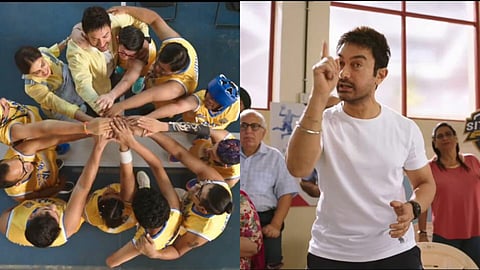


R. S. Prasanna’s Sitaare Zameen Par, written by Divy Nidhi Sharma, adapted from the Spanish film Champions (2018), is Aamir Khan’s return to form, at a slight angle to his do-gooder filmography. Playing Gulshan Arora, an arrogant basketball coach with a temper who is forced to train a team with disabilities for a tournament, Khan’s character in this film is not a moral paragon—he doesn’t school; he is schooled.
The studio which had the rights to the original film reached out to Prasanna (Shubh Mangal Saavdhan), and Prasanna sent the promo of the original film to Aamir Khan to gauge his interest. Since Khan does not commit to a project on the basis of the story alone, Prasanna looped in Sharma—writer of hit television shows like Yeh Rishta Kya Kehlata Hai and Anupamaa— to write the script and narrate it to Khan. This was in 2020.
Khan leapt at the film, but the pandemic, Laal Singh Chaddha’s (2022) failure, the acidic discourse around this failure, and Khan’s premature announcement to retire, widened the chasm between his excitement for this film, and its eventual making and release this past week.
In this conversation with THR India, Sharma breaks down the decisions made to culturally adapt a European story and what the limits are for making stars unlikable on screen.
Was Aamir Khan in your mind while writing the script? Were you tailoring it to him?
That is true, because we always hoped to pitch the film to him since he showed interest.
You are writing for a star. You poke fun at his height, but at the same time, you cannot dismantle what makes him a star. There is this balancing act at play in Sitaare Zameen Par. Can you talk about this?
To make Aamir Khan a basketball coach is an outlandish idea. To make it palatable you have to address the elephant in the room—that he is not tall enough to be a player, forget a coach.
We were clear that this is a bright, happy film. So, the only way we could address the height issue was by making fun of it, taking jibes at the character, and Aamir was sporty enough to take these jibes. But we also never went overboard with it. Besides, the jibes are always taken by his mother, calling him tingu. It is not a world where players are making constant fun of him. The only other person who makes fun of him — the head coach— Gulshan punches him.
You are making a star who has taught people how to be kind, via his roles on screen, an unlikeable character. What are the lines you would not cross to make Gulshan a character who needs to be taught a lesson?
I would like to believe that Gulshan is a likeable character with some unlikeable traits. With both the women in his life—his mother and wife—there is a tiff, but in spite of that, both women love him, so the audience will think, “Itna bura toh nahin hoga”. (He must not be so bad).
Besides, we also see Gulshan as a man-child, the way he hits the head coach. If we see him as a mature person who behaves the way he does, then maybe he would be unlikeable? We wanted Gulshan to be a fun character to watch, so you are enjoying it when uska band baj raha hai, shuru se. (He is a loser, from the beginning) So unlikeable is not a word I would like to use.
Why are the women around him so accommodating?
It is the milieu. It is not just about women being more accommodating, but the family being more accommodating to someone like Gulshan and family giving you the space to be who you are. Besides, towards the end we see that Gulshan has some saving graces. But his immediate family—his wife, his mother—had seen this at some point, which is why they stick around.
One of the criticisms was that Sunita (Genelia D’Souza), his wife, is a male fantasy, because she keeps coming back to him, despite him being so stand-offish.
That is one way to see her character. I did not feel that Gulshan is abusive or has any fatal flaw because of which Sunita does not want to be with him. He is a boyish, roguish, politically incorrect man, while Sunita is by-the-book and sweet. The only bone of contention is that Sunita wants a child and Gulshan has daddy issues, and does not want a child. They both want to work on their marriage, but Gulshan is an idiot. Notice that neither gave a court notice. No talkh or teekhi taqraar. This is not a toxic relationship. Theirs is an uljha hua, teda, but khoobsoorat rishta. (Troubled, but beautiful relationship)
Aamir Khan, known to give sermons, is now being given sermons. It is a counter film to his filmography. Did you think about this when writing such a character?
The idea came in retrospect, by the time we had already written the film. It was the natural course the script could have taken. There is no other way this character could have been devised. Besides, it is similar in spirit to the character he played in Dil Chahta Hai or Rangeela. It is not a new Aamir, but a throwback to the good old Aamir days.
What were things you added or removed when re-interpreting a Spanish story to an Indian context?
In the original film, Sunita is friends with Gulshan’s male friend—and they meet in a bar. When you put that in an Indian context, the Indian audience will imagine something is going on between Gulshan’s friend and Sunita. We did not want their attention to deviate from the main plot.
Similarly, with Gulshan’s mother and Daulat’s relationship, we needed to have that follow up scene where Gulshan does not want to use the word “boyfriend”.
Also, by nature we are more sentimental. Compared to my angrezi friends who feel I am stretching a scene, the common audience, who have grown up on a staple diet of Hindi melodrama, enjoy this sentimentality. So, we made Guddu’s bathing a high emotional point of the film—but it is not like that in Champions.
Maybe people with refined tastes, watching lots of world cinema, might find it in-your-face sentimentality. But humse nahin ho paata, (I cannot do that) I want oil to be dripping from my bhatura. My films too are like that.
When writing specially-abled characters, on the one hand, you want it to be their story. But the film is about Gulshan’s arc, and these characters become mere catalysts. How do you balance that as a writer?
When I spoke to children who watched the film, almost everyone thought it was the Sitaaras' story and Gulshan was the catalyst, or an obstacle—the antagonist. They relish it when the Sitaaras give it back to Gulshan. I suppose it is about which angle we perceive the story from.
Only Gulshan needed to change in this film; the worldview of the Sitaaras is perfect. Of course they have their own problems, but for our emotional satisfaction, we need Gulshan to reform. But we were careful to not put the Sitaaras under one umbrella, like a monolith. Each of them should feel and be different from the other.
When we think of sports films, we think of a climactic tense battle. What you have done is soften it. When you were writing it, did you want to bring a trace of tension or up the stakes, because they keep winning all their matches except the last one?
The real tension in the film is between the Sitaaras and Gulshan. As with any story of a married couple—one being the Sitaaras and the other is Gulshan—any external tension does not affect the core of the film. It would just be an add on. Our tension is about the two accepting each other. I don’t think this is a sports film. Sports is aaate mein namak. The backdrop could have been anything—passing an exam, and he is a maths teacher, for example. It would have been the same film.