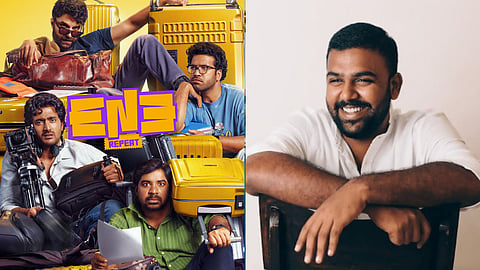


Eight years ago, an unassuming buddy comedy captured the imagination of countless young Telugu men. Tharun Bhascker's Ee Nagaraniki Emaindi, a film about four 20-something men navigating ambition, romance, mistakes, and their love for cinema, all built around the conceit of a missing diamond ring, has since become an integral part of Telugu meme legacy.
Or, as Bhascker puts it in a conversation with The Hollywood Reporter India, an entire generation has romanticised the material that spun out of this film. Eight years later, the boys have grown up, and of course there's a new film on the horizon. Another problem: the growing pains of male adult friendships as they transition from reckless twenties into much more complicated thirties.
As Bhascker revisits ENE Repeat with Vishwak Sen, Abhiinav Gomatam, Srinath Maganti, and Venkatesh Kakumanu, the excitement is palpable. So is the nervousness. The director speaks to us about the sweet appeal of well-done sequels and showing the strengths and frailties of formative friendships.
Excerpts from the interview:
What drew you to this world one more time?
So basically, it is a coming of age for me also; I’ve seen my 30s and how that could actually damage interpersonal relationships or strengthen them, in retrospect. But the themes are very different as the boys are growing into men.
Adulting is a very, very complex thing, where you’re still trying to protect that child in you, which becomes more difficult as we grow. I know when somebody hits their 30s, you become more drawn into yourself, especially men. We're drawing inspiration from fathers who were not that expressive, at least in my generation. So, communication becomes really flawed, and we just become closed in. Even when we're drinking, socialising, or having a really nice moment with our friends, we're not supposed to talk about our problems.
Vulnerability is considered a weakness. Not strength. That's how friendships silently drift apart, and we don't even know why. This was something that haunted me for quite some time, and then I thought, there goes my climax, and there goes my moral compass to start writing again.
The film explores different expressions of masculinity. How did you approach writing these characters?
See, there are four different personality types personified by four different characters in the film, even in the first part, and now as they're growing, they become more complex. I’m drawing inspiration from the observations that I've had around me.
One thing for sure is it exists as a spectrum; we can't compartmentalise them and put them into one box. Men are generally labelled as insensitive (smiles). I mean, sensitivity exists, but it's just complex and different across the spectrum, and I think we've categorised them into four different types here.
We are called out, at least on the internet, and there's a generation that is basically immediately not scared, and they’re often pointing out toxic behaviour. We've had a little fun around these labels too. This duality exists; we are aware of it, but we are trying to navigate it in our own way, I guess.
It’s interesting that you mention this generation because they’re vastly different from the audiences that found ENE relevant eight years ago. Was that also a pressure point in your head while writing the film?
No, I'm always constantly trying not to because, you know, that affects the honesty and the authenticity of what I'm trying to put on paper. I mean, right now, there are so many things that are paid, that are selling something, messaging that is trying to drive advertising, that we do not know how to distinguish what from what. So the only thing that burns through all this is honesty. And my best efforts have always been to observe whatever it is and, without a filter, put it on because a strong statement, whether right or wrong, creates a debate in society and itself is half the work done, I feel.
Today's generation is definitely a very woke generation, but we're also calling everything out, and I think that's a double-edged sword. There is a problem when everything is deemed unacceptable — we're not supposed to do this, say that, or talk about certain things because they're condemned. But, again, it all boils down to the same thing: vulnerability is not weakness.
We should be able to joke about ourselves and talk about ourselves. What we need to measure, though, is something we cannot quantify: intention. We need to understand where a person is coming from before deciding whether what they're saying is right or wrong. I think that discernment comes only with experience, and that is a kind of maturity we need to develop
What was the major drawing point with the sequel for you?
For me, it was easy to encash or milk a fat cow (laughs). But you know, again, I see other films do that. And instantly my thing is, okay, so they're trying to get onto this bandwagon right now. And I think the sensibility is the same for all the audience and I'm from the audience. That's where I came from.
I am not the type who's going to sit in a boardroom meeting and say ‘let's dumb it down.’ Because there's no solid evidence as to why we should dumb it down. That is the reason I didn't want to just put a film structure together, get a writer's room and just crack some jokes, whip up some random theme and just put it out there. I’m very careful about the return of investment for any producer that I work with.
But the higher priority is definitely at the end of my entire career. And when I grow old, I don't want to look back and regret the decision that I just did it for money. And probably failed at it. So that's why I took a lot of time because nothing really hit as hard as this one. And every time the nightmare is for a writer to just sit in front of a blank page. This time it just flowed beautifully and I just didn't feel like there was any obstruction. The energy was right for me.
That's a valid point. But what are the challenges of revisiting a cash cow, especially eight years after the first instalment?
So I think naturally, these four characters had to go through their elinati shani period (laughs). I think seven and a half years went off like that. But on a serious note, I had a lot of apprehensions after writing it.
I mean, the pressure began after I finished writing it because as a director, I really needed to understand what the market is for this kind of a film. Ironically, I've never looked at my other films and had that pressure of expectations. But now the old one is the biggest competition for me.
I need to deliver something bigger because one entire generation has romanticised the material that spun out of this film. And I don't even know if they remember the underlying drama and the underlying themes of the first one right now.
So I wanted to be rooted in that, and I wanted to remind them that this is what the film is about. And I'm so happy that the producers also took the right stand and said, ‘let's set the expectations right.’ Even if it doesn't, even if it means we're going to create a lot of discussion and doubt about the film. We are definitely going to tell them that this is what it is.
The first setback was the backing out one of the actors [Sai Sushanth Reddy who played Karthik in the first part] who was a core memory for a lot of people. But then I thought, ‘OK, if people sit five minutes into the film and still think about a casting choice, I failed as a writer-director.’ So I took that challenge pretty constructively. And kudos to the producers because they are the major decision makers anyway. They've got most to lose at the table.
What is it about sequels that make the format attractive for audiences? We saw this recently with the success of ‘Jailer 2’, which went on to become the highest grossing Tamil film.
See, I think fundamentally, movies are an emotional transaction. We are always doing transactions and emotions and, you know, we're just bartering and bargaining to see if this gives us a feeling.
If a film has created a world and it's given you a sensation that it has creeped into your culture and your nostalgia, you want to be transported to that feeling. And I think when there's a guarantee that there’s that feeling, immediately your brain is set to release those chemicals for you to experience it all over again and that’s a solid promise.
That’s what the star material is all about as well. I mean, a star image promises you something familiar.
I recently spoke to Vishwak Sen, who observed that audiences seem to be gravitating towards smaller, character-driven films centred on internal conflicts and interpersonal struggles, moving away from the larger-than-life action-hero template. He also spoke about being impressed by the recent wave of Tamil cinema, where smaller films are finding their footing. How do you see this shift, particularly in the context of Telugu cinema this year?
It doesn't make any sense for us to look at it year-wise. Because a film takes a lot of time to actually brew inside somebody's mind, get it onto a floor, get it to green light and then, you know, distribution is a whole new thing again.
It's just taking time and I think it's coincidentally falling. And there is no evidence that points to an algorithm where we can say that this year is going to be great, next year is going to be great. Those metrics are actually baseless because there are a lot of factors.
And coincidentally, probably Tamil has done really well for itself, which is going to be great because that is going to influence a lot of filmmakers down south or anywhere else to try and look at that direction even for this as a market. And probably there will be a year in the future where Telugu will dominate the box office in this perspective also.