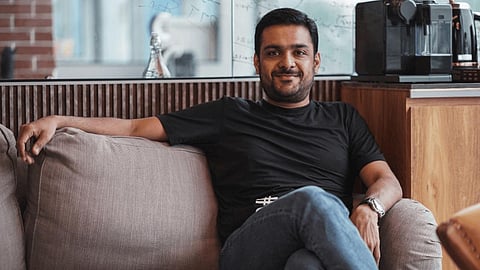


Over a Zoom call, just a few days after his production Mahabharat: Ek Dharmayudh premiered on JioHotstar, Vijay Subramaniam appeared calm. The release of the series, created entirely through artificial intelligence, came in the wake of an online storm that erupted months ago when he announced his upcoming AI-generated feature Chiranjeevi Hanuman: The Eternal, part of his larger ambition to explore storytelling through artificial intelligence.
There were concerns and criticism over the announcement, especially in a climate where the entertainment industry is navigating uncertainty and box-office volatility. Yet Subramaniam, founder and Group CEO of Collective Artists Network, remained composed.
“It’s hardcore engineering, not just prompting,” he said, addressing misconceptions about the process. “It’s not like you open your laptop, go to ChatGPT, and type, ‘Show me a blue Krishna with a wheel.’ That’s not how it works. That’s a big piece of misinformation!”
In an interview with The Hollywood Reporter India, Subramaniam discusses his pivot toward AI-driven content, why he believes mid-scale films will face extinction, his long-term vision for the technology, and his response to filmmaker Anurag Kashyap’s critique of his venture.
Edited excerpts:
I've always been betting on market trends that are, say, four or five years ahead. When we acquired Galleri5, a deep tech and AI company, the idea was simple: to assess how distribution is going to become more democratised, and how content creation can become cheaper by bringing technology into the fold. Can you show the world of India and the history of this glorious nation without having to spend ₹500-600 crores on it, which is a fundamentally broken economic model? And can you create more impact by showing global scale, reach, along with, you know, real deep-rooted Indian stories? That was the ambition.
There's a lot of misinformation on this. Working on Mahabharat is no different than working on an animation film. You have writers, directors, music directors, sketch artists, all of that behind the scenes. The technology of it, however, is something that we really, really mastered after acquiring Galleri5 last year. And what we've been able to do is quite path-breaking.
A lot of it is not classic prompting in terms of AI. It is hardcore R&D and engineering. So, for all those critics who feel that they can just open a laptop screen, type in a few commands and boom, something great will come out, that's far from the truth. It's nothing like that.
It's why we are saying we are building the new-age Pixar. Because you need creative minds behind it, a writer's room, a director team... all of that doesn't change. The fundamentals of movie-making don't change. It's just that the actual cost of producing it on the ground reduces to close to one hundredth of the actual cost, which is where you can actually supply for a lot more economies.
It is hardcore engineering, not just prompting. So it is not like you open your laptop, go to ChatGPT and type, ‘Show me a blue Krishna with a wheel.’ That's not how it works. You have to work on character consistency, dialogue delivery, and emotion. These are really large things that one needs to work on. It just doesn't really stop at pure, unwarranted, mindless prompting. That's not what we're building here. So my line is, it is enabled by AI created by humans.
We have close to 130 or 140 people. We also have Chiranjeevi Hanuman in the pipeline. We have a full slate coming up on the ‘Historyverse’, the IP that we made.
When automobiles came in, when the internal combustion engine was formed, chariots went out of use. So if you were a horse rider and you didn't know how to drive a car, it was a problem. When personal computers came in, typewriters were at risk. When the smartphone came in, Kodak and Canon were at risk. When the internet came in, it changed the way the world looked at things. When e-commerce came in, you didn't have to go into a store. When quick commerce came in, you didn't have to go to your general store. When OTT came in, you didn't necessarily have to go to a theater.
But what did all of these do? If you actually see, with every large technological evolutionary move in the history of mankind, you always had the opportunity of creating more that mankind can consume. It's never diminished anything; it has always enhanced skills.
If I look at music, we have this AI band called Trilok. The two guys behind Trilok are music composers. There was a time when RD Burman, SD Burman, and Laxmikant-Pyarelal used to book out big studios with 80-90-member orchestras. That got shifted to a patch on Fruity Loops or Sound Logic. Why didn't people crib about violinists, orchestra and dholak guys losing their jobs? Because we all had to advance. So let's face it: AI is not a tool, it is the new technology.
I keep telling my actors that imagine if you can work 700 days a year. That's what AI is enabling us to do, right? When the social media revolution happened, the number of events that you did came down, because in the early to late 90s, they used to go to cut ribbons, right in Jaipur, Udaipur, Jodhpur, that went down to one Instagram post in one story. The air around this is so much more.
How is it any different from animation? I don't think you can ever take away the experience of Metallica playing live with robots. I don't think you can ever take away the experience of Shah Rukh Khan opening his arms. I don't think you can ever take away the experience of Deepika Padukone being all elegant and grand. The fundamental thing that we need to understand is what Henry Ford did with the assembly line. He churned out more automobiles by using technology as an advantage to serve mankind.
I think you'll have more content pieces that will come out. I don't think they're going to be replaced. But yes, financial models will have to change. Because then these are the same people who are sitting and crying about the movie business not making money. So what are you doing about making money for the movie business?
I have no room in my life right now for armchair activists. I'm very, very clear. I'm a founder, a CEO with a very strong action bias. I do believe that people who want to make a change eventually don't have to sit in their couch and make commentary. I think you have to go be a part of something that's enabling the world to move forward rather than stagnate or move backwards.
So my good friend who commented about this, little does he know that I'm going to end up making my clients more money and I'm going to make them more immortal than they've ever had. That’s a stunted mind talking, which I don't want to comment on.
I think a lot of it is training and education. What is the biggest thing in an actor's life? Time. It's the one thing that money can't buy. So if an actor can do four hours of work in two hours, if an actor can do 10 hours of work in eight hours, and thereby monetise the remaining time that he has... the chances are this is a new business model emerging.
It's all about educating actors and our communities on how to use this technology as a friend. I think the moment you start viewing it as reductive and substitutional, and not creative and enhancing, you will obviously play from a place of fear. And I don't think any ambition grows on the back of fear; it grows on the back of possibilities. So the way I see it, there are licensing rights, marketing rights, monetisation rights, and saving of time… Imagine if you could make an actor ageless?
What if you don't have to say, ‘Good evening, everyone. I'm Vijay Subramanian. Welcome to XYZ FM channel. Catch my next film, Collective Artist Network, this Friday on Diwali.’ What if I don't have to do that? What if I get paid while saving that?
There is a world where content has to become more commercially viable to produce at scale. People keep talking about what we're doing with Mahabharat, but we also launched a very cute little Netflix film called Greater Kalesh. It was a live-action film by the other company I acquired in 2023 called Terribly Tiny Tales. I think content models are going to get disrupted. The big films are going to do bigger business; the mid-tier films are going to go away into oblivion. The small films are what's going to be repeatable and snackable. The mid-tier will get replaced by actually having technology as a very, very strong conduit…
Take Mahabharat, for example. I'm not going to get into the commerce, but if you had to make this show, it would have cost you ₹ 150-200 crores with these visuals. So we have to be clear about that.