

With “Urdu writers, German directors, Bengali actors, Marathi singers, Parsi producers, and so on — it is not surprising that English emerged as a lingua franca for cultural producers based in a British colonial port city,” reads Tejaswini Ganti’s chapter in the book Precarious Creativity: Global Media, Local Labor (2016). Interestingly, she called it “No One Thinks in Hindi Here” — it’s no wonder that no one writes scripts in it either.
“I can't understand Hindi in the Roman script,” says actor Anupam Kher. He says that many years ago, he told Amitabh Bachchan that he regretted not being able to speak in English when he first came to Mumbai. “I could read and write, and even had authority on Russian and American literature, but I could not speak it.” The superstar’s response caught him by surprise. “Mr. Bachchan said, ‘you are so lucky you went to a Hindi-medium school and now work in Hindi films. The language takes care of half your work.’” Kher adds that he is, after all, not a Japanese actor asking for a Devanagari script. He’s a Hindi actor who is.
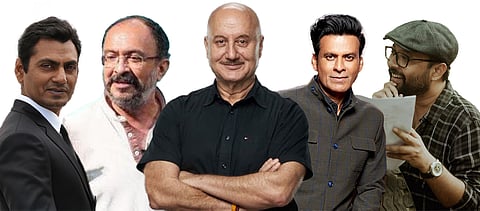
While speaking at the ‘Aspiration to Action’ session at Times Network India Economic Conclave on April 23, 2022, actor Nawazuddin Siddiqui also expressed a strong preference for receiving scripts written in Devanagari. Criticising the predominant use of English on Hindi film sets, he said the practice adversely impacts actors’ performances. And in a Hindustan Times report, actor Manoj Bajpayee shared the same sentiment.
Kher explains that when he reads a Hindi script written in Devanagari, he experiences a rush of emotion. “It has to be written in the language you're speaking it in, otherwise it’s as though dal were served in a Chinese soup cup,” he says.
In that light, The Hollywood Reporter India asked two of the most celebrated Indian screenwriters to explore the nuances of the issue and, more importantly, find a way forward.
An Aesthetic Dilemma
“I've been in the profession for 32 years,” says Anjum Rajabali, a seasoned screenwriter best known for his work on films like Droh Kaal (1994), Ghulam (1998), The Legend of Bhagat Singh (2002) and Raajneeti (2010). He notes that the number one reason for Hindi film scripts being composed in the Roman script since the past 20-25 years is that most literate Indians have been educated in the English medium.
“While they think and speak fluent Hindi, those who do not come from a Hindi linguistic subculture are more comfortable reading the Roman script.” Rajabali explains. He adds that while Anupam [Kher] and Manoj [Bajpayee] might prefer to read scripts in Hindi, most other actors, technicians, directors, producers, studio executives and lawyers find Roman English easier to read.
The practical aspect is another factor. “Getting used to Devanagari font is not easy. While you do get the phonetics in Microsoft Word these days, that facility is not available in most screenwriting software yet,” he adds. Rajabali has an easy fix for those looking to convert English to Devanagiri — give it to a typist to print it out. While the screenwriter considers this a minor issue that can be resolved through discussions among the actor, director and writer, another problem that could arise is if a character is meant to speak in a particular local dialect, which the Roman script can’t adequately capture.
He believes the underlying issue is one of aesthetics. “Ideally, a script should have the scene heading, action description, transitions and character name — which appear on top of the dialogue column — in English. The actual dialogue should be written in Devanagari,” he says. “And that is very beautiful to read. It captures what India is — because let’s face it, in India, English is an across-the-board language.”
Having read scripts in several languages, he’s come to realise that Hindi may be one of the only film industries in India in which dialogues are written in the Roman script. When the script is written entirely in English, as was the case with Droh Kaal, issues with subtextual nuances emerge. “For example, to translate ‘let sleeping dogs lie’ in Hindi as ‘sote hue kutto ko sone do’ would be incorrect. The right translation would be: Gade murde ko kahe ukha.”
“I was given a beat sheet by director Govind Nihalani. I wasn't brought up in a [Hindi-speaking] culture, as a result of which the dialogues were actually in English. I knew enough to know that while I wrote in English, it rang inside my head in Hindi — the rhythm lent itself to what I considered would be an easy translation. But it was also adapted because the idioms, phraseology and references changed,” he says. He adds that while he had to revise the Droh Kaal script several times it took him a couple of films to hone his understanding of Hindi adequately enough to feel confident to start writing in it. “That’s when you need to be careful about what you're trying to say and if it has come through; that’s where the subtext business comes in.”
A Multilingual Problem
For Satyanshu Singh, who co-wrote the short films Tamaash (2013) and Chintu Ka Birthday (2019), and the poems in Udaan (2010), it’s all about prioritising comfort.
“I pay attention to choosing the best-possible Roman letters to convey [the message]. For example, when I want to say ‘no’, I write it as ‘nahin’ instead of ‘nahi’. Phonetically, I try to make it as easy as possible, and since my Hindi is better than my English, the tone or essence comes naturally.”
In Singh’s opinion, this isn’t a question of right or wrong. “Devanagari is difficult for a lot of crew members who may not be from the Hindi-speaking belt. That’s why Roman English makes sense to me. But every time an actor wants the dialogues in Devanagari, I happily oblige, and ask my team to as well. This is irrespective of the length of a role, and for up-and-coming actors as well.”
Hindi film crews are composed of people from across India and even other countries. Singh recalls that when he directed Jehanabad - Of Love & War (2023), his cinematographer was a Bangladeshi man who couldn’t read Devanagari but understood Hindi. “Screenplays are hardly a hundred pages so teams should write it in Devanagari for those who cannot read in English. It’s not a problem as long as we are open to the needs of the people.” he says.
Back when Kher started out, there were no scripts in the first place. “They had the story in their mind but we were given the scenes on the spot,” he reveals. “Sometimes, before a scene started, they would say it was still cooking. I have even performed scenes written on the backs of cigarette packets.” What a long way Hindi cinema has come since then.