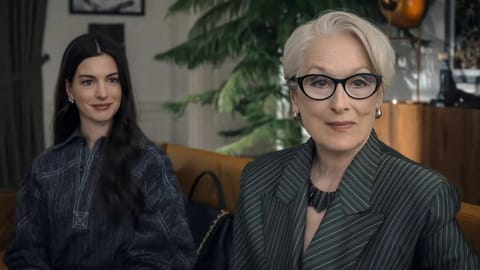


Journalists have long been the first frontier of information. Today, they are also the last bastion of hope and integrity. I know that isn’t the reputation many publications in this country have earned, but I would like to believe that the work I’ve done—and the people I’ve worked with—have tried to hold on to whatever semblance of journalism we’ve been allowed, by the skin of our teeth. This is why The Devil Wears Prada 2 hits too close to home. Far too soon.
We pick up 15 years after the last film, and the first thing you notice is the inconsistency in Miranda Priestly’s character. Since Meryl Streep can do no wrong, you are forced to reckon with a different possibility: that the devil herself has succumbed to a bigger evil—“content”. The film grapples with the realities of a journalistic publication in 2026, of running a print magazine at a time when no one reads, or seems to care.
Anne Hathaway (who seems to have been granted eternal youth) returns as Andy Sachs, who left Runway to do “real” journalism, only to be laid off the very day she is given an award for her investigative work. Desperate, she returns to Runway, which is itself clawing its way back from a credibility crisis following a PR disaster. Their mutual desperation brings Andy and Miranda together again. Emily (Emily Blunt) is now heading sales at Dior, one of Runway’s biggest advertisers. Nigel (Stanley Tucci) is still Miranda’s right-hand man. Bringing the original cast back is convenient, yes, but the film manages the harder task: it makes their return feel believable. These are still the same people, but the world around them has shifted so drastically that they’ve had to shift with it.
For those of us who work in magazines, in publications trying to stay relevant in 2026, this film—directed by David Frankel and written by Aline Brosh McKenna—plays like a horror movie. Not because the jokes don’t land (they do), but because they land while something else curdles underneath. Many scenes feel lifted verbatim from conversations we’ve been having for years. It’s as if our group chats have been leaked, our editorial meetings recorded. The parallels are not just striking; they are invasive. They also change the identity of the “devil” in this film.
In the first instalment, the devil was clear. It was a sharp rebuke to legacy publications with toxic and nasty (sorry, had to) cultures that justified cruelty in the name of taste and authority. This sequel turns its gaze outward. Those same institutions are now facing irrelevance at the hands of “content creators” who have democratised influence, for better and for worse.
Layered on top of that is the flattening force of AI, which levels the playing field so thoroughly that distinction itself begins to disappear. The problem is not just that power has shifted. It’s that nobody seems to care about integrity or credibility anymore.
A few weeks ago, the US bombed a school in Tehran because no one double-checked coordinates selected by AI. You might wonder what that has to do with The Devil Wears Prada 2. It does. Bear with me.
Journalists are flawed. There are plenty of reasons to dislike snobs who believe they are arbiters of taste. But humans come with accountability. Journalism, at its best, comes with verification. With credibility. You can hold a person responsible for getting something wrong. You cannot hold an algorithm accountable in the same way. “Content” has no moral centre. Algorithms flatten creativity; excellence has no incentive to exist. Everything begins to look the same, read the same, feel the same. The people still trying to keep journalism alive are, in some small way, trying to keep humanity alive with it.
We are all caught between what people ought to know and what they will click on. Like Andy, who still has something meaningful to say, but finds that no one is interested in reading it.
The slightly utopian ending of The Devil Wears Prada 2 reminds you that, for all its resemblance to reality, it is still fiction. The urgency of its argument, however, is not. We don’t have much longer. Read. Pay for subscriptions to credible publications. Don’t rely on influencers or AI summaries to tell you what matters. Yes, the curators of culture have often been gatekeepers. But a known devil is still better than a faceless, tasteless bot.
This review has turned into a personal essay. But you don’t need me to tell you that The Devil Wears Prada 2 is a good film. Of course it is. If this is my last review for the foreseeable future, then let this be the only thing I insist on: this was written by a human. This is not content. I no longer have the luxury of hoping that something will dramatically change. But my friends and colleagues who continue to do journalism—whatever fragile version of it remains, a wooden plank beside a sinking Titanic—do so because, beyond being the first frontier of information, they are still the last bastion of hope.