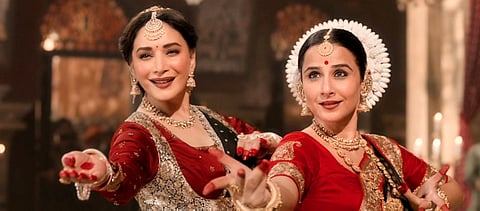


The Bhool Bhulaiyaa 3 dance off between Vidya Balan and Madhuri Dixit Nene comes right after the interval. This dangling placement tells you everything, for the “post interval” scene is one for which audiences are still trickling in, with popcorn and Pepsi, silhouettes cutting off your view of the screen as they slowly swipe past, sighing sorry-sorry-sorry, shuffling between legs. It is the scene that is the most expendable. Dixit Nene is performing Kathak while Balan embodies an awkward marriage of Odissi and Bharatanatyam — the tahiya or headgear from the former and the starched poses of the latter? The song is a portrait of tragic incompatibility — that these two dance forms cannot share space meaningfully, coherently, or even playfully.
From their costumes — the clashing shades and textures of red, the flares and lack thereof of the fabrics — to the fact that there is only one voice for two women, the two never seem to even acknowledge the other in order to respond to their energies with their own. It is as though their bodies are floating separately, yanked together at the edit table. The continuity of the song, too, is a toss-up, characters ending up on either side of the other on either ends of a cut, their placements jumbled around. It is clear that neither thought nor care went into crafting this song, or imagining and lensing its possibilities.
But the dance-off is a Hindi cinema tradition that brings to it the energy of the respective fan clubs. It is charged with competition, each bringing their best to the table. Here are some such examples:
Shiamak Davar’s choreography of ‘The Dance Of Envy’ in Dil To Pagal Hai was a cultural realignment — a new form of dance was entering the vocabulary of our movies, the song would be without words, the acrobatics would be preferred to the sinews. Their bodies do not contain the dance but fling it outwards. It is a new kind of radiating presence.
Where ‘Dola Re Dola’ seemed coherent, ‘Pinga’ felt disjointed. The long-limbed Deepika Padukone would take that much more space and time to move through gestures that Priyanka Chopra Jonas would quickly embody. This is not the first time she has shown what ease can look like — in ‘Girls Like To Swing’, her soft movements really become clear against Anushka Sharma’s quick-limbed chaos. Though, this is Sanjay Leela Bhansali, and he finds ways to exaggerate the emotional landscape to blur the awkward encounters of the two bodies. The top shot and the final pose seal the song.
Vyjayanthimala, a Bharatanatyam dancer herself, is no stranger to the dance-off — from Vanjikottai Valiban (1958), its Hindi remake Raj Tilak (1958), to the dance-off in Prince (1969) against what Usha Iyer calls Helen’s “loose-limbed insouciance”. The Amrapali dance-off, though, is littered with small, joyous asides — the two dancers competing with sticks, then cymbals, using the footwork of their dance to make rangolis with their feet. These cartoon-like sketches of one challenging and the other outmaneuvering infuse nakhra into the natya.
This is what basic choreography and uninspired setting and composition can get you, if you let the dancer take their space (Hrithik Roshan), if you let the acrobat pirouette (Tiger Shroff). A perfectly ordinary song, ‘Jai Jai Shiv Shankar’ is a clash of generations — the kurta-jeans and the sleeveless-torn jeans, the sinuous and the agile — that plays out at a frenetic pace, the cut of the camera and the swoop of its motions allowing for the illusion of too much movement. The biggest draw of the song is it allows both Roshan and Shroff to bring their whole selves to the stage, neither looking nor feeling shortchanged by the axed screen-time that a dance-off entails — instead, there is joy in being in the presence of the other.
This is the gold-standard, with the bodies of the dancers (Madhuri Dixit Nene, Aishwarya Rai Bachchan) fitting hand-in-glove with the dance they have been gifted — there is no other word for it. Choreographed by the late Saroj Khan, the lithe limbs of Aishwarya Rai Bachchan and the full-bodied presence of Madhuri Dixit Nene never chafe at each other, they build alongside the other. Their presence, separately and together, give space to elaborate their respective and collective emotional desires — for a man, of course.