

Of all the environments I expected to encounter in a modern Hindi film, a post-liberalisation, post-Cold War and post-Iron-Curtain New Delhi on the eve of a Russian president’s visit might have been the least likely candidate. It’s such a specific setting and period that the film’s title, Berlin, feels like a gag about an old India in search of a new identity. The director, Atul Sabharwal, is no stranger to specific backdrops. He often marries the forensic approach of a historian with the idealism of fantasy. His directorial debut, Aurangzeb (2013), opens with a quote by a Roman poet and infuses the Gurgaon-based family drama with the doctrines of a Mughal emperor. His personal documentary, In Their Shoes (2015), views Agra’s shoe trade legacy through the lens of his father’s life. Jubilee (2023), the Vikramaditya Motwane-directed series that he wrote, dramatises the golden age of Bombay cinema in a newly independent India. Even Class of ‘83 (2020) is set in 1980s’ Bombay, when the underworld is supplied by men rendered jobless by a mill strike.
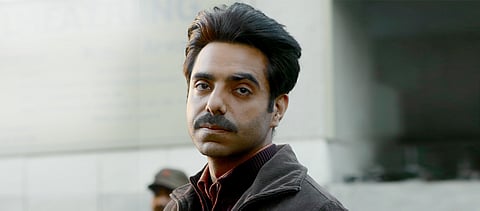
In the same vein, Berlin refers to a fictional café in the diplomatic enclave of the Indian capital in 1993. But this is no normal café. Like a coffee shop in Mumbai’s Lokhandwala, it is full of strivers exchanging ideas and information. Except, these are not Bollywood aspirants but agents from competing foreign embassies in the area. It’s almost a nostalgic ode to the Berlin that sustained them. Most of these officers are bereft of purpose after the long Western conflicts that kept them busy – the Cold War, the Berlin Wall – have ended. Deaf-mute waiters are hired to maintain the confidentiality within the place. The film revolves around one of these waiters, Ashok Kumar (Ishwak Singh) – who is accused of being a foreign spy – and Pushkin Varma (Aparshakti Khurana), a sign-language expert hired by the government to interpret this interrogation.
Varma is of course named after Alexander Pushkin, the Russian poet whose controversial work led to exile and constant police surveillance. Varma is no poet or genius, but his empathy for Ashok soon results in him being put under surveillance by Sondhi (Rahul Bose), the cunning intelligence officer who brought him in. Pushkin starts to interpret far more than he’s supposed to. He dives without a parachute into a world of espionage, assassination plots, blackmail, honeytraps, cover-ups and agency rivalries. His curiosity refuses to subside.
Evidently, Berlin is rich in craft and period detail. The muted greens of the interrogation chamber merge with the brutalist architecture of the concrete buildings to evoke an Eastern-Bloc palette. At times, this conveys the Soviet-era hangover of the officers in the bureau and their rival agency, most of whom seem to be manufacturing their own conflicts and concepts of nationalism in the absence of any. Sondhi is no patriot; his attitude towards both Pushkin and Ashok reeks of a deeper conspiracy. The fate of the two (alleged) commoners — casualties of an internal government war — brings to mind the passengers of the hijacked plane in IC 814: The Kandahar Hijack.
I like that there are no cheap parlour tricks either. As the audience, we are conditioned to consider the possibility of Ashok faking his disability. But that’s not the kind of movie Berlin is. If anything, it’s quietly political about a system that hides its own disability behind the excesses of fiction. Rahul Bose does wonders with his feral body language and diction to embody the establishment. He continues to excel at roles of men who think they’re smarter than everyone else.
As has been the case with Sabharwal’s work, the narrative isn’t always clear. At times, it almost loses itself in its Spielbergian milieu. Unlike Class of ‘83, however, this isn’t a deal breaker. Given the two-men-against-history situation, it’s hard not to think of Bridge of Spies (2015). The most striking shot features the camera doing a 360-degree turn while characters exit the interrogation room and enter the observation room on the other side of the one-way mirror. This is not an empty gimmick; it’s in service of the suspense surrounding both characters. At another point, the typist and the recording apparatus provide the soundscape with a natural mic-drop moment. Later, Pushkin meets a prospective bride’s father, who makes the sort of small-talk (“now everyone can afford cars”) that doubles as a reminder of post-globalisation moods. It’s the kind of filmmaking that’s fertile enough to keep us interested despite an overactive plot.
This affection for texture is everywhere. There’s a cheeky silent-movie-versus-talkies metaphor in the ‘communication’ between Ashok and the agents. It’s like they’re hoping to design his voice with the questions they ask. There’s also the pure storytelling Ashok indulges in — as opposed to the impure stories they tell themselves.
Ishwak Singh does a fine job of playing a bit of a dreamer. It’s a sincere and playful turn that makes it look like Ashok is enjoying the attention from the professional spies. In his head, he is the protagonist of an unlikely underdog tale. But Ashok is defined by the fact that he is named after the first Hindi film superstar to play an anti-hero. The officers are surprised by his skills; to him, it’s a boost to his self-worth.
Aparshakti Khurana’s performance as Pushkin is a weak link, though. The pitch is too high; it’s as if the character is a secret B-movie fan with a penchant for easy theatrics. As a result, Pushkin’s transformation from submissive worker to defiant truth-seeker feels abrupt. Thankfully, Berlin is a place, not any single person. It’s a place where waiters wait, interpreters miss the signs, spies distract, and regimes narrate their own scripts. It’s also a time that passed but never really left. It’s all wonderfully niche and specific — until it isn’t.