

When Indian shows get it right, they become their own genre. They’re used as a point of comparison by creators and viewers: Oh, you mean it’s a wannabe Mirzapur? It’s giving slice-of-life Raat Jawaan Hai energy? They’re Panchayat-coded characters? What, it’s a slow-burning Paatal Lok-meets-Kohrra thriller? But when they get it wrong, you think fondly of the ones that became their own genre. Do You Wanna Partner, for instance, made me appreciate all the titles that ran so that Do You Wanna Partner could crawl: the upscale-and-socially-mobile-NCR entrepreneur drama of Made In Heaven, the middle-class business hustles of Rocket Singh and Band Baaja Baarat, the scammy Delhiness of Khosla Ka Ghosla, even the cross-cultural swag of Rocky Aur Rani Kii Prem Kahaani (whose ghost haunts imitations from the production house).
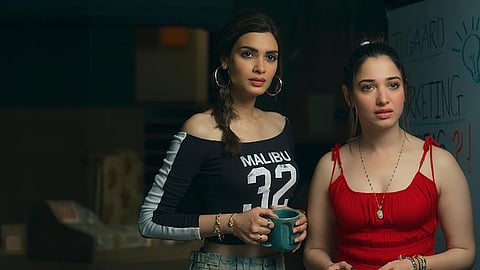
This stubbornly mainstream show is inspired by so many popular styles and themes that its own reflection in the mirror barely registers. Despite a curious screenplay, the spot-the-easter-egg writing becomes its identity. This is a common problem in an age where newer storytellers get too preoccupied with aping the past and mining their cinephilia instead of exploring their own voices. The eight-episode series revolves around the adventures of two childhood friends — marketing whizz Shikha (Tamannaah Bhatia) and financial analyst Anahita (Diana Penty) — launching a craft-beer startup in India’s notoriously male-dominated alcohol industry (and region, and country).
Their entrepreneurial journey is packed with checklist obstacles and over-the-top personalities: a loan shark named Laila, a Bengali method actor with short-term memory issues, a green-flag chef boyfriend, a hot-tempered Jatt brewmaster, a queer sibling with a graphic-design studio on Lodhi Road called Vibe Shibe, and a dastardly booze baron named Walia of course. Walia is the clown prince of Good Times; his physical elasticity is the sort of nutty pulp that such shows fantasise about without having the conviction to pull it off. You know how the rest goes. Shikha gets laid off, she misses her dead dad who was a passionate brewer but a bad business brain, she convinces her bestie to complete his dream, and before we know it, a lager called Jugaaro takes the nation by storm (can anything happen without a viral social media campaign?), and the villain gets jealous. Shikha is supposed to be a strong and complicated girlboss, so she behaves like she’s infected by toxic masculinity instead. The threat of another season looms large.
The thing about Do You Wanna Partner is that it becomes forgettable against all odds. The idea of a beer startup plays out like a yoga-names version of a Rocket Singh template (the noble supplier from both the YRF business-themed hits, Neeraj Sood, gets a casual-sexism upgrade here). It’s a specific subculture of urban aspiration; I’m almost surprised there isn’t a Shark Tank pitch subplot. The protagonists come from privilege, curated hardship, and family inheritance (they manage INR 2.5 crore in seed investment and need another 2.5) — one can imagine a self-made outsider quoting Siddhant Chaturvedi’s famous line “Where our dreams come true, their struggles begin”. He would not be wrong. But the point is that first-world ambitions need not be lesser ambitions; Shikha and Anahita have a whole lot of societal conditioning, North Indian patriarchy, systemic flaws and generational trauma (kind of) to fight. The challenges are good-looking but real. Yet at no point do the stakes feel tangible. It’s the Call Me Bae-coded treatment that trivialises the chaos of starting a company and weaponising the chauvinism they face. It’s hard to take the partners seriously for reasons that are more fundamental. They manage to look and sound unconvincing about ‘passion’ itself (forget the agency and expertise), playing into the lazy stereotypes that men in the field mentally approach them with.
It’s not about inauthenticity so much as the show’s emotions being digital; its understanding of people, work and friendships seems to be derived from the internet, not life itself. The hashtag-beer-as-a-feminist-construct aesthetic is too smug to have fun with. But there is a semi-decent beer-is-filmmaking metaphor: particularly with Shikha’s father’s backstory (the naive artist cheated by a business-minded friend), the director-producer-style clashes between the tattooed brewmaster (a Vikrant-Massey-coded Nakuul Mehta) and the trendy founders, and the ‘arthouse’ craft-beer brand trying to be accessible and penetrate the ‘massy’ alcohol market of Gurgaon.
Some of the micro-level gags almost work. At some point, Anahita’s voice becomes manly after a night of drinking, and vendor calls go seamlessly because they mistake her for a businessman. It’s not a sore-throat scam they can sustain for long, so the two friends come up with a fictional identity named David Jones — which is how failed theater actor Dylan (Jaaved Jaaferi) enters the story. After we are informed repeatedly that Kolkata is where time stands still, we come to appreciate the early-Dibakar Banerjee touch. Jaaferi’s restrained presence turns Dylan into a paternal figure beneath the decrepit-artist humour. Despite the tone of his character, he doesn’t play to the gallery, retaining a kind of sadness and wisdom that one associates with veterans who haven’t gotten their due. We are therefore gaslit into believing that David Jones becomes a national sensation with not a single background check; when in doubt, blame bad journalism. Besides Neeraj Kabi’s committed hamfest as Walia and Shweta Tiwari’s cold ambivalence as the gangster, I also like the concept of Shikha’s love-life and her self-sabotaging nature; she’s with a man so caring and woke that she’s uncomfortable with the feeling of obligation towards him. To be fair, he’s so cloyingly perfect that I was waiting for him to out himself as a predator. But the show just about resists, just like it resists the temptation of including a fish-flavoured beer as another cutesy ode to Bengali culture.
That said, Do You Wanna Partner — try saying the title without visualising Govinda on a beach — is undone by its macro-level choices. For instance, Anahita’s loneliness is so superficial that her attraction to brewmaster Bobby is about as persuasive as a Manchester United goalkeeper. The inevitable conflict between the two friends unfolds like mugged-up answers in an exam, as is the cringey breakup scene between Shikha and Kabir where you're almost rooting for them to end it. The two leads try to sound relatable, but they succumb to a trait that plagues most modern actors. There are two stages of performance here — first they must play the role of someone who thinks in Hindi (or Hinglish), then they must play the role of fictional characters. There’s a dissonance between expression and spirit, because they jump to the second stage without clearing the first. One might still survive a film like this, but eight episodes is a stretch. Even the conceit of Shikha subconsciously becoming like the men she distrusts looks accidental. Those glossy montages of music festivals, pub events, big launches and hipster offices can go only so far as surrogate entertainment.
The second half of the series is replete with recycled tropes. Dylan has an anticlimactic arc (I hope the makers recognise that he's a worthy spin-off subject). Shikha’s daddy issues are reverse-engineered to lend the narrative some tension. When she lashes out at everyone, her ready-made-supportive mother materialises like she’s a figment of her imagination and slips in a “life is an act of letting go” line. Again, you can tell where reality stops and the pull quotes (this one from The Life of Pi) start; the gravity is so scripted that it pulls the viewer out of the moment. Even if one were to assume that the lady is an Irrfan Khan fan, it’s hard to reconcile with the stilted exchanges between alleged people. It’s also hard not to recollect the original genres and the times they were done right. I’m all for alcohol positivity in an era of bans, but this is the cinematic equivalent of waking up hungover without touching a beer. It’s nothing but vibes shibes.