

Creators: Salona Bains Joshi and Shubh Shivdasani
I remember watching the first season of Panchayat (2020) and thinking: Wow, this is going to change things. And it did. It altered the way we perceived “comedy” as a serious genre. It was very exciting to see a simple, slice-of-life environment — the iconic fictional village of Phulera and its bittersweet characters — seared into the modern streaming lexicon. But I’d be lying if I said I was blindly optimistic. At the back of my mind, there was this fear — a fear derived from years of watching Hindi cinema overkill a new sensation. Nobody knows how to quit while they’re ahead.
I was anxious that, just like the modern horror comedy or the mid-2010s small-town romcom, Panchayat might have created a monster. The inferior imitations would arrive. The ‘template’ would be ground to genre dust. But the crime thrillers and police procedurals continued, and the rural dramedies never came. I kept waiting and fretting.
Until now.
Dupahiya (“two-wheeler”) is so Panchayat-coded that it feels inevitable. It’s almost the same set and production value, only with slightly different characters and dialects. The brother-from-another-mother vibe is deliberate, almost as if the streaming platform is counting on fans to simply cross over. Even the aerial establishing shots of the remote village — Dhadakpur in Bihar this time — have identical drone movements. The quirky sound cues, the dry-light cinematography, the character-a-minute design, the bricked bylanes, the mundanity and feel-goodness, the low-stakes humour; it’s like watching Prime’s version of a Spy Universe (the ‘Cutesy Village Universe’) expand into a Malgudi Days-esque franchise. It’s more world-rebuilding than world-building: Panchayat has a water tank, Dupahiya has a well.
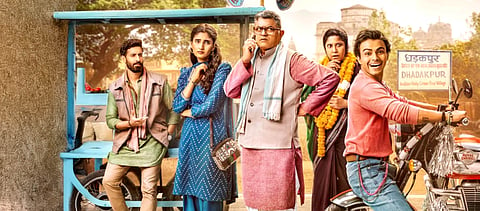
The ensemble cast is just as solid. There are the elders: a respected local teacher (Gajraj Rao), his wife (Anjuman Saxena), the proud village sarpanch (Renuka Shahane) on the brink of elections, and a lazy cop (Yashpal Sharma). There are the ‘youth’ who have big-city dreams: the teacher’s spunky daughter Roshni (Shivani Raghuvanshi), her Instagram-reeling brother Bhugol (Sparsh Shrivastava), Bhugol’s best friend Tipu (Samarth Mohar), Roshni’s macho ex-flame Amavas (Bhuvan Arora), and the sarpanch’s dark-skinned daughter Nirmal (Komal Kushwaha). Everyone is very watchable in their roles, but Sparsh Shrivastava has the sort of remarkable screen face that can do nothing in a frame and still own it; he extends his Laapataa Ladies persona into a jittery riot of physical tragicomedy. His performance makes you wish Bhugol was the sole protagonist of the series; his ambition to become an actor in Mumbai is so palpable that you can almost visualise Bhugol getting kicked out of a Yari Road audition room.
The problem with Dupahiya, however, is not its lack of novelty. It’s not bad, purely functional, makes for decent ambient television, is three episodes too long, and has its moments. It’s the fact that, in its pursuit of non-Panchayat identity, it scrambles the entire DNA of the genre. It turns an everyday premise — an episodic account of life in India’s only crime-free village — into a mainstream plot. An expensive motorbike bought as dowry for Roshni’s upcoming wedding is stolen. It’s the first theft in Dhadakpur in 25 years. Rival chiefs, a nosy journalist and the district police smell an opportunity to expose Dhadakpur, but Roshni’s family and others spend the week concealing this broken record and keeping the wedding on track. By hook, crook and a lot of manufactured whimsy.
Every character goes on their own little curated adventure. The desperate dad and the cop enter a cat-and-mouse game; the bratty groom aches to spend quality time with his beloved bike; Bhugol and Amavas try to arrange for a second-hand Bullet, but find themselves embroiled in a world of owl-loving gangsters and mechanic-cum-pimps. Meanwhile, Nirmal is on her own trip to raise funds for skin-lightening treatment at a laser clinic, all so that she faces no more marriage rejections.
Too much colour is added: there are romantic flashbacks, musical montages, gender-equality monologues, and two men dancing to an item song in drag to assuage a bunch of Uttar Pradesh goons. It’s almost as if the makers don’t trust the quotidian rhythms of the village, so they stretch a 90-minute comedy-of-errors movie into 9 episodes of staged mishaps. Unlike (Season 1 of) Panchayat, it’s more about story continuity than the storytelling of moments; the characters are too pre-formed to reveal themselves over time. Sparsh Shrivastava isn’t always on screen, so the pattern gets repetitive. Nothingness can be charming, but not if it’s infused with commercial shape and direction. It’s a bit like hearing a well-meaning remix of a vintage song: catchy in parts but full of unnecessary moderations.
Another issue with Dupahiya is how its emotional punches don’t land. In Panchayat, you had this poignant father-son chemistry between the pradhan-pati (Raghubir Yadav) and the urban outsider (Jitendra Kumar); you also had each of the residents battling life and real-world influences to preserve the utopianism of the village. Here, all the conflicts and payoffs feel formal. A moment where the wily inspector is schooled by the pained dad triggers his transformation into an honest cop, but it doesn’t feel earned. Another one features the boycotted family looking forlornly at their empty wedding venue, only for the villagers to show up and join the party — the timing is off, the buildup is short, and the ‘surprise’ (or the father’s tearful face) doesn’t hit the spot. It’s a lesser version of Panchayat’s pradhan-pati and gang showing up at the young man’s doorstep with beer after they sense his loneliness.
Similarly, Roshni’s outburst at the end is Bollywood-social-message-ish, and the village’s progressive stance is too sudden to be a genuine feel-good resolution. Nirmal’s mother, the sarpanch, is a single parent who says all the right and liberal things; yet their exchanges sound like a sanitised urban gaze of how rural citizens think and evolve. When the identity of the bike thief is finally revealed, it feels incidental to the long-running spinoffs that have already happened. It makes sense on paper, but the narrative effect itself is anticlimactic.
Dupahiya nails some of the texture. Nirmal trains adults to speak better English because most of them dream of migrating to Kuwait and Saudi Arabia. Pop-culture references range from Disha Patani, Dhoom and the Honey Singh hit ‘Chaar Botal Vodka’ to Arbaaz Khan (from Pyaar Kiya Toh Darna Kya). Tipu is seen nowhere without his Salman Khan-coded Firoza bracelet. Two Bihari youngsters get drunk at a dhaba in UP and spend a small fortune on beer because they’re no longer in a dry state. The word ‘atma-nirbhar’ (self-sufficient) is said by multiple civilians in a way that feels like it’s been force-fitted into their vocabulary by political leaders; they say it like they’ve heard it everywhere. The village is called Dhadakpur, but it inherits the caste-blindness of both Dhadak (2018) and Panchayat. Character names like Nirmal (“pure”), Durlabh (“rare”), Roshni (“light”) and Amavas (“new moon”) speak to the South Asian superstition of naming kids to summon specific qualities.
But Dupahiya misses the mark in how it expresses the irony of a crime-free village riddled with regressive customs like dowry, gender discrimination, patriarchy and colourism. Except in the dying minutes of the finale, there is no sign of the writing even recognising the irony, forget exploring it. Dhadakpur is laced with cultural shortcomings, but they pride themselves on a political statistic that means little in an India where social transgressions are normalised under the guise of tradition and religion. The show is so focused on being a story in motion that it fumbles the essence of social inertia.
It’s why the abrupt humanity of the village doesn’t ‘emerge’; it pops up as token commentary in a narrative that’s torn between being the next Panchayat and the first Dupahiya. I can think of worse inspirations, but the characters are not nearly endearing enough to merit a full-blown franchise. The only way it can keep being called Dupahiya is if the characters migrate to Mumbai only to go viral when celebrities and ex-cricketers lecture them about wearing helmets and maintaining road safety. The bike can take a hike.