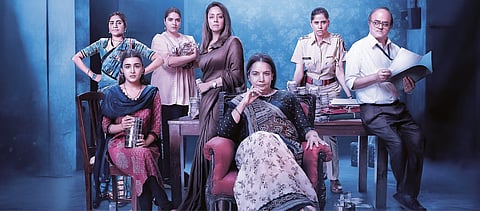


When we call a studio-led series “well packaged,” it’s not always a compliment. Sometimes it’s a euphemism for being too slick, too curated — another way of saying it’s overproduced to hide the weak writing. Sometimes it’s a cursory nod to the technical departments: the visual aesthetic, the budget, production value, the general look of the show. Sometimes it’s just a consolation prize for not messing up; you can almost hear the ‘but’ that follows.
But calling a show like Dabba Cartel “well packaged” reclaims the positivity of this term; it expands its meaning beyond the physical traits. Of course there’s the pun of the narrative revolving around actual packaging: a group of five unlikely partners launch a tiffin service as a front for a covert drug-peddling business. Yet it’s the clever world-building, the cultural composition, detailing and the thematic patterns that distinguish Dabba Cartel from other stylish Excel Entertainment productions. The craft is smooth, but so much of the show’s subversive nature and entertainment is rooted in its narrative design.
The premise sounds like the kind of social gimmick that often runs out of steam. The five partners here are women from different walks of life. So the ruse of a tiffin (dabba) service — a business that depends on kitchens, home-cooking and sacred meal schedules — plays not only into the women’s domestic identity as default homemakers in a patriarchal setup, but also their invisibilisation as breadwinners by a society steeped in everyday sexism. Director Hitesh Bhatia (Sharmaji Namkeen) resists the quirky-gangster tropes and visual posturing of this genre. If anything, the gimmick builds up steam across seven episodes and derives drama from these preconceived biases. The plot is driven entirely by these characters and the choices they make.
A majority of Dabba Cartel has two parallel threads running, almost like two parallel storylines. The first one features a crooked pharma giant and corporate conspiracy. This is the sort of story — full of self-important men, desperate worker bees, honest officers — that most shows are based on. A company named Viva Life is thrust into the national spotlight when a high-profile accident reveals a banned medicine called Modella. A top-level executive, Shankar Dasgupta (Jisshu Sengupta), takes charge when a drug-control inspector, Ajit Pathak (a superb Gajraj Rao), arrives to investigate. Shankar is soon assisted by a mid-level employee, Hari (Bhupendra Jadawat), who wants to seal a transfer to Germany. This cat-and-mouse game unfolds across Ajit’s leads in North India, a Pune laboratory, and the company housing colony in Thane, where Hari and Shankar struggle to function as family men during this crisis. In short, the male characters in this thread behave like they’re the protagonists of the show.
The parallel thread features the women that these men are wired to underestimate. Theirs is an existence that mainstream thrillers reduce to footnotes. Raji (Shalini Pandey), Hari’s middle-class young wife, runs a modest dabba service from her kitchen with her househelp, Mala (Nimisha Sajayan). Together, they covertly supply herbal-viagra tablets through the lunches to earn extra dough. Raji dreams of a better future in Germany, while Mala, a feisty single mother, is tired of tolerating the tantrums of the colony’s housewives. Raji’s mother-in-law, known as Baa (Shabana Azmi), quietly lives with the couple and meets her best friend Maushumi (Lillete Dubey) at Marine Drive on the weekends. Raji’s search for a new working space brings local broker Shahida (Anjali Anand) into their lives. And finally, there’s Varuna (a scene-stealing Jyothika), Shankar’s wife and a former Viva Life hotshot whose upscale garment shop is in trouble. There’s also a sub-inspector, Preeti (Sai Tamhankar), who’s been assigned to aid Ajit Pathak in the Modella case; she is aiming for that elusive promotion.
The women are brought together by the inherent chauvinism of their circumstances. It’s nothing dramatic, just a routine erasure of agency. The men are too self-involved to notice them. In the male-led thread, they’re wives, mothers, service providers and people who absorb the rage and aspirations of the “providers”. They are infantilised, existing only to listen, hope and indulge the men in their lives. Raji is simply someone Hari comes home to; for him, her tiffin business is just a hobby. Baa is just a body in the house; Hari barely acknowledges her presence after work every evening. The neglect is so stark that even the sworn enemies of the joint-family ecosystem — a mother-in-law (“saas”) and daughter-in-law (“bahu”) — form a poignant bond. Mala’s boyfriend casually blackmails her with a sextape. Shahida is marginalised by not only her faith but also a boss that offers her peanuts. Varuna becomes an emotional punching bag for a husband who thrives on being more successful. Even Preeti sets out on her own investigation after Pathak — otherwise a principled, nice chap — refuses to take her seriously.
It’s almost as if they use the males’ main character energy to their advantage, becoming the primary thread of the show by staying under the radar of both the narrative and the people in it. Their camaraderie relies on the automated narcissism of Indian husbands and sons; the patriarchy isn’t smashed, it’s lulled into submission. Even the incident that triggers the idea of a cartel involves an impulsive reaction against a brand of alpha masculinity that Indian cinema thrives on normalising. The shadows these women operate in are the blind spots of an environment that doesn’t expect them to be brave or gatecrash a male-dominated field. By the time their world collides with — and hijacks — that of Shankar and Hari, it’s clear that even their ‘victory’ is tinged with the inevitability of defeat. The spotlight, and the illusion of agency, comes with consequences.
To the show’s credit, it doesn’t glorify their ‘Narcos: Thane’ (Varuna’s joke, not mine) and ‘Breaking Bad: Thane’ (mine) arcs beyond a point. It refuses to play up the cartel as a catalyst of slow-mo feminism and badassery. It never loses sight of the fact — or perhaps stages it for future seasons — that their confidence comes from excelling at a dangerous and harmful job. We’re spared bleeding-heart montages of youngsters dying from drug overdoses, but the moral repercussions of their business is baked into the threats they keep facing. They’re the Rocket Singh-like underdogs taking over a big-player market, but that doesn’t make their work noble. The irony is that, even here, they are forced to choose between career and family.
Little touches frame the drug cartel as a metaphor for the travails of womanhood. For instance, Baa is only addressed by her actual name (Sheila) when the younger women realise that she’s a veteran with a past in this profession. It’s almost like they remember she is human, not just another old person reduced to the tag of their familial relationships. Sheila’s reaction here brings to mind Ratna Pathak Shah’s muted surprise as ‘Buaji’ in Lipstick Under My Burka (2016) when she is asked her name in a swimming pool; for a split second, it’s as if she too has forgotten who she once was. Azmi’s stoic performance — her transformation from Baa to Sheila — allows this character to be the driving force behind the cartel. The others are doing it for financial and survival reasons, but she is in it for the reclamation of identity — for the feeling of being seen, respected and perhaps feared again. Thankfully, we shall skip the obvious “Sheila ki jawaani” pun here.
Despite its caper-like pace, Dabba Cartel finds the time to revel in the passing details; real-world life keeps bleeding into the business. In an early scene, a decision is made to mark the ganja tiffins with bindis. During a drug-making montage, Raji surprises the (male) chemist by equating the technique to the process of cooking biryani. A new party drug is named ‘Mithai’ as an ode to the very domestication it weaponises. A rival drug-lord is introduced in a shot where we only see his hands elaborately preparing a Cinnamon Old Fashioned cocktail. There’s also something to be said about how the two women in manipulative marriages don’t act in broad strokes. It’s never as simple as lashing out against toxic husbands or teaching them a lesson. The men aren’t totally demonised, which is a way of admitting that the partners can’t afford to suddenly abandon a sense of co-dependence and security for the sake of a progressive message.
The setting of Thane in the monsoon lends context to the Mumbai-but-not-Mumbai vibe and the orthodox Maharashtrian values at odds with each other. The colony might be cosmopolitan in terms of Bengali, Marathi, Kathiyawadi and Marwari families sharing space, but the class structure is where the hidden tensions emerge from. Mala’s temper stems from being called “kaam-wali bai” (servant) by those like Varuna and Shahida — mirroring office peon Chottelal Mishra’s situation in Rocket Singh: Salesman of the Year, except all the women here are bound by shapeless degrees of oppression. A partner in a queer couple confides that she dreams of leaving India and living in a country free of stigma. When told that the law might change soon, she remarks that mentalities won’t — a truth that can just as readily be applied across the minority and fringe spectrum. The implication being: breaking the law is easier than legitimising a sidelined identity.
There are a few flaws, but none of them deal breakers. Like my pet peeve of how breaking news reaches people: everyone at the same gathering receives texts and alerts at the exact same time (cue a 100 beeps). When will storytellers learn that technology doesn’t work like fire-fighting alarms? Or the way the media is lazily used to crack open the plot at a dead end; imagine a primetime journalist exposing a pharma giant without any roadblocks (and with a blogpost-like piece). The season ends on a doppelganger, but the kind where you can tell that this origin story might be the best part (like Aarya) before the franchise tone takes over.
Most issues are tided over by a diverse cast. The actors aren’t pigeonholed on the basis of the film industries they primarily work in. Nimisha Sajayan’s Mala shows an ambition that speaks no single language. Jyothika’s Varuna withers away in a house where male entitlement reduces her to a voiceless entrepreneur; one of the show’s most intense scenes is her marriage-altering spat. Shalini Pandey’s (a dead ringer for Alia Bhatt) Raji is on the brink of speaking the tongue of motherhood. Anjali Anand’s Shahida uses broken Marathi as a love language. Sai Tamhankar’s Preeti is intuitively pulled towards the sounds of an all-women cartel. Which is to say that the gender discrimination against the reel characters melts the semantic barriers between the real ones.
They all belong to the same category for a society that’s too busy to care about what kind of immigrant (or ‘pan Indian’) they are. That they resort to selling addictive and euphoric stimulants, then, is almost poignant. At some level, it’s to maybe fool consumers into believing that equality — on either side of the law — is the real deal. It’s to perhaps trick people into believing that this is a world in which women are as powerful and free as men. A hallucinatory drug, if only for a few hours, might amplify the Cartel in the title. The handsomely packaged dabba can wait.