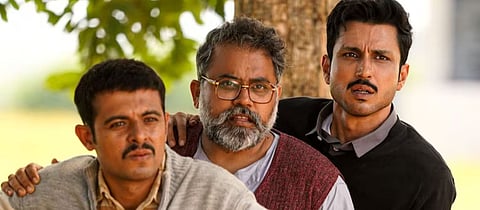


Needless to say, the creators of Gram Chikitsalay — a five-episode dramedy that revolves around an urban doctor (Amol Parashar, as Dr. Prabhat Sinha) who arrives to take charge of a derelict PHC (Primary Health Center) in rural Jharkhand — are also the creators of Panchayat. In recent interviews, they mentioned the term “Village Cinematic Universe,” a grounded TVF version of the Marvel Cinematic Universe or the YRF Spy Universe. The irony of the commodification of small-town life (featuring Gullak, Kota Factory, Aspirants) is lost on most, but that’s a formal complaint for another day. The streaming platform, Prime Video, is already a step ahead: its release of Dupahiya (a motorbike goes missing in a…Bihari village) in March marked the expansion of the ‘Cutesy Village Universe’ franchise: a nice cast, colourful personalities, curated nothingness, grassroots commentary, cultural tokenism.
If you reheat a dinner long enough, however, even the original taste begins to fade. Three seasons in, Panchayat itself would finish as the runner-up in a Panchayat-lookalike contest; Gram Chikitsalay is the sort of imitation that would sit in a corner, join the applause, but take the stage only after the contest. The analogy is specific to offset the genre fatigue. With Season 4 of the flagship series releasing in July, the timing makes this a fanfic palate cleanser. The fictional village is called Bhatkandi. It has a lazy compounder named Phutani (Anandeshwar Dwivedi), a spirited wardboy named Gobind (Akash Makhija), a hard-working nurse named Indu (Garima Vikrant Singh), the local quack (Vinay Pathak) whose clinic is always packed, a junior sweeper who works for a senior sweeper, a grumpy farmer, and other characters who insist on behaving like characters.
Prabhat is the new medical officer (“MO sir”). He peppers his angst with some English (and a Mokobura bag) to show he’s a cityslicker, then struggles to attract patients and connect with the soul of the place. The officers preceding him ran for the hills, so nobody quite expects him to stay beyond a week. Indu, Gobind and a next-door MO (Akansha Ranjan Kapoor, as Gargi) mention this often so that we know Prabhat is different. Even if it never shows.
Gram Chikitsalay is so Panchayat-coded that you can tell when it’s trying to be different and forge its own identity. For instance, the misfit-hero here is not a middle-class MBA aspirant looking for a bullet point on his CV; this isn’t a job-experience stint or a punishment posting. The backstory is that he cares too much. Prabhat is a gold medalist from a top college, has a dad who owns a private hospital, but chooses to work for the country. Basically, he’s an idealistic rich kid who wants to make a difference and defy his nepotism — the village becomes his wake-up call. He has the intent but lacks the execution, much like the show he occupies. Everything feels a little more performative: the episodic conflicts, the acting (especially the musicality of the accents), the moral-of-the-story dialogue (“you have to accept the place for it to accept you”), the brown-facing of the actresses, the general vibe. The setting (like the interiors of houses and the clinic) resembles one of those rustic-themed restaurants where the faded walls and utensils belong to a city museum.
The background score is pitched higher, as is the tone of a subplot that’s centered on a misunderstood mental illness. Prabhat soon rolls into the Aamir-Khan-in-Taare-Zameen-Par zone. The way this drama is staged — stormy skies, screechy violins, a 70s-prop look, tears and monologues — suggests that the show is so desperate to diverge from its source that it turns into a satire of itself. You can’t suddenly infuse the simplicity of the Malgudi-Days-ish oeuvre with a cinematic flourish. The gags rarely land, whether it’s an old man who asks for money to have his inflamed testicles operated on or Gobind explaining a ritual called ‘BJ’ to a shocked Prabhat. The mundanity doesn’t land either. At one point, Gobind launches into a boring anecdote about vegetables and his father, by the end of which I was so fried that I forgot the context of the scene. At another point, the farmer who dislikes Prabhat is summoned as an eye-witness, and his long narration is supposed to test the patience of his listeners. As a bonus, it also annoys the show’s viewers.
Even the trademark feel-goodness feels packaged and predictable — like when Prabhat wins the loyalty of the compounder by not reporting him for selling medicines; or when the local quack ‘educates’ Prabhat at a function in Munna Bhai-style for placing science (“so what if I don’t have a degree?”) over humanity (“my patients are like my family members”). This other doctor is presented as a greedy rival of sorts, but the speech comes out of nowhere. I’ve always liked Amol Parashar on screen, but his Prabhat is flattened by the derivative writing — his reaction shots and anxiety of being an urban saviour don’t add up to much more than the moments they’re in. The show spends too long trying to establish Prabhat’s battle to earn the trust of the villagers. A broken healthcare system only becomes a gimmick, because at no point does Prabhat behave like a brilliant doctor. He’s just a guy who happens to know important facts. Most of the supporting characters speak like they’re appropriating regions and dialects.
At the risk of sounding like a broken record, the TVF gaze is now a gentrified one. The novelty of sweet anti-stories has been replaced by the sanctimoniousness of a systemic voice. In Gram Chikitsalay, everyone is playing a type. There’s a condescension — a ‘country bumpkin’ tone — about such settings. The infantilization of villagers becomes a little tiring, because it’s the protagonist who ‘requires’ them for a transformation. Prabhat’s privilege is exposed when, in one episode, he participates in opposing political rallies to publicise the clinic. When the leaders arrive to bully him into dispensing favours, Prabhat reflects the social centrism of the TVF legacy: “I don’t have any politics, I just want to spread the word”. Prabhat could’ve been a wealthy heir who opens an NGO in a village averse to change, but the show insists — as in Aspirants or Panchayat — that he be a sincere state servant in service of its noble schemes. In short, there seems to be a patent on the cinema of everyday living. The emotions and coming-of-age arcs are branded. The craft might be visible, but the truth goes missing.