

On our school’s Sports Day, the inter-house cycle race — especially after the success of Jo Jeeta Wohi Sikandar — would be the most anticipated event. Excited students would line up the oblong track an hour in advance. It was a weekend finale of sorts; everyone wondered who the new ‘Sanju’ would be. It was all about the need for speed. But my favourite event was a relatively unheralded one: the slow-cycling race. I enjoyed the skill and balance required to reach the finish line last without stopping. The best of them would find ways to crawl, manage motion, and make the most of the track — a minute-long nutshell of life itself.
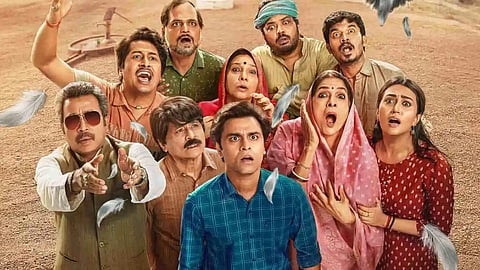
In terms of the Indian streaming landscape, Panchayat has been the ideal slow-cycling contender: a charming little exercise in mundanity, nothingness, the in-between moments of living, and lateral movement. It takes the longest possible route from one narrative beat to another, finding meaning in dry detours. The series expands time, staging the cultural conflict of a city-bred engineering graduate who starts working as a gram panchayat secretary in a remote village while preparing for his MBA entrance exams. There is no hurry, no ‘plot point,’ and every other episode seems to revolve around routine interactions that would’ve been reduced to side-tracks in other shows. It’s taken a considerable amount of skill to stay so still and still keep advancing. But Season 3, which dropped last year, showed a few cracks — the storyline zoomed out and started searching for broader arcs, political showdowns and louder stakes. It ended on a cliffhanger of sorts: pradhan-pati Dubey (Raghubir Yadav) is shot in his shoulder during a scuffle, and young Abhishek (Jitendra Kumar) leaves for his CAT exam amidst all the chaos. For better or worse, the show was growing up.
Season 4 of Panchayat inches towards the imminent village election and Abhishek’s CAT results — both within a day of each other. But the slow-cycling trick is now a bit old to watch: repetitive, stretched, shaky, darting sideways to avoid stalling. The trademark nothingness has mutated into a curated aimlessness, one that has more to do with extending the franchise than exploring its moods. The frictions with rival candidate Bhushan (whose cartoon-villain sound cue is cloying) and gang have a been-there-done-that vibe. There’s an Asterix-coded everydayness to their bad blood, but it becomes harder to stay patient with the disputes and sabotaging. Abhishek’s blossoming romance with Dubey’s daughter, Rinki (Sanvikaa), continues to be subdued, but his impending departure from the place is milked for ages. The MLA (Pankaj Jha) who backs Bhushan (Durgesh Kumar) continues to be excess baggage; scenes featuring him unfold as if they’re too shy to be dramatic and too unsure to be farcical.
I like that the controversial question of who shot Dubey last season is left hanging. He’s happy to use it as a political tool to gain sympathy and support. He is often accused of orchestrating the attack on himself. His greyness is shaped by a desire to stay in charge of his beloved village. In fact, the decisions of several characters — including Prahlad (Faisal Malik), Vikas (Chandan Roy), Manju Devi (Neena Gupta) and Abhishek — are driven by “what people will think”. At some point, Vikas and his wife even return Prahlad’s money because Bhushan’s wife questions the sanctity of their bond. The problem with this micro-drama is that the series fails to convince us that the village is bigger than these two factions.
Other than some head-nodding extras and dubbed whispers, there is no evidence of whose votes the candidates are fighting for. Whenever there’s a fight or an incident in public, it rarely earns the scale of a character feeling embarrassed or humiliated. They act like the whole world is watching them, but the place always looks too isolated to merit that kind of urgency. Given the production value, perhaps an illusion of a community with a voice — rather than stray references to the East and West Phulera, or its ‘border area’ — might have sufficed. Who are these residents? Do they exist beyond their many reaction shots? The geographical identity of Phulera has been an invisible presence over the seasons (the mental map of the water tank, office, bylanes), but this time, it feels like a set stitched together in the edit.
You can tell that Panchayat is conscious of monotony, and so it searches hard for emotional punches and impact scenes. The result is too visible: musical small-town-comedy-styled montages, sudden meltdowns, and dramatic scenes that almost always feel blown out of proportion. For instance, when Bhushan’s cunning wife (Sunita Rajwar; the Gullak-multiverse tone is deliberate) flings dirt at Vikas and Prahlad during her campaign, the tension between the two men comes out of nowhere; it’s resolved by the end of the same episode, not even letting the viewer process the randomness of the rift. Ditto for Dubey’s rants at home, which stem from a fear of losing the election. Or Bhushan’s minions shedding tears of happiness towards the end. Or even Abhishek’s drunken adventure in the first episode, where he sets out to apologise to Bhushan in the middle of the night. The few thematic gimmicks — a bratty boy studying with Abhishek during a power-cut; Manju Devi’s old father spending an episode being the voice of reason; a police raid; an endless and unfunny argument between the frustrated MLA and his boss — rarely land either.
Every now and then, though, there are glimpses of what turned Panchayat into more than a lockdown hit. Like an episode centered on the wavering loyalty of Bhushan’s right-hand man, Binod (Ashok Pathak). The simpleton is humanised during a dinner at Dubey’s house, where they try to wine and dine the man into spilling secrets and switching parties. The moment he realises they have an agenda, there’s a flash of heartbreak on his face — his sense of belonging is shattered. The beer-drinking camaraderie between Abhishek and the pradhan-trio is still endearing. There’s an unsaid solidarity between the four men that Abhishek used to resist in earlier seasons, back when he thought he was only a temporary guest in this Schitt’s Creek-coded setting. His love story with Rinki, too, resists a more mainstream rhythm; it feels inevitable and matter-of-factly, because he fell for her family before falling for her. Rinki’s lack of ambition isn’t judged. She quits her MBA preparation and drifts along as a young woman in transition. You’d think they’d be pushing her to get married in a patriarchal household, but the space she gets is a refreshing change of pace without being preachy.
But the overall body of Panchayat Season 4 is a fan-servicing, functional and hastily-crafted one. Subverting the expectations of the viewer — the way Season 2 did by refusing to cater to our notions of linearity — used to be its strength. Now it’s more of a commercial choice. Perhaps familiarity is the point, but in an age where Hindi long-form storytelling is miles ahead of their glamorous feature-length cousins, familiarity can breed contempt. An ordinary film today might feel great by virtue of comparison, but an ordinary series is no longer enough. The finish line is in sight for the franchise; there’s a sense of an ending. But it’s also in danger of becoming that one cyclist who breaks lanes and goes around in circles to finish first — by finishing last.