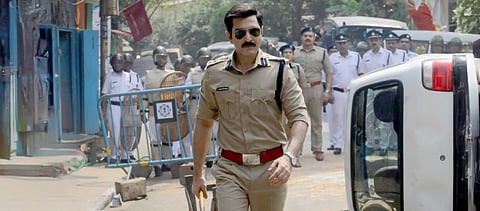


Like Khakee: The Bihar Chapter (2022), creator Neeraj Pandey’s standalone sequel Khakee: The Bengal Chapter represents the awkward second rung of crime thriller television — too trashy to be taken seriously, too serious to be pulpy, too long to be bingeable, and too predictable to be culturally specific. It’s more or less an old-school Prakash Jha potboiler stretched into long-form entertainment. A loaded ensemble and the illusion of a grassroots narrative are supposed to offset the generic tone, a cyclical plot and a repetitive landscape.
This time, the focus is Kolkata in the early 2000s, where a no-nonsense IPS officer arrives to clean up a city ripe with bloody gang wars, sinister politicians and confused cops. A reporter exclaims: “Is the City of Joy now the City of Bhoy (fear)?”. Thankfully, the show explicitly mentions the timeframe at some point, because this is the one city that makes it hard to distinguish a period setting from a modern one. Timelessness is an aesthetic here; I assumed it was 2025 until I spotted a character holding a Nokia 6600 (which still made it look like 2022). Unfortunately, rumours of a Sourav Ganguly cameo in this seven-episode drama remain rumours, despite there being plenty of scope for a princely outsider with shirt-twirling charisma leading a team of gritty underdogs.
The makers do pull off a casting coup anyway. The series is packed with big names of contemporary Bengali cinema. Jeet makes his web-series and Hindi debut as the honest IPS officer Arjun Maitra; Prosenjit Chatterjee plays the powerful ruling-party puppeteer named Barun Roy; Subhashish Mukherjee plays the Chief Minister of West Bengal and Barun’s trusty puppet; Parambrata Chatterjee appears as Arjun’s predecessor, DSP Saptarshi Sinha, whose murder sparks off a chain of violence and power grabs; Saswata Chatterjee features as Bagha, a dreaded gangster whose nexus with Barun Roy grows fragile. Most of these characters speak in Hindi for commercial reasons, but they sound vastly more comfortable during the throwaway Bengali phrases and emotions. Even as someone who doesn’t speak the language, I could tell that the stars become better actors when their gestures and gait match the environment.
When Arjun Maitra is summoned, Bagha’s two young henchmen Sagor (a striking Ritwik Bhowmik) and Ranjit (a Sanjay-Dutt-coded Aadil Zafar Khan) are already hostile successors in waiting, the ‘Ram Balram’ of the Kolkata underworld. In addition, Chitrangada Singh plays Nibedita, the dogged leader of the opposition party (“Bengal Democratic Front”) whose activism keeps Barun and his aides on their toes. The real-world parallels of these politicians and their outfits are not difficult to guess, though it’s a bit surreal to see them actually care for optics and react to criticism, public opinion and media interviews. The good old days, I suppose. The CM, Barun and gang spend their meetings sitting around an office, chain-smoking, whining and scheming to counter Nibedita’s latest questions; it’s why they appoint Arjun, an ‘anti-establishment’ cop, to shut her up. Arjun’s plan is primarily to turn all the kings and pawns upon each other and watch them self-destruct. It’s not a madly original journey, but it relies on the shock value of unexpected deaths.
For a series of such narrative scale, Khakee: The Bengal Chapter falters at a treatment and staging level. For starters, it inherits the Padmaavat-coded problem of the Bihar edition: the hero is extremely bland, almost boring, compared to the baddies he’s up against. I get that Arjun is morally upright, and I also get that his face should be unreadable, but it often looks like he’s a rigid mass hero stuck in a cat-and-mouse psychodrama. It’s partly a performance issue and partly by design. The ‘villains’ played by Prosenjit, Saswata, Ritwik and Aadil are meant to follow in the colourful footsteps of franchise predecessors Avinash Tiwary and Jatin Sarna, but Jeet’s Arjun is overburdened by the idea of aura and screen presence. He does little more than show up. There are times his stiffness works because at no point do we know what the stoic character is thinking or feeling. Every move of his becomes suspenseful by default.
The other weak links in the cast aren’t as prominent. Chitrangada Singh’s Nibedita is reduced to a protestor yelling into the camera in every other scene, while Mahaakshay Chakraborty’s Himel — the bulkiest of Arjun’s team members — struggles to justify his value beyond a film-school-level twist. Himel is one half of a framing device that involves another cop; their conversation allows the series to be narrated in flashback (and flashback within flashbacks when Bagha’s origin story is recalled by a policeman), and one of them is supposed to be the mole. Needless to say, this trick doesn’t end well for anyone — including the audience. Then there’s the strange action choreography; a bunch of outdoor chases, murders and gunfights make the cardinal mistake of looking like they were devised in 2002 instead of looking like they’re happening in 2002. The blocking of shots and clunky sound mixing leave a lot to be desired. The choppy editing doesn’t help matters. Every moment unfolds as if it’s being rudely suspended in pursuit of pace; there is no rhythm to the fadeouts, and few frames are allowed to breathe.
There are some cosmetic flaws, too. The title track sounds like an item song that’s forced to behave itself; “Ek aur rang bhi dekhiye Bengal ka” (experience a new shade of Bengal) isn’t exactly a catchy hook for a show like this. If the intent is to make it resemble a political slogan with an identity crisis, the mission is still not accomplished. The background score collapses into a wolf’s howl every time a light-eyed Ranjit — the loose cannon — appears in a shot. When not complaining to reporters, Nibedita spends her time weeping by the bedside of a comatose friend; the man doesn’t age a day and he could be taking a power nap. An organ trafficking racket is abruptly shown; the production value glitches, and human skeletons start to look like the plastic props they are. Both Arjun and Saptarshi set up emergency hotlines for citizens to call with anonymous tips; their Special Investigations Team (SIT) seems to follow these tips without any due process, verification or doubt. The story may not have the patience for routine and grit, but it’s hard to root for the authorities when they depend entirely on the early-2000s version of Reddit gossip.
One of the episodes features a grief-stricken and vengeful Sagor hunting down a gang he used to work with. It’s a gruesome little passage. The political bosses want to take him down, he wants to take his former best friend down, Arjun wants to take his own replacement down. It’s in these parts that Khakee: The Bengal Chapter gives us a glimpse of the show it imagines itself as. But then we see the protagonist of the series — the metropolis of Kolkata — on high alert, yet relegated to a background featuring news anchors, neighbourhood names and lethargic extras. The energy is flat and not a single frame bristles with detail or urgency, which is quite a feat for a place of deep character and history. The younger actors try their best to steal the show, but the writing is rigged against them. And if there’s one thing we’ve learned in reality and fiction, it’s that seniority is India’s everyday religion.
At some level, Khakee misses the mark by definition. In a streaming era crammed with good and bad police procedurals, it is only interested in staying watchable. Or in other words, playing it safe. It rarely rises above its regional gimmick. Technical slickness and social curiosity don’t figure in its agenda. At times, it almost remains basic to defy the Paatal Lok(s) and Black Warrant(s) of the world, but it also remains functional to be a counterpoint to the Indian Police Force(s) of the universe. By that yardstick, this second-rung Netflix space is a whole new sub-genre — one where high expectations are the crime and low expectations are investigated. Given the period and theme, though, Khakee: The Gujarat Chapter might be a difficult pitch. My bet is on The Maharashtra Chapter delving into the production of Khakee (2004), a Rajkumar Santoshi thriller so politically alive that not even the Bollywood re-release roster can bring it back.