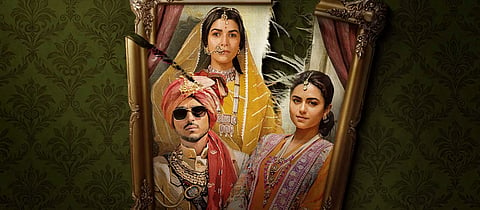


Kull: The Legacy of the Raisingghs opens with a bloody corpse floating in a palatial pool. The senile King of Bikaner, Chandra Pratap Raisinggh (Rahul Vohra), has been murdered. The butler did not do it. As is the template, we learn of the days and circumstances leading up to the tragedy. The next three episodes revolve around a birthday celebration gone wrong, lots of wheeling and dealing, and of course, a dysfunctional and greedy family. Everyone needs money, nobody is happy, and almost nobody is sad that the old man popped it.
There’s the oldest, Indrani (Nimrat Kaur), in a lavender marriage with the Chief Minister’s gay son, Vikram (Suhaas Ahuja). There’s Kavya (Ridhi Dogra), the pensive one handling the property; she’s having an affair with the videographer (Arslan Goni) who’s filming this royal family for a streaming platform. There’s Abhimanyu (Amol Parashar), the coke-addicted and bratty prince who addresses an indulgent Indrani as “maa” (mother). And there’s Brij (Gaurav Arora), the king’s illegitimate son and the only loyal royal around. A cocky CBI officer named Bhagwan (what else?) arrives, sorts through the fresh characters and the raw footage, and the killer is revealed as early as the fourth episode.
All this is fine. What I cannot shake off is the fact that the pool is never cleaned and drained of its water after the discovery of the dead body. A child and adult are seen frolicking in it before the funeral. Is this some sort of royal quirk that I’m not aware of? Is it some twisted way of preserving a ‘blue’ bloodline? Forget hygiene, is there a thought process that compares this to the holy act of taking a dip in corpse-and-sewage-infested rivers, or the domestic act of swimming in urine-infested public pools? Another stabbing in this pool bookends the narrative, because trust a royal household to kill as extravagantly as they live. Nobody cares about the small fortune it costs to replace that water; why can’t they murder like normal people, you know, in a courtyard or a toilet? It’s a small and inane detail, but one tends to get sidetracked by these things when the show itself unfolds in only a handful of ornate locations (which also includes the library of Mumbai’s St. Xavier’s College). The expensive blood-in-water shots try to offset the lack of visual diversity. The Rajasthan hangover is so strong that every time a car goes somewhere, it lands up speeding through the middle of an exotic desert.
Now that I’ve gotten the pool out of my system, let’s get to the actual storytelling. Director Sahir Raza’s previous series, Doctors, felt like a lesser iteration of Mumbai Diaries, and Kull seems to happen in the same aristocratic-family-feud universe as The Royals, Saas Bahu Aur Flamingo and Aarya. It’s not as flimsy as The Royals or as incoherently gritty as the other two (there’s a Rajasthan Royals joke somewhere in there). The problem of this Balaji Digital production is that it’s neither total-Balaji nor full-digital; it occupies that awkward middle ground between a tonal soap opera and a thematic OTT drama. The TV algorithm dictates that every episode ends on a cliffhanger, even if it compromises the overall plot and rhythm. At times, it feels like the last shot is conceived first and the rest of the episode — the bickering, conflicts, power struggles, internal politics — is then reverse-engineered into existence.
There’s a needlessly elaborate backstory about the king and his secrets halfway through. It’s hard to keep track of all the names and sins. The incessant scheming and shifting allegiances get a bit exhausting, as if Succession were forced to buy an India Tourism holiday package. There’s also a sudden 5-year jump after an accident, which allows the series to cram in two seasons and timelines for the price of one. It’s not a bad idea on paper, because it lets the future be haunted by the events of the past. But it feels like a copout to avoid dealing with the immediate consequences of the incident. The writing seems to be aware that there’s not a single redeeming trait in any of the characters, so the revelations and twists keep coming to make up for the lack of depth. When in doubt, leap half a decade.
That said, Kull does have its merits. It’s the sort of series I might end up watching on a slow weekend even if I didn’t have to write about it. Not because it’s good, but because its cast does the job. Right from Rahul Vohra’s cameo as the Alzheimer’s-afflicted king to Ridhi Dogra’s catty annoyance as Kavya and the swimming pool’s dignified silence, the performances shape the chaos of the plotty household. I particularly like Nimrat Kaur as Indrani, the de-facto protagonist whose weakness is her affection for a toxic kid brother. Indrani has the fullest arc of the lot, and Kaur flits between moods and phases of the character as if she’s playing different women with different people. At one level, she’s the oldest and most maternal sibling, but at another level, she’s breaking the chain of patriarchy by morphing into the very men that have infected the palace walls. Kaur has an alt-intense screen presence that’s been wasted by mainstream Hindi cinema, so it’s nice to see her chew up scenes and forge chemistry with everything (including portraits, walls and ghosts of children).
I also like the uncharacteristic meanness of Amol Parashar’s Abhi, a vile young man who’s barely protected by his heritage. It’s not easy to weaponise a babyface (ask me) and subvert the nice-guy image that TVF’s recent Gram Chikitsayat deployed so dryly. But Parashar does the high-pitched masculinity well, committing to a sort of primal wildness that defined Divyenndu’s star-making turn as Munna in Mirzapur. He’s had a big few streaming weeks; one can only hope that this versatility changes the way storytellers view him. It’s true that both Kaur and Parashar belong to a better, more curious and less derivative series. But perhaps a middling Royal Mess is better than an unwatchable Royal Mess. The bar — currently stocked with props of 18-year-old Scotches and other regal drinks — is low. Now excuse me while I renew my expensive swimming membership and pretend that nobody bled in that pool.