

Mercy is like that enthusiastic science geek who tries his hand at art, has little aptitude for it, but is indulged by his elders because who’s going to criticise a kid? He’s in the wrong line, but hopefully his hobby is temporary. The movie belongs to a culturally specific subset of independent Hindi cinema: the simplistic social drama that plays mainly at South Asian diaspora international film festivals. It’s mostly the representation pick, the anyone-can-tell-a-story draft, the identity-over-merit selection. The symptoms are familiar: beginner-level craft, questionable performances, a bleeding-heart subject, actors who are also the producers (or vice versa), a semi-famous cameo, an early-2000s indipop music-video vibe, and a storyline at odds with a hummable album.
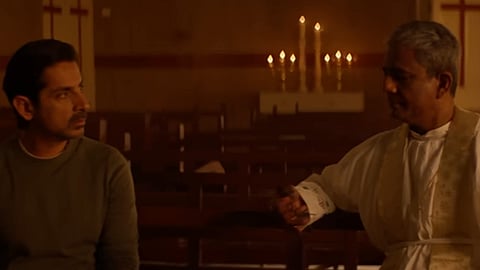
The theme of Mercy is passive euthanesia (Guzaarish fans will pronounce it as Ethan-asia, of course). It revolves around a 30-something man named Shekhar (producer-actor Raj Vasudeva), who is faced with the crushing decision of whether to let his comatose mother (Aparna Ghoshal) die. The narrative is absurdly non-linear. It opens with Shekhar asking for guidance from the local priest (Adil Hussain, brandishing a God voice), before flashing back 25 years to the time Shekhar was a kid who resented his mother for putting their injured dog down (foreshadowing much?), before flashing forward 24 years to show Shekhar and family at a dinner where he fights with his younger brother (Kunal Bhan) much to his mother’s dismay, before flashing forward nearly one year to show Shekhar visiting his comatose mother in the hospital (the visual ‘twist’ is that he arrives with his heavily pregnant wife, fooling the viewer into thinking it’s a routine checkup until his paralysed mom becomes a reveal), before connecting back to that priest scene in the beginning. That’s a lot of back and forth. It’s unnecessary for a script that could have done with emotional continuity. It chooses to ping-pong between timelines and mental spaces to offset its inherent lack of depth. The gimmick is strange for a film about inner conflict, guilt, anticipatory grief and familial trauma.
Mercy unfolds like the kind of film that stems from the life experience of watching other films. The tropes are too curated to be interesting. Take the character of the priest, who orates to Shekhar like an echoey self-help module. Or the random character of a street-dwelling orphan, who appears and drops a few adult pearls of wisdom (variations of “we must make the most of the time with our loved ones” followed by a “saheb”) as if he’s the priest disguised as a child. Or a moral-of-the-story anecdote narrated to Shekhar about an old couple, where a paralysed wife takes her own life to stop being a burden on her loving husband. The whole world is conspiring to be Shekhar’s unofficial therapist. It’s a wonder that a tree didn’t start patting Shekhar’s back as he forlornly ponders about whether to pull the plug. One of the final moments features two brothers hugging on a bench at magic hour. The acting by the younger one is so affected that you can tell how clearly Hrithik Roshan’s cute lunge in Kabhi Khushi Kabhie Gham is the reference.
I do like that it's the younger sibling, the immature drifter, who has the more practical opinion of letting the mother go and liberating her from the pain. Shekhar is the responsible adult, but he's the irrational one about keeping an ailing parent alive for his own heart. But there’s the old habit of tying up all of the protagonist’s problems — an estranged brother, a wife who wonders if he wants a baby at all, the financial toll — neatly into the central theme. We’ve seen movies do this for decades. The idea is that his decision will set him free, fixing all the other issues in one fell swoop. If only life were that merciful. Mercy doesn't have the guile to pull it off. It's clunky at best, despite a soundtrack (and background score) that tries to belong to a more accomplished film. You can tell, though, that the songs have been shoehorned into a tonally different story; the brother is introduced as an angsty singer so that a lilting rock ballad can appear in the end credits. And it's never a good sign when all I can offer at the end of an allegedly heavy drama is: “the music was decent”.