

One of my pet peeves features Hindi cinema’s toxic relationship with technology. You know how, in the middle of a public event, every single cellphone in the hall simultaneously beeps with a headline alert because the famous person it’s about is also present? Everyone turns to dramatically look at this unfortunate person; whispers and gossipy glances hijack the scene. This is how news spreads in such stories. It can be at a press conference, a panel discussion, even at a party. In Mithya: The Darker Chapter, it’s at a business auction that comes to a standstill. My questions are simple. How is it that nobody’s phone is on vibrate mode? Why are the shock and awe so coordinated? Why is it that no other message or app on the phone has a pop-up sound? The closest I’ve experienced as a real-world viewer is when, during a press screening of Super 30 (2019), most journalists in the hall audibly gasped when Dhoni got run out in that World Cup semifinal.
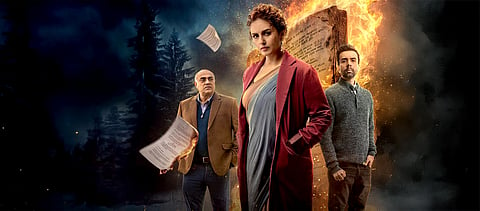
Now that I’ve gotten this out of my system, back to business. Based on the British TV series Cheat (2019), Mithya: The Darker Chapter is the follow-up season to Mithya (2022), a corny thriller revolving around an honest literature teacher (Huma Qureshi, as Juhi Adhikari) and her unhinged student (Avantika Dassani, as Rhea Rajguru) who, ultimately, turn out to be half-sisters. The first season ends with Rhea getting arrested for the murder of a pregnant Juhi’s husband, after their dad Anand (Rajit Kapur) atones for his sins by choosing the nice daughter over the illegitimate one. The setting is Darjeeling, yet another hilltown reduced to an atmospheric template by the streaming-era algorithm. Season 2 unfolds a few years later. Juhi is now an author whose debut book, Dhund (“fog”), is a bestseller; she is a single mother who lives with her parents in a cottage that looks like it’s run by an Airbnb superhost; she is also about to start afresh with her son in faraway Oxford as a Hindi professor. All is well, until Rhea returns from jail (as if she was on a hipster sabbatical) for a new round of revenge and robotic swag, while a small-time writer named Amit (Naveen Kasturia) accuses Juhi of plagiarising his work. Naturally, the two are connected.
In theory, The Darker Chapter has some interesting ideas. The six-episode season attempts to blur the lines between the two women; it lives in a space of moral ambiguity. Rhea becomes the Joker to Juhi’s Batman — not a sentence I thought I’d write here — as both hero and villain start to resemble two sides of the same coin. Juhi’s journey may or may not include staging a fake kidnapping to frame Rhea, attempting to kill, leading the police on, a resurfacing of past infidelity, and her going a little cuckoo. There’s the arc of Anand, the father responsible for everyone’s daddy issues, who is finally held accountable for being a man. He gets consumed by guilt in a story that exposes his complicity in the undoing of his family. Cheating as a form of generational trauma, too, echoes the core of Gehraiyaan (2022). Rhea is driven by a desire to belong — she wants to punish her dad rather than her half-sister — as much as an inherent bitterness for adultery. Everyone cheats: Juhi’s late husband, Juhi, Anand, Juhi’s colleague Vishal, Rhea’s comatose aunt, probably the dog and cat too. I also like that Amit’s writerly bitterness is exploited; controversy becomes his claim to fame.
However, theory is as far as this series goes. It fails all its themes in a mainstream heartbeat. The treatment remains unserious. When we see Rhea come back to Darjeeling, for instance, her ‘entry shot’ as the new trustee of the university is framed as a slow-mo walk from so far that Juhi’s shocked reaction wears off by the time she reaches the stage. Avantika continues to play Rhea as a vamp of sorts; it’s a stilted and uncomfortable performance that’s at odds with the mental complexity of the woman. The cops remain blissfully incompetent; the new investigating officer keeps wondering why nobody in the town cares for the murder of a rich tea estate owner, while her subordinate is readily satisfied (without any proof) with a suspect’s alibi of watching a Salman Khan movie. There are the usual B-movie oddities — like how Juhi’s voice becomes whispery in a confession when the flashback is shown. Or how a character’s makeup game stays fashionable (style: Deathly Elegance) on a hospital bed. Huma Qureshi is watchable, particularly when Juhi reaches the brink of insanity, but the actor is shackled by the mutations of the simplistic script.
The crimes go beyond the screen. The cat-and-mouse game murders the linearity of the narrative. Everyone becomes a schemer in quick succession. Rhea tries to destabilise Juhi’s family and life, then Rhea’s helper goes rogue and becomes the new villain, then Juhi does some plotting, then Amit pretends to join forces with one of them to bring down the other. Then someone dies; I’m not sure who. All along, Juhi’s poor infant suffers because nobody knows whether he’s kidnapped, dead, both or none. Characters flit between good and bad so abruptly that, storytelling-wise, it’s like watching the cat and mouse having an identity crisis and going all Freaky Friday on each other. At various points, the series sympathises with Rhea for being a victim of parental neglect, conveniently forgetting that she is still a psychopath responsible for the deaths and unraveling of multiple people. Every episode closes with a flash-forward of a dramatic twist, which is the show’s way of begging the viewer to stay. It’s not a smart gimmick, given that “3 days later” often has to be followed by “2 days earlier” in the subsequent episode.
Now for my pettiest of pet peeves. The writing of The Darker Chapter rivals the writing in it. Hindi cinema is not exactly known for authentic, or even agreeable, depictions of authors and literary cultures. Forget the passing mentions of Jaipur Lit Fest or random awards called “Best Debut Author Of The Year”. Juhi’s novel, Dhund, is subconsciously based on the battle between the half-sisters; the book’s student-film-like premise is centered on a character who is revealed to have dual personalities. Its final passage is: “It becomes evident that they are two facets of the same person”. So much for trusting the reader. It sounds like a shoddy review of the book rather than an actual line in it. Never mind that Amit’s short story that Dhund allegedly rips off is called Man in the Mist: The Light Within. Later on, he starts a manuscript called Reflections: An Illusion Called Life.
When Amit quotes his favourite author whose words guided him through a difficult childhood, he goes: “Stars are phoenixes rising from the ashes. How can you rise if you haven’t burned?” Is it pulp fiction, a pretentious student essay, or an emo Facebook post written by surgeons who think they are poets? Why is it that films or shows about writers have no clue about what proper writing looks like? The irony never ceases to amaze, or in this case, it never ceases at all. It’s a bit like me ending this review with a line like: “Mithya: The Darker Chapter is a grand celebration of mediocrity, a lost marble that masquerades as a fiery planet barrelling through the cinematic solar system in defiance of gravity and logic”. If I were a character in the series, I’d have won the Booker Prize, the Nobel Prize in Literature and the Pulitzer Prize for TV criticism by now.