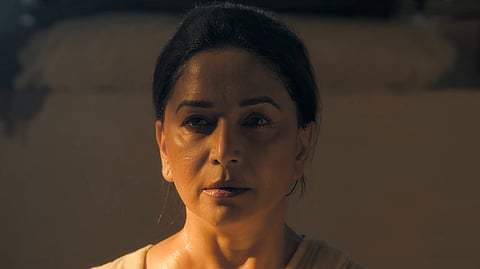


Nagesh Kukunoor’s had quite the year: an uncanny performance in Paatal Lok 2, the maker of the meticulously dramatised The Hunt: The Rajiv Gandhi Assassination Case, and now the director of a series in which Madhuri Dixit plays a serial killer. It's no small deal, particularly because Dixit's role in and as Mrs. Deshpande feels like a spiritual sequel to her role in Anjaam. This six-episode series is based on a French thriller called La Mante, but Dixit’s homemaker is very much the future of that vengeful widow who slaughtered all the evil men that ruined her life. As a character, Mrs. Deshpande is less personal and, in keeping with the times, more patriotic. The stillness about her borders on inertia. Her vague modus operandi revolves around finishing off societal villains like paedophiles, rapists and corrupt politicians. (Add film critics to her list this month). An ethical vigilante of sorts, the show opens with the middle-aged woman being summoned from Hyderabad jail when a copycat killer seems to be on the loose. The style of murder is hers, so she is the only one who can help an absurdly trustful police team to solve the case. A young inspector named Tejas Phadke (an awkward Siddharth Chandekar) leads the investigation, and he's very suspicious of Mrs. Deshpande — who has renamed herself as Zeenat — and her chequered history. He takes a while to warm up to her in the safehouse. She loves cooking for everyone, but he wonders what plan she’s cooking.
The edgy premise arrives on a readymade platter. It's harder to mess this up than have some dark fun with it. Yet Mrs. Deshpande is so preoccupied with being accessible and algorithm-friendly that the result is flat, devoid of personality and strangely sanitised. It's very consumption-oriented in terms of the OTT landscape; the cultural translation, too, remains generic and incurious despite the Maharashtrian slant. She's out of jail after decades, but the toll of isolation is barely visible except for a passing scene where she’s fascinated by a smartphone. It's a pity, really, because it takes some doing to nullify the idea of female rage and weaponised domesticity in a patriarchal setting. There's so much to mine and explore, but the show reduces its big swings to a series of small misses.
It's never a good sign when the opening scene features a young and deviant Bollywood star saying “order two Russians” into his phone before breezing into his drug-addled penthouse for a night of debauchery. Of course he's a goner. One of the problems with the series is this simplistic staging — the business-like tone worked in a chatty and sweeping procedural like The Hunt, but you can tell that Mrs. Deshpande is produced in a hurry. It’s like every scene is taken hostage and threatened until it conveys some information, action or drama. The buildup and exposition lack spontaneity, which was an issue with Kukunoor’s generational politico thriller City of Dreams too.
What this does is also expose the plot without any cushioning. For instance, it rings hollow when Mrs Deshpande keeps feeding the cops, lulls them into trusting her, drugs them to escape at some point, but is promptly put back on the case once they realise her intentions were maternal (she only wanted to meet her estranged son’s family, you see). Nothing like a sanskaari serial killer. It's also weird when the series introduces one red herring after another: clumsy false alarms to keep the story going at any cost. The film-making stages the ‘suspects’ in such a deliberate manner that you instantly know it's trying to fool the audience. The police pursue these fake leads like they're amateur online sleuths chasing conspiracy theories. First it's a nutty follower named Hosh, who's seen with ropes and potential victims repeatedly until his exchange with Mrs. Deshpande reveals him as a fraud. Then it's a shady family member from the past, who randomly shows up and behaves like a creep only to act totally normal once it's obvious he's not our guy. It's like the story keeps playing mindgames with itself.
Amidst all the narrative chaos and unreliable flashbacks, the real offender remains on the loose and Mrs. Deshpande herself continues to communicate everything — including anger, relief and grief — with a patented half-smile. The series fumbles both her character and the performance, largely because it's not brave enough to go all Silence of the Lambs on us; it simply refuses to stage her as a cold-blooded woman addicted to a life of chilling crimes. The gaze is male and ironic, almost as if it's trying to veil the nakedness of her intent. It goes out of its way to justify and Indianise her motives (she compares herself to cops and soldiers at the border), because God forbid she's just an unhinged person doing unhinged things. She would've been infinitely more interesting as a morally empty sociopath who treats conscience as a toy. It's a lost opportunity for both performer and adapted script, particularly in context of how even female criminals in such stories are forced to be homely, socially meaningful and plausible. A lot of it is down to the casting (which has a lot in common with Kajol’s recent roles), but the woman's vigilantism often feels like a crutch to humanise her agency.
Finally, the identity of the copycat killer — along with that elaborate face-to-face explanation — makes for a lazy and irresponsible twist that we've seen too often in Hindi whodunits. (Think Prachi Desai sporting a moustache in Forensic, or the effeminate ‘villain’ of Kaala). It's 2025, and the demonization of LGBTQ+ characters is still used as a trope to fetishise the trauma of the classic misfit. Mrs. Deshpande is guilty of the same, and almost as if to cover its tracks, it then chooses to end on a note of violent closure for its protagonist. It's like the copycat subplot was merely a ruse to let the housewife finish the job: gimmicky in theory, awkward in execution. At this point, there are glimpses of Dixit’s madness from Anjaam, back when big-screen emotions weren't always afforded the messiness of a feminist revenge spree. To imagine that even a serial killer grows old to conform to stereotypes is to acknowledge the dying risks in the modern OTT landscape. You don't even need a serial killer to murder those risks. All it takes now is an old TV aesthetic posing as a new one.