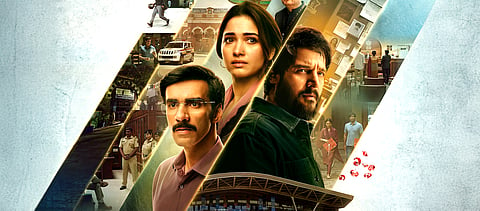


For Tarantino, it’s the foot shot. For Rohit Shetty, it’s the drone shot. And for Neeraj Pandey, it’s the walking-talking shot: unbroken over-the-shoulder and full-frontal shots of self-serious men striding in and out of spaces, between rooms and corridors, between people and objects. Cops walk. Robbers walk. Waiters walk. Dogs walk. Thoughts walk. The air walks. No cinematographer finishes a schedule unfit. Basically, walking equals narrative momentum. Pandey is a master at making it look like something is always happening even when nothing is — but not in a good way.
In Sikandar Ka Muqaddar, the background score is an extension of everyone’s busy legs. It’s like a gym membership for film-making. No moment is allowed to exist without a sense of urgency and emotional cardio. A man moving in with his girlfriend cannot be just that. The glum man leaves his house — tense music suggests that his next step is a mystery. He knocks on a strange door — the music reaches a crescendo. The girlfriend opens the door and they both smile — soft anti-climactic piano takes over. The shortest of scenes are forced to have three acts. A character so much as breathes, and the aggressive score asks: is he really breathing? I paused the movie to fix myself some dinner, and the music in my head asked: wait, is the rice burnt? I take a restroom break, and the music asks: is his kidney failing? You get the gist.
The setup is almost interesting. In 2009, four priceless solitaires go missing from an exhibition during a raid. After a lot of walking and talking and smirking, top cop Jaswinder Singh (Jimmy Shergill, in the most Akshaye Khanna role possible) arrests three suspects: single mom Kamini Singh (Tamannaah Bhatia), gem trader Mangesh Desai (Rajeev Mehta) and computer repairman Sikandar Sharma (Avinash Tiwary). Jaswinder insists that his “mool-vriti” (instinct) is legendary. He is convinced that Sikandar is guilty; he detains him to squeeze out a confession. The film jumps to 15 years later: Jaswinder is an alcoholic who gets fired and divorced on the same day. His obsession with the unsolved diamond heist has cost him his sanity. The implication is that his mool-vriti was wrong. He calls Sikandar — now settled in Abu Dhabi — to accept defeat. Sikandar takes a flight back to hear his apology in person. The two men meet at a terrace dive bar, and as they chat, the film grins like a Cheshire cat and reveals how both their lives have been haunted by that event. The stigma has ruined them, but male egos have persisted.
The premise of Sikandar Ka Muqaddar is an extension of its 10k-steps-per-day score. The whole thing is shaped as a giant question mark: Is Sikandar innocent or is he great at pretending to be innocent? You’d think the film would choose to be a blurred-lines morality thriller. Imagine if he was innocent but the cop’s crazed pursuit turns him into a criminal: two sides of the same coin and all. But complexity is a (foot) bridge too far for this film. The casting gives it away. The acting (Tiwary clocks ‘intense’ on the scale of 1 to Laila Majnu) gives it away. The title gives it away. The name gives it away (there’s “win” in Jaswinder). The writing gives it away. The flashbacks show that the court case led Sikandar to fall in love with fellow suspect Kamini, move to Agra to start a new life with her, then move to Abu Dhabi to start a newer life, all this while facing constant setbacks every time he thinks he’s fine. The red herrings are redder than the flags that the female characters in this film are. At one point, Sikandar finds out that his colleague — a potential love interest — was a bar dancer in her past. His paranoia drives her away, but when he sees her years later, he mentions that he’s going to meet Jaswinder. When she gets annoyed and asks who Jaswinder is, he says: “He is my dance bar”. She grins. Forget homoerotic tension, this is slowmo-erotic tension.
All the Neeraj Pandey-isms aside, Sikandar Ka Muqaddar has a massive Netflix problem. The recent Kanika Dhillon-created thrillers — like Do Patti and Phir Aayi Haseen Dillruba — are composed entirely out of corny twists, twists within twists, and twists within twists within twists. The one-upmanship and one-upwomanship keep happening in an endless loop. No viewer walks away without trust issues; even when they reach home, they wonder if home itself is a conspiracy. This film does the same. It has no intention of quitting before duping its audience. One character says he knew all along. The other character says he knew that he knew all along. Then it turns out that the first one knew that he knew he knew all along. Everyone knows everything.
There is no end to this — quite literally. In what is a first for an allegedly serious film, a “The End” slate appears in comic sans, only to be followed by an “Oops”. Then the film goes on for another 20 minutes, with an added climax that unfolds like an unwanted post-concert encore. When Sikandar Ka Muqaddar actually does end, it’s so abrupt that the “Oops” now appears before “The End”. You can’t make this up. It made me feel like I was a 13-year-old boy watching a gimmicky high-school stage production. How can the screen say “Oops” to me after 142 minutes of artificial fakeouts? Imagine if Inception inserted an “Oops” after the ‘Directed by Christopher Nolan’ credit only to show the totem spinning and falling. Imagine if I randomly end this review here and say “Oops.” I may as well do it in Hugh Grant’s voice: Whoopsie-daisies!