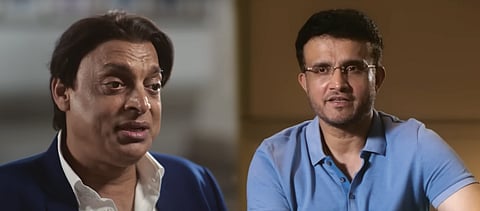


The series starts with Virender Sehwag saying, “Bharat-Pakistan ka jab bhi match hota hai toh kewal bat aur ball ka nahi hota hai… usse bhi bada hota hai” (Whenever India-Pakistan are playing a match, it’s not just with the bat and ball... it’s always more than that). And you think to yourself, “Okay, I see what he’s alluding to”.
Shortly after, Pakistani cricket commentator and former cricketer Ramiz Raja says, “I think it’s the political garnish that makes this rivalry world class," as they show us glimpses of war and the Beating Retreat ceremony at the Attari–Wagah border, and you think to yourself, “Okay, a bit more on the nose... but I see what he’s saying”.
Later, Shikhar Dhawan says, “India Pakistan ka match ek jang se kam nahi hai” (India Pakistan matches are no less than a war), followed by Imran Khan quipping, “People were dying for the two countries to play against each other."
To top it all off, we have Shoaib Akhtar going, “Jab hum match dekhne jaate hai (India vs Pakistan) toh woh emotions blast ho jaate hai” (When we go to see an India vs Pakistan match, our emotions explode)
All of this is said before we even see the title of the first episode; it’s a teaser for all the fervid things that are going to be shown and said later in the series. Finally, the credits roll showcasing a cricket pitch on fire and ‘Episode 1: Rise of the Legends’ begins.
While we are shown glimpses of what happened back in the 1983 World Cup up until the “Kohli goes down the ground, Kohli goes out of the ground” event (yes, that’s what India's T20 World Cup match against Pakistan in 2022 is now known as), the main focus of the documentary is on the cricket matches that the two countries played in the mid 90s up until the late 2000s.
The pièce de résistance is the 2004 Samsung Cup Series, that took place in Pakistan. Which means that you get to hear stories from icons of the sport like Virender Sehwag, Shoaib Akhtar, Waqar Younis, Sourav Ganguly and the like. However, there’s no sign of Sachin Tendulkar, Mohammed Kaif, Shahid Afridi or even VVS Laxman, each of whom played an important part in the series.
Like Netflix’s The Roshans, this documentary too takes the liberty to recreate visuals of the stories being narrated, adding to the already dramatic tone. At one point, they even get someone to recreate the commentary from Pakistan’s World Cup winning moments in 1992... which just sounds wrong.
However, the moments when the real footage is shown is when The Greatest Rivalry: India vs Pakistan is most effective. For instance, the BCCI office in Mumbai was trashed by political activists upon the announcement of the Asian Test Championship and Triangular One-Day series, and the makers show real footage of the broken glass, a worker sweeping it off the floor, and the damaged 1983 Prudential World Cup trophy. The embodiment of a glorious achievement, tarnished by the powers that be. Somewhere in those visuals is a larger meaning that does more for the documentary than the re-enacted scenes ever could.
While episode one feels like an exposition — one where not much time or importance is given to anything or anyone — the second episode is where the show finds its beating heart in the dichotomy that is the relationship between the two countries and what the sport means to their people. There are beautiful visuals of Indians travelling to Pakistan and meeting long lost friends and family that shine a bright light of optimism, even if it is only momentarily.
As far as the cricketing stories are concerned, one wishes that the makers focused more on the actual games, rather than trying to balance the politics with the sport and getting stumped in doing so. Similarly, an important topic like the abuse faced by India’s Mohammed Shami after their loss to Pakistan in the 2021 T20 World Cup is brushed over in a matter of minutes as if it were a token acknowledgement.
For the ardent cricket fan, there is little on offer, for the stories that the players narrate have been told many times over the years. But for someone that isn’t from the subcontinent and is looking for a gateway into the sport, this documentary might be a decent watch.
Ultimately, there were a few scenes that made me want to celebrate like Sourav Ganguly on the Lord’s balcony, but many more that made me feel like that disappointed Pakistani uncle.