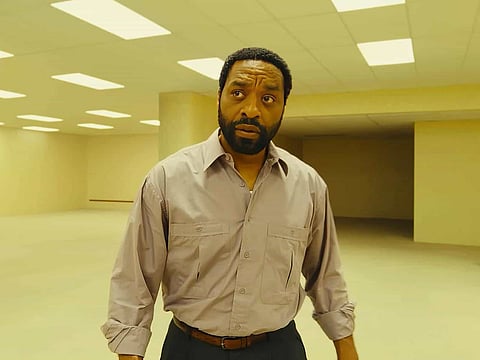


Trying to explain Backrooms (2026) is a bit like the challenge Clark (Chiwetel Ejiofor) describes to his therapist, Dr. Mary Kline (Renate Reinsve), early in the film: it's like describing a dog to someone who's never seen one before. You can list the features, outline the shape, explain the behavior — but the details never quite add up.
Kane Parsons' feature directorial debut resists explanation. It's one of those films you have to experience for yourself because any attempt to summarise it feels inadequate.
The film isn't especially gory, nor is it relentlessly violent. What makes it unsettling is something harder to pin down: the dread that hangs over every scene, the feeling that something terrible is waiting just around the corner.
The same reason why Edvard Munch’s The Scream remains unsettling almost a century later; the painting itself isn't particularly scary, but what unnerves us is that we never learn what the figure is screaming at. Our imagination fills in the blanks, and that’s often worse than any monster shown on screen.
The opening sequence is particularly effective. Shot with a shaky handheld camera, it creates the uncanny sensation that we've wandered into the backrooms ourselves. For the uninitiated, the backrooms are a kind of liminal space: endless yellow-lit corridors, nondescript rooms, and furniture that seems to have been arranged by someone who hasn’t seen the real world, but only heard of it.
The result is a space that feels familiar enough to recognise and strange enough to fear.
Clark, the owner of a failing furniture store, has practically moved into the business after his wife throws him out. He drinks too much, carries too much regret and seems trapped in a life that's shrinking around him. Mary, meanwhile, has her own ghosts to contend with, from the loss of her daughter to the trauma of growing up with a schizophrenic mother.
One of their conversations touches on neural pathways and humanity's tendency to follow the path of least resistance. It's an idea that quietly echoes throughout the film. When Clark discovers the backrooms beneath his store, curiosity becomes that path. Rather than walking away, he keeps moving deeper.
At first, these rooms resemble an abandoned office building cluttered with forgotten furniture. But almost immediately, signs appear that something is deeply wrong. A stop sign stands where it shouldn't. A dead bird lies in the middle of the floor. Small details add up until the space begins to feel hostile.
Naturally, Clark decides he needs proof. He recruits employees Bobby (Finne Bennett) and Kat (Lukita Maxwell) to document the discovery. Unsurprisingly, this turns out to be an awful idea.
Visually, Backrooms often feels like wandering through a surrealist painting. Hallways stretch too far, doorways appear too small; perspectives warp and fold in impossible ways. The geometry of the space never obeys the rules we expect, which keeps the audience permanently off balance.
What makes this achievement particularly impressive is the film's modest budget. Production designer Danny Vermette transforms ordinary furniture, mannequins and empty rooms into sources of genuine terror. The imagery is mundane, yet deeply unsettling. Parsons' origins in online horror are evident throughout. He understands that the scariest images are sometimes they're everyday objects placed in contexts where they no longer make sense, an idea he explored through his YouTube series by the same name.
Jeremy Cox's cinematography adds to that unease brilliantly. Wide-angle lenses make the narrow corridors and steep chutes create a persistent feeling of claustrophobia. The sound design and score, composed by Parsons and Edo Van Breeman, are equally effective, filling the film with an almost constant low-level anxiety.
There is clearly something evil lurking at the centre of the maze. Whether it's the strange wall-painted creature, the shadowy scientists apparently observing events, or something even less tangible remains deliberately unclear. The film hints at experiments and research but refuses to explain what any of it means. Like Clark, viewers become lab rats trapped in an environment governed by rules they don't understand.
The most fascinating idea the film introduces is that the backrooms are built from memory. They are distorted versions of places that once existed — Mary's childhood home, Clark's furniture store, fragments of forgotten spaces stitched together into something uncanny. The same seems true of the people who enter them. Everything becomes warped. Familiar, but damaged.
In that sense, the backrooms aren't simply haunted by monsters. They're haunted by people themselves. Their regrets. Their failures. Their refusal to confront uncomfortable truths. Clark, especially, finds himself forced to navigate a space that seems uniquely attuned to his tendency to avoid accountability.
And yet, when the film reaches its conclusion, the 20-year-old director refuses to provide definitive answers. What might seem frustrating, is actually quite refreshing. Too many modern horror films become obsessed with explaining themselves. Backrooms understands that mystery is often the point. It's here that the film achieves its most unsettling effect. Not when it's showing us blood or impossible architecture, but when it leaves us alone with uncertainty.
Like most things in life, the backrooms remain impossible to fully understand. And perhaps that's exactly why they're so frightening.