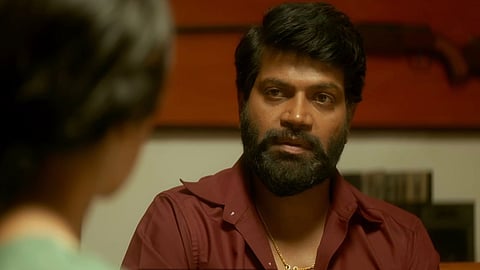


Balaramana Dinagalu isn’t trying to tell us something we haven’t heard before. It’s all about how it’s told, and the film’s proposal is clear. KM Chaitanya, who directed the hit Kannada movie Aa Dinagalu (2007), returns to tell blood-soaked stories of Bangalore dons who once lived. The stories, which eventually go on to reveal the sinister and often wasteful nature of violence, have tiny glimmers… of edge and authenticity (Chaitanya based Aa Dinagalu on former gangster Agni Shridhar’s book on Bangalore’s underworld) when it tries to differentiate itself. But the film ultimately loses its way, ending up feeling like a laundry list of criminals and their crime sheet rather than a nuanced character study.
If the film is about the Bengaluru underworld, its pith is Balarama (Vinod Prabhaakar). Hailing from Hassan, Bala is fresh meat to the Bengaluru city of the 80s. He gets quite the welcome, too. On his first day in the city, minutes after failed attempts at getting a government job, Bala kills a local area goon, wards off thugs, gets jailed, gets bail, and also joins a crime syndicate. We note the film’s rush to skim over these backstories and get to Bala’s main arc, but this has a bit of an unsettling effect. We don’t see the rush of emotions on his first kill (he’s introduced as a man with a clean past) or the disquiet of a life now lost. Instead, he joins Jayaram (Ashish Vidyarthi) on his pursuit, as if this has been his calling.
The rest of the film scurries to introduce us to the various dons that uphold the city’s underbelly. There’s Rai (Ramesh Indira), a gangster with ties to Dawood Ibrahim, who prefers guns to Jayaram’s machetes, Kathi (Vinay Gowda), a Tamil-speaking braggart who is full of empty threats, and Shashidar (Atul Kulkarni), the “intellectual” rowdy. And then there is Bala. Who is Bala, though?
The hero is written and performed with a dwindling emotional reserve and that remains Balaramana Dinagalu’s biggest issue. Bala keeps his loyalties clear, falls in love (Priya Anand plays Revathi), says a few lines about the pointlessness of violence, and expresses the will to leave this all behind and tend to a farm. The film is also not foolish enough to posit him as a hero who flexes his invincibility. He uses his smarts to get ahead when he knows his muscles can’t be put to use. But these moments are hard to come by. The writing does little to justify these traits, distancing us from Bala, who forms such a pivotal part of the film. The film also doesn’t spend enough time fleshing out the supporting characters — an integral part of gangster movies that intensively map out various crime mob families.
The way it’s shot, edited and composed (Santhosh Narayanan brings the mystical sensibilities that underscored Karthik Subbaraj’s gangster film Retro) gives Balaramana Dinagalu a little edge. A wedding procession song is cut with a political procession, lending the story some zhuzh. But the effect eventually wears thin.