

I have two core memories from the time of J.P. Dutta’s Border (1997), the era-altering Bollywood blockbuster that made national pride an innocent household emotion two years before the Kargil War. One: a talented classmate named Rohan won the singing competition the next three years in a row by nailing the anthem-coded hit “Sandese Aate Hai”. We often ended up crooning along like rogue choir vocalists. But his pre-teen voice never faltered, towering over the auditorium without needing to understand the lyrics. They were just musical words to us. The second memory is more haunting. The final montage of the film — where newly widowed women, penniless old parents and glum relatives wait in vain — left a lasting impression on me. Most of us had enjoyed the action sequences, bloodshed, martyr-like deaths and slow-mo courage up until that moment. To be hit with the sobering price of war felt like an out-of-syllabus chapter; the sadness had no sides. I did not expect a patriotic and violent war epic to close on a slightly reflective note.
When I recall that montage today, I can’t help but imagine a new face in it: Dharmendra from Ikkis. The late superstar played the role of a retired army officer and the father of a slain war hero. Attending a school reunion in Pakistan two years after the Kargil War, he embodies the lived-in compassion and grief of a post-partition veteran. His presence alone poses a question most civilians are afraid to ask: Is it worth it? The tragic irony is that Border 2 — starring Sunny Deol, whose name appears as ‘Son of Dharmendra’ in the title credits — provides the loudest possible answer to that question: You’re damn right it’s worth it. Both movies stem from parallel skirmishes of the 1971 India-Pakistan war, but this spiritual sequel to Border adapts its spirit in the combative language of 2026. Only the cinematic universe is shared (the Battle of Basantar makes a cameo); the rest is divided. The similarities are uncanny; the differences are not. Like Dharmendra in Ikkis, Deol plays an army officer who loses his son in battle too. But his response is not closure and melancholy. It’s the mood of the hour: rage and revenge.
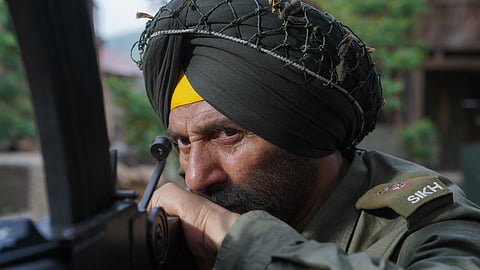
Deol’s character, Lt. Col. Fateh Singh, is so angry that even his magnanimity — when he spares a rival soldier because he remembers his son — is a form of revenge. Personal loss is a catalyst of new-age patriotism here; when a character learns of the death of two close comrades, he can only walk so far before his grief is framed against the backdrop of the flag. If Ikkis gently wonders “kaun dushman?” (Enemy who?), Border 2 leaves no blood-soaked stone unturned to yell: “Hindustan ke dushman”. If Ikkis implies that there are no winners and losers, Border 2 insists that there is only one winner. If Ikkis unfolds across two timelines to show that hindsight can be humbling, Border 2 unfolds across two timelines to show that payback can be justice. If this ‘exchange’ between two companion-piece movies sounds like a generational conflict, perhaps that’s what it is. There’s no room for sad music when a life is taken; there’s only motivational music — a mix of Jai Hind and Hindustan chants — when a life is given and sacrificed.
Deol’s Fateh Singh isn’t the only protagonist, of course. It’s a multi-front war drama, so we have three of his proteges (with their customised evil-Pakistani counterparts) fighting on land, water and air. The combined operation is represented by Army officer Major Hoshiar Singh Dahiya (Varun Dhawan), Air Force officer Nirmal Jit Singh Sekhon (Diljit Dosanjh), and Navy officer Mahinder Rawat (Ahan Shetty). That’s essentially four movies crammed into one — and four separate mediums to reiterate the same message. The first half of the film has the more watchable parts. It plays out like an armed-forces-coded Mohabbatein of sorts: Fateh Singh is the strict and grumpy Narayan Shankar of an academy that contains a budding friendship between the three promising students. The banter between lone wolf Hoshiar — who is soon revealed to be not that much of a lone wolf — and Sekhon is fun and human. We get a peek into each of their personal lives, and if the casting hadn’t made it clear already, we sense a hierarchy of screen-time and importance. The Air Force and Navy men visibly get the shorter end of the stick in terms of character development (Rawat’s obsession with Goddess Durga fails to offset his jarring 2D existence). The armymen, meanwhile, enjoy unrestricted access to flashbacks as well as the most provocative lines (“We won’t just cross the border, we will change it!” or “There aren’t as many people in Pakistan as there are goats we sacrifice on Eid!”). They also get a chunk of the ‘Sandese Aate Hai’ tribute song, and a nice supplementary track of two soldiers receiving contrasting letters from home.
The second half is due-process storytelling. To paraphrase a recent article by former Foreign Secretary and Ambassador Nirupama Rao, it’s the usual formula of demonising and flattening the enemy so hard that violence inflicted on them feels like catharsis. When a trash-talking head was blown off mid-sentence, I heard a delighted whoop from the man behind me (who spent enough time watching Border reels during Border 2). The formula also features the suffering and torture of the heroes, not just the one-note antagonism of those who say things like “those Hindustanis and Bengalis are cowards” or “you should have seen your cowardly son die” (compare this to the conceit of Ikkis, where the enemy who killed Dharmendra’s son is the man who hosts him with dignity and respect). It doesn’t help that the stepchild treatment to the air force and navy extends to the VFX and action set-pieces in the sky and sea; the ship, especially, seems to be defying the laws of physics, because there’s no concept of wind and motion and waves in their world. In comparison, the soldiers on the ground get a long and noisy combat sequence, which for some reason is shot Day for Night; at one point, I almost whipped out my phone torchlight to see the screen better. Of the performances, Sunny Deol certainly makes his presence felt — make of that what you will. It often feels like the movie is scolding the legacy of its predecessor; nostalgia is only the entry point.
Towards the end of the film, there’s a disarming little callback moment. Major Hoshiar stops in the midst of carnage when he recognises the young Pakistani soldier from his intro sequence; he had disciplined him back then, and now he’s face to face with a frightened human rather than a janaab-spouting caricature. It’s a bit surprising to see the film break character like this; it’s the closest it comes to the essence of that final montage. But it also returns to position in the blink of an eye, as if the moment never happens; the kid is gone, and Hoshiar gets busy being a one-man army. That’s when something disconcerting occurred to me. Some movies use storytelling in service of an ideology, but there are some — like Border 2 — that perhaps employ ideology in service of storytelling. Which is to say that it has no actual stance; it’s prepared to do anything to make a scene look dramatic and cool, even if it’s crossing over to the other side for a second. (One of its writers — perhaps the most in-demand dialogue specialist right now — also wrote for Jawan, Chandu Champion and 120 Bahadur). It’s easy to label movies as “propaganda,” but it’s stranger when the filmmaking just does things for the sake of narrative punches and big-screen emotions. There is no politics; the only philosophy is ‘paisa-vasool’ entertainment at any cost.
It’s not even opportunism. It’s the cinematic equivalent of The Dark Knight’s Joker: “Do I really look like a guy with a plan? I’m a dog chasing cars, I wouldn’t know what to do with one if I caught it”. There’s further evidence of this in how Border 2 ends — with a familiar montage of the news reaching the families of the slain soldiers. Some of them break down; some of them react with pride. It doesn’t fit after all we’ve seen, but it’s only there as a tribute to the original film. It’s there because it can be there. But the poignant song “Mitti Ke Bete” then fades in, not as a heartbroken ballad but more as a proud reminder of how there’s no greater honour than dying for the nation. They don’t come back, we are musically assured. Divinity is summoned; a man sees the heroes replacing gods at a place of worship. The film immediately snaps back into position, like a soldier saluting his superior after breaking curfew. Time for the next Rohan to win the interclass singing competition.