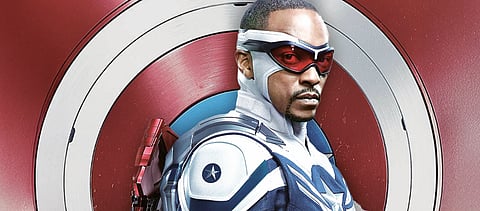


At this point, calling Marvel’s Captain America: Brave New World a disappointment feels redundant — like saying water is wet, or that AI-generated images are wonky. This film is neither brave nor new; it is, at best, a glorified patchwork of better MCU movies.
This tangled mess of nostalgia-baiting callbacks and half-baked ideas starts with us meeting President Thaddeus Ross (Harrison Ford, clearly just having fun at this point). But this also means that we are somehow expected to remember the events of The Incredible Hulk (2008) clearly; yes, the Captain America film you paid to see is actually a follow-up to a 17-year-old Hulk movie that most people had mentally archived under “miscellaneous Marvel films.”
In the MCU’s increasingly bizarre cinematic universe, Brave New World feels less like a Captain America movie and more like a contractual obligation Marvel forgot about until the last minute.
Anyway, in this film, Thaddeus Ross is trying to secure a treaty for the fair distribution of adamantium, but his past blunders pave the way for Samuel Sterns, a.k.a. The Leader (Tim Blake Nelson), to cause mayhem and jeopardise the deal. This makes him the main villain even though The Leader is Hulk's adversary, not Captain America’s. But the MCU thrives on reshuffling comic lore, so we play along. Except, this time, there’s little else to hold onto and the small things become infuriatingly large.
Somehow, despite its two-hour runtime, the film still manages to be astonishingly boring. The first half is essentially The Winter Soldier in a cheap disguise — same action beats, same espionage framework, except now with zero thrills. It’s almost impressive how they managed to copy-paste one of the MCU’s best films and make it feel completely lifeless. There’s exactly one good action sequence at the very end, but by then, the only thing keeping you in your seat is either misguided optimism or sheer exhaustion.
The film looks cheap, the reshoots are obvious, and the entire experience feels like a rough draft that somehow made it to theaters.
The writing credits boast three story writers — Rob Edwards, Malcolm Spellman, and Dalan Musson — along with Julius Onah and Peter Glanz handling the screenplay. With five writers, you’d expect some wit and sparkle. Instead, we get over-explanation and hollow monologues.
The characters talk so much — explaining their every thought like they’re in a daytime soap opera. And yet, they still manage to say absolutely nothing of value. It’s exposition disguised as dialogue, but only just.
Anthony Mackie does his best as Sam Wilson, valiantly trying to inject some heart into this mess, but the film gives him nothing to work with. Sam’s struggle to define himself outside of Steve Rogers’ legacy is mentioned, but never explored; his insecurities about not being a super soldier are reduced to mere jokes.
While the mini-series Falcon and the Winter Soldier (2021) attempted to explore what it meant for a Black man to be the symbol of America, this film fails to push that conversation forward, instead losing itself in Thaddeus Ross's estranged daughter and cherry blossoms. At one point, Sam is hit with the stinging words, "You're not Steve Rogers!"—a truth that echoes through every frame of the film. But no super serum can make Sam a hero when the filmmakers are hellbent on making sure he never truly becomes one.
Some great comic book characters like The Leader and Sidewinder are wasted in this film. Even Red Hulk takes forever to show up. And when he finally does, he lasts for about seven minutes. He smashes stuff, fights Captain America, and that’s all there is time for.
Every aspect of this film seems locked in a grim competition to be the weakest link: the story, the screenplay, the cinematography, the editing, the visual effects. Even the acting, burdened by flat dialogue and clumsy direction, struggles to rise above mediocrity.
Then there’s the sheer homework required to even understand what’s happening. If you haven’t kept up with Avengers: Endgame, The Falcon and the Winter Soldier, The Incredible Hulk, and (for some reason) The Eternals, piecing it all together is tedious. Frankly, no film should demand this much effort when it offers so little in return.
Similarly, Marvel’s attempt at political commentary barely registers. The film gestures vaguely at real-world parallels — there’s a red monster in the White House, the villain is an insider — but these ideas remain just that: gestures.
The real tragedy, however, is how little Sam Wilson gains from his own film. This should have been his moment, his defining film, the one that solidifies his place as a hero people can look up to and aspire to be. Instead, his journey is buried under Marvel’s relentless desire to recycle old formulas and churn out uninspired, TV-movie-level content. The film briefly acknowledges the challenge of stepping out of Steve Rogers’ shadow, but if Brave New World makes anything clear, it's this: it's Marvel, not Sam Wilson, that needs to step out of the past and forge a new path.