

I admit I have trust issues with a Luv Ranjan screenplay. When it’s funny, I worry if I’m amused for the right reasons. When it’s dramatic, I get anxious about the gender politics behind the gender politics. When it’s chatty, I look for hints of meninism in the elaborate arguments and expository dialogue. When it’s good-looking, I am distracted by everyone speaking like they’re in a detergent ad. When it’s progressive, I suspect it’s trying to fool us. When it’s regressive, I wonder if it’s aware. One might argue I’m being too paranoid about a harmless genre: the romantic comedy. (I can almost hear the “stop overanalysing, just enjoy” voices). But we live in an age of relentless commentary; storytelling is only a vessel. Every new-age Hindi film, regardless of form, has something to say. Maybe it’s on us to figure out what that is, before choosing to be entertained or disappointed.
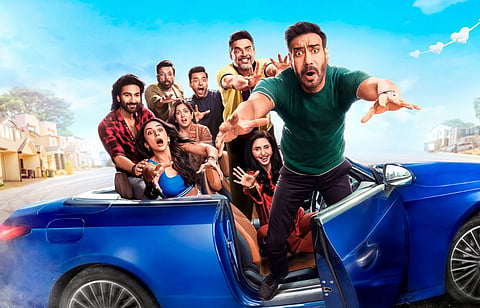
In that sense, De De Pyaar De 2 — co-written by Ranjan and directed by Anshul Sharma — fully exploits these trust issues. It toys with the expectations of the average viewer, toys with the social conditioning of those who leave their brains at home as well as those who come attached with brains, toys with itself (that sounded better in my head), and toys with a Bollywood genre that’s too proud to be flexible. A sequel to De De Pyaar De (2019), it starts from where the first film ended: as a flimsy age-gap romcom. Days after a 27-year-old Aisha (Rakul Preet Singh) wins over a 52-year-old Aashish’s (Ajay Devgn) family — including his ex-wife and “kids” — the London-based couple decide it’s time to convince her family in Chandigarh. This means they take the first of many flights between the two countries with the nonchalance of SoBo characters commuting between Juhu and Bandra. Despite belonging to a happy and functional family, Aisha is skeptical. Just as she is as young as Aashish’s children, he is as old as her father. She knows it won’t be easy. Her parents, Rakesh (R Madhavan) and Manju (Gautami Kapoor), are cool parents, but even coolness has limits. So Aisha remains vague about how much older Aashish is — until he arrives.
The first half of the film milks this setup for easy gags. Aisha’s heavily pregnant sister-in-law fakes labour pains to soften the household. Rakesh and Manju use roundabout ways to find out Aashish’s age — like casually inquiring about the currency exchange rates when Aashish moved to London, or making wisecracks about the age of a Single Malt bottle. Rakesh introduces Aashish to relatives as an old college friend; he rightly doubts the integrity of a man like Aashish for not liking daal. Aisha urges him to win her parents over the way Raj won Simran’s folks over in Dilwale Dulhania Le Jayenge. (Someone observes that she wasn’t born in 1995). The result is a gag designed solely for Devgn to go meta and refer to wife Kajol’s iconic role. It’s not long before there’s a reference to Shaitaan, a film in which a villainous Madhavan brainwashed Devgn’s daughter. There are some perceptive notes on the relationship — like how Aisha is irritated by her older boyfriend’s maturity about the whole thing; or how she demands intent by reminding him that it’s her first time even if it’s his second. She reads his experience as a license for complacency. But the film is more focused on being unserious — until it isn’t.
De De Pyaar De 2 takes an interesting turn before the interval. The fun and games end, and the tonal shift isn’t too jarring. A generational war emerges; two worldviews are pitted against each other. As is often the case, the men and their egos hijack the story, and the ‘heroine’ is reduced to a pawn with no agency of her own. It stages the kind of traditionalism that’s inherent to the genre — a contest of masculinity that was a common staple in 1990s hits like DDLJ and Pardes. The film takes a predictable nosedive, until a twist in the third act turns the gender dynamic on its head. Suddenly the nosedive makes sense in hindsight; the film counts on us thinking it was sincere all along. The twist works in terms of how it upends the social grammar of such movies; the irony of it being a Luv Ranjan-led movie expands the gimmick. In theory, I love the narrative conceit of the second half. It’s a bit creepy and far-fetched, but at least the idea accounts for the plot contrivances and the main-character energy of the men. Incidentally, this is the second Devgn-starring comedy sequel this year after Son of Sardaar 2 that’s surprisingly ambitious with its messaging.
The problem, though, is the execution and treatment of this theme. For one, the film takes too long to come to the point — 146 minutes is a stretch for a romcom that thrives on playing mindgames with the audience. Every scene lasts 20 seconds longer than it should, and there’s enough talking and philosophising to give Aaron Sorkin a complex. Half of the film is composed of overcooked and deadpan reaction shots, almost as if the shot refuses to quit until we notice every twitch of every facial muscle. The general volume of the film is so high that the drilling behind the walls of the cinema hall (it’s Mumbai, don’t ask) folded into the background score. The odd joke lands (especially when Jaaved Jaaferi is involved), but the performances are just as high-pitched. Most films have a habit of acting clownish instead of playing it straight and letting the situational humour do the rest; De De Pyaar De 2 is no exception.
Madhavan’s Rakesh takes the brief of covert masculinity too literally; he moves into Shaitaan and Rehnaa Hai Terre Dil Mein territory when the drama is amplified. In pursuit of conflict, the parents reach a stage where they’re almost irredeemable. Devgn’s Aashish is the opposite: so passive that he barely registers. Rakul Preet Singh, to her credit, swings for the fences as Aisha — it’s her meatiest role by far, but the writing goes into overdrive to cushion all those ear-splitting yelling matches. It doesn’t help that she shares more chemistry with Madhavan, who plays her dad, than Devgn. Perhaps it supplies the gag of Aashish hiding his identity, crippled by his own niceness. But the lead couple of an age-gap story should be compelling enough to shake the tree. Showing matters more than telling (again and again). But attraction is an aesthetic here, just as ideologies are.
Which brings us to the paradox of such forward-minded romcoms. The franchise is conceived as a nod to the notoriety of hero-heroine pairings in Indian cinema — age-gap propaganda, if you may — but the conviction feels hollow. The De De Pyaar De formula is built on a brand of backhanded wokeness. It’s like a liberal method actor who gets so consumed by the role of a bigot that their real personality remains a mystery. The second half of the film goes so far to sell its trickery that you’d think it’s enjoying the prosthetics more than the skin. While the plot is pretending to be orthodox, it seems worryingly invested in the pretense; it’s the twist that feels reverse-engineered and farcical to rescue the film from itself.
Whatever its true colours, the sight of Aisha galavanting with a stud her age and provoking Aashish into feeling is enough to suggest that they’re just another couple who see toxicity as the proof of love. It’s almost as if she’s avenging the trauma of what she had to go through in the first film, where he made grave mistakes to hide their controversial relationship. It may make for a stretch of self-aware comedy towards the end, but the film demands too much tolerance from the viewer to earn that last hand. There’s a running gag about her parents claiming to be “modern, educated and progressive” only to drop the act and become manipulative at the slightest sign of stress. The film takes a swipe at this moral posturing of upscale India, yet it resorts to the same posturing to make its point. In theory, the subterfuge should have worked. But it just yaps so much and can’t get enough of its own silver-tongued reflection. In other words, my trust issues persist. My guard is still up. Is it my fault if De De Pyaar De 2 itself reduces trust to the side-hero of an alleged love story?