

You only live and die once, goes the overused saying. But what if you were to die twice? Murali Kanth Devasoth’s Dhandoraa opens with such an idea, but not so much in a surrealistic twist of fame. But in an on-our-face depiction of caste reality. The corpse of an old woman, who is denied entry into the main burial ground, is unwittingly rappelled down a bridge. When the rope frays and finally gives up, someone lets out a guttural scream, “You’ve killed her again.” This chilling scene forms the basis of Dhandoraa.
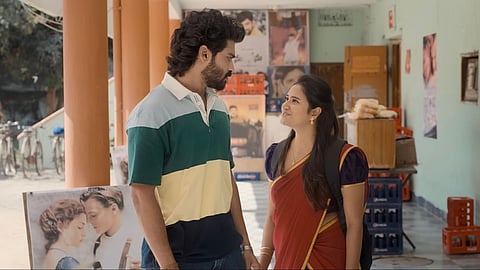
It’s interesting how writer-director Devasoth chooses to map out the characters of Dhandoraa. No character gets a line or introduction without meaning (the precision is apparent in the way the characters are written with almost no loose ends), with their lives interconnected, not just by the small-townisms but also their outlook on caste. When Sujatha (Manika) falls for Ravi (Ravi Krishna), a friend from a lowered caste, her father Sivaji (played by actor Sivaji) unleashes hell upon his family. We’re all familiar with how this story might go, but Dhandoraa makes sure it gives us something beyond familiarity. While it takes some time to get there, the film forces us to look at caste intersectionally.
So apart from the central romance, the film also shows us how caste realities affect people (Navdeep gets a good role here as the village head who works his way up), and especially women. This is fleshed out quite well in scenes between Sivaji and Bindu Madhavi, a courtesan who opens his eyes to his own atrocities. We also see this in Sujatha’s brother Vishnu’s early romance. Vishnu, in one instance, reflects on why anyone would turn down a groom like him, named after a reincarnation of Lord Ram and all that. But the girlfriend curtly responds, “They worship Lord Ram, but for son-in-law, they look at caste.” This isn’t just an observation on discrimination, but the necessitated maturity of a woman who is prepared to dodge the marriage market.
Caste differences shorten the lives of many in the village of Medak — whether it’s literally or metaphorically. This is especially apparent in Sivaji’s character development. In an astute portrait of failed fatherhood, Sivaji portrays the inefficiencies of the role quite well. When he gets a second chance at this gig, he leaps at the opportunity, breaking the cycle in his village once and for all. It doesn’t matter if Dhandoraa takes some time to get here. A few superfluous jokes and a meandering first half aside, the film finds its lost focus post-intermission and largely doesn't look back.