

Mild Spoilers ahead:
There’s no dearth of complex character detailing in Nelson Venkatesan’s DNA. We have a man navigating a tricky breakup (Atharvaa), a father who detests his son to the point of bellowing a curse, a woman struggling to make sense of her personality disorder and the regressive marriage market (Nimisha Sajayan), and a police officer who is pulled back into an emotionally triggering case, days before his retirement. The well-performed film even has a solid premise to back it up. But the thriller very quickly descends into the territory of a templated action drama, taking its focus away from its characters and giving in to cliches and sometimes dodgy stereotypes.
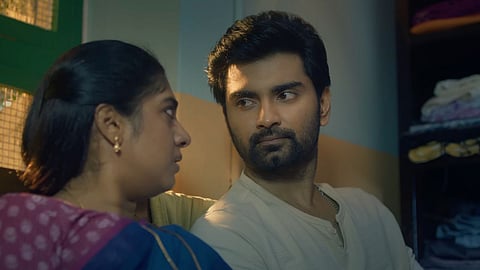
Anand (Atharvaa) and Divya (Sajayan) are deemed to be outliers by society — especially their parents — for different reasons: one is a drug addict struggling to get over his ex-girlfriend, and the other is a woman living with a borderline personality disorder. But Venkatesan initially makes it clear that it’s not the film that judges these individuals, but its people. So we have scenes emphasising the importance of therapy and medication for Divya’s condition, and rehab for Anand’s illness, as if explaining their stance with a disclaimer. So, again, when the marriage between the two is fixed because they’re both “damaged goods,” Venkatesan nudges us to remember its disclaimer. But it treads a very thin line in this regard. When friends of Anand tag Divya to be a “loosu” (a derogatory term often used to refer to the mentally challenged), we expect Anand to explode, but he avoids the discourse and simply marries her by “choice”, which immediately makes us wonder if this is a man's saviour complex decorated under the garb of “acceptance.”
Sajayan and Atharvaa share a very believable chemistry, which takes their union from a marriage of convenience to one of love and kindness, sharing their angst about life’s injustice. Marriage soon leads to pregnancy, where the couple has to eventually navigate parenthood, apart from their disorders. “Will you take care of our child even if she is born with my condition?” she asks, to which Anand wordlessly agrees. So, when the film progresses into a whodunit territory, you’re half-expecting an emotionally charged thriller. It’s fantastic how Divya is the one who points out the elephant in the (delivery) room, moments after giving birth. “This is not my child. Where is he?” she asks with terror-tinged urgency.
The premise lays almost the perfect way for makers to dive into a tense parenthood thriller exposing piercing truths about guilt, grief and self-pity, much on the lines of Dinjith Ayyathan’s Kishkindha Kaandam (2024), which was wound around excellent character studies, even if it followed a missing son’s case. But DNA takes a warped, extremely commercial route to get to the point. It might be Divya’s heightened emotional sensitivity (a symptom associated with her disorder) that identified the issue in the first place, but the film sidelines her to focus on Anand’s dangerous investigative adventures to get his son back.
This is a shame because this novel premise is also where things get undone in DNA. While the investigation is stringed with fascinating arcs — one involving twins, another with a troubled man (Mohammed Zeeshan Ayyub) who is waiting his days for fate to punish him for a mistake, and a retiring cop who lost his child as a young father — the film lacks feeling. What should’ve ideally been an intricate thriller about new parents, and by extension, motherhood — who better than Nimisha Sajayan to flesh out the nuances of a grieving, guilt-addled mother? — turns into a generic action drama. There is this beautiful scene where Divya lets out a guttural scream when she has to give up yet another piece of her motherhood, she's been clutching to. What would’ve been her battles as a mother with BPD? Especially around doctors who gaslight her truth to be “psychosis.”
Ghibran's inventive score keeps us hooked through certain portions, elevating scenes that would've otherwise fallen flat. And the film, too, ties in a social message in its process of piecing together the mystery: the world's obsession with childbearing. But DNA doesn't apply the same thought that went behind some of its astute observations to its filmmaking.