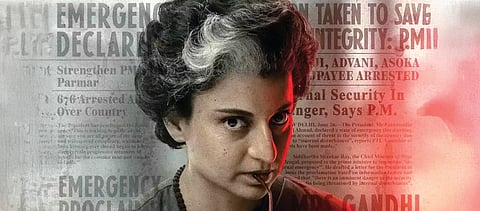


In Emergency, Kangana Ranaut plays Indira Gandhi who plays Kangana Ranaut. Let me explain. Ranaut performs as the former Prime Minister of India when the politician is flawed, cruel, paranoid, a nepotism hire, power-hungry, guilty, and the mother of Sanjay Gandhi. Her voice becomes high-pitched, uneven and shaky in these parts. But Indira Gandhi seems to perform as Ranaut when the woman is defiant, patriotic, headstrong, resilient, reverential towards the opposition (Janata Party leaders Jayaprakash Narayan and Atal Bihari Vajpayee), and the mother of the nation. Her voice becomes firm, furious and confident in these parts.
Curiously, or perhaps not, the craft of the biographical drama is selective too. The film-making springs to life in scenes of Indira’s assassination, her mental spiral (she sees a zombified version of herself stare back from a mirror), her affinity towards a wayward son (she scolds the house help after he flings away his plate of eggs), the Pakistan army’s villainy (they smash a baby against a wall), and her supervillain-origin-story-coded downfall. But the same film-making looks reluctant when she wins the election, teaches United States president Richard Nixon a lesson (he calls her multiple times to boast that his soldiers are reaching the shores of East Pakistan), schools the French president, ‘creates’ a grateful Bangladesh, grieves loudly, stands up to her naysayers, or displays any sort of humanity and initiative.
For those familiar with the actress’ political stance and the politician’s acting stance, the design is hardly surprising. Indira Gandhi doesn’t get a stylish entry shot. But Field Marshal Sam Manekshaw (Milind Soman) does. After her first meeting with Atal Bihari Vajpayee (Shreyas Talpade), Indira calls him a true “deshbhakt” and wishes him a successful future; when he remarks that he will be a future Prime Minister, she looks embarrassed like a bumbling 1990s sidekick and drives away. She resents her father, Jawaharlal Nehru, for being “weak and defeated”; she vows to never be like him. Her son Sanjay Gandhi (Vishak Nair) is depicted as a rich and sociopathic brat straight out of a 1990s potboiler (think Rajesh Khanna’s ‘American’ son in Aa Ab Laut Chalen); he’s perpetually one beard away from being an Animal-coded antihero. Indira turns over a new leaf and starts to love her country more than her son only after a humbling exchange with Jayaprakash Narayan (Anupam Kher). Her wise rivals spend most of the 21-month-long Emergency being dignified and lyrical in prison.
Normal propaganda movies demonise the enemy in praise of the state. But movies like Emergency, along with The Accidental Prime Minister (2019), end up demonising themselves in service of the state. It’s the strangest brand of method storytelling. At times, it’s almost striving to be bad. As a result, absolutely nobody wins. The people it’s supposed to please might accuse it of humanising Indira Gandhi. The people it’s supposed to provoke might accuse it of humiliating her. One side might accuse it of being intentionally biased. The other side might accuse it of being unintentionally balanced. Cinephiles might accuse it of campiness, caricature and a hammy Kangana Ranaut performance. Kangana Ranaut fans might accuse it of being too smart for everyone. Regular audiences might accuse themselves because everyone else is busy accusing the film.
Basically, its identity crisis is a sight to behold. At one point, the film simply gives up and becomes a musical. A parliament debate suddenly has Vajpayee breaking into a fervent song — before Manekshaw takes over in the planning room, soon joined by Gandhi herself looking into the camera and imploring the viewers to fight for “Swadesh, Swarajya and Swatantra”. Later on, a sad romantic song (“Bekarariyan”) plays over an oblivious oedipal montage of the mother and son bonding after a setback.
There’s also the matter of how Emergency — which lacks both skill and self-awareness — is yet another brick in the wall of the modern Bollywood period-biopic multiverse. Identical scenes, settings, evil Pakistani generals and actors have appeared in separate movies with shared intentions. For instance, the Bangladesh Liberation War conflicts and the Dacca military coup of 1975 — where Sheikh Mujibur Rahman and his family were killed — look eerily similar across Mujib: The Making of a Nation (2023), Pippa (2023), Sam Bahadur (2024) and now Emergency. It’s as if they shared shooting (the camera kind) dates. I’ve lost count of how often Yahya Khan’s bushy eyebrows have hijacked a moment. Ditto for Nehru’s meekness, Jinnah’s smoking and Indira’s brooding gaze; Marvel has nothing on the sheer laziness of this multiverse.
At the end of the day, the protagonist of Emergency is a character called Irony. We see many shades of Irony. Sometimes, Irony is injured: Indira Gandhi’s Janata Party dissenters sit in jail and bemoan the murder of democracy and press freedom. Sometimes, Irony cries: a minister drives through a predominantly Muslim locality and rolls his eyes at the “poverty of Delhi” (punctuating it with “Indians breed like rabbits”). Often, Irony is happy: Sanjay Gandhi’s friends foreshadow his death by telling him, “Your mom is making you the villain of Emergency and that’s not good for your image!”. Often, Irony dreams: might there be a film called Demonetisation 50 years from now? Occasionally, Irony has a drink: a well-wisher tells Indira that she’s made citizens scared of speaking their mind. Most of all, Irony grows up. We keep wishing for Hindi biopics to be less hagiographical and more critical of the legacies they explore. When it finally happens, it’s Emergency. It’s the other extreme altogether: a biopic so critical of its complicated central character that it becomes hagiographical — of the opposition. But there’s no need to panic. It could be worse. Imagine watching an Emergency and not even realising it.