

Director: Ridley Scott
Writers: David Scarpa, Peter Craig, David Franzoni
Cast: Paul Mescal, Pedro Pascal, Denzel Washington, Connie Nielsen
Language: English
In one scene in Gladiator II, Ridley Scott’s tale of decaying cities, diseased men and devious plots, a Roman noble sits at a cafe, reading a newspaper. Only it would take 1,200 years more for printing press to be invented, wrote a University of Chicago professor last month, denouncing the film as “total Hollywood b*llshit”. But then again, Scott has never been interested in historical accuracy — characters in The Last Duel (2021) speak in anachronistic terms and Napoleon only ever fired his cannons at the pyramids in his 2023 film — instead valuing emotional honesty. He stages films of monumental battles and small men, constantly returning to the idea that though centuries may turn and empires may fall, human greed, selfishness and their capacity for cruelty remain the same.
Scott casts his cynical eye over Rome once more 24 years after he did in his original swords-and-sandals epic Gladiator (2000), but despite the improved CGI and sharper cinematography, the heightened spectacle only pulls into focus the film’s emotional shallowness. For its all sumptuously staged battle scenes, there’s not a single moment in Gladiator II that captures the visceral fear of the colosseum like the shot of urine running down a frightened scribe’s leg seconds before he’s forced into the arena in the first film. And nothing captures the harsh futility of believing in divine providence quite as succinctly as the prequel’s shot of tiny figurines being placed in a model colosseum — in this universe, men are mere playthings, their fate subject only to the whims of other men. If no one in the film snarls, “Are you not entertained?” as Roman general Maximus Decimus Meridius (Russell Crowe) did, a blistering indictment of the crowd’s enjoyment of public barbarity, it’s probably because the answer is one they aren’t keen on hearing.
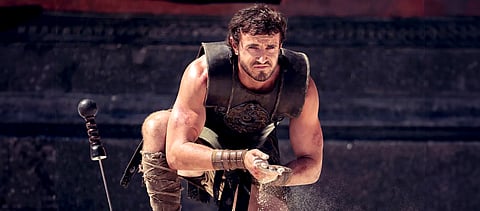
Gladiator II follows Hanno (Paul Mescal), ostensibly a Numidian warrior, though his true parentage is hinted at right from his introductory scene, in which grains of wheat slip through his fingers, a potent visual callback to Gladiator’s now-iconic shot of a hand grazing wheat stalks in a field. When the Roman army, led by General Marcus Acacius (Pedro Pascal), invades his home, Hanno is captured, winding up in the employ of slave trader Macrinus (Denzel Washington) and eventually forced into colosseum-set combat. Mescal, taking over from Crowe, has large sandals to fill, and while he looks the part physically, he lacks either the quiet conviction or the blistering fury to make his big battle speeches work. In scenes that pair him opposite the film’s other main cast, it becomes apparent just how much he’s dwarfed by Washington’s commanding sweep or Pascal’s conflicted gravitas.
While Gladiator was about a man whose sole burning desire was to return home, the protagonist of its sequel has spent a lifetime turning his back on his. As reluctant as Hanno is to embrace his past, however, the film he’s in has no such compunctions. Gladiator II pulls imagery and lines of dialogue from its predecessor, these references only inviting comparisons between the two films and casting the latter in a further unflattering light. Painterly opening credits depicting Maximus’ death ensure that the film’s shadow hangs over its sequel right from the beginning.
Scott’s recent run of films have all had an undeniable ‘end of an era’ finality to them. House of Gucci (2021) chronicled a dynasty enfeebled by infighting and backstabbing, culminating in the death of heir apparent Maurizio Gucci (Adam Driver). And in All The Money in the World (2017), patriarch (Christopher Plummer) was eventually depicted in the wake of his death as yet another bust in his collection, the marble just as cold and unfeeling as he was. Likewise, Gladiator II trades the optimism of its prequel for a more clear-eyed condemnation of the state of its world, and ours.
There’s very little of the humour that leavened Scott’s previous run of tragedies, none of Napoleon’s whiny outbursts about boats or Gucci’s generous assumptions of what an Italian accent entails. Instead, “There was a dream that was Rome. It shall be realized.” is replaced with “Rome must fall.” Acacius’ sacking of Numidia, his proclamation of conquest for “the glory of Rome” is immediately undercut by the images that precede it — mounds of the city’s dead set on fire as their relatives wail. It’s revealed that one of Rome’s emperors (Fred Hechinger) is slowly dying of an STD that has reached his brain, a diseased monarch heading a diseased city. Cinematographer John Mathieson's composed, elegant frames are in stark contrast to the city’s moral decay, and he frames even the prisoner's cells with the preserved pristine neatness of a museum display, as though the empire were already a relic of the past.
The colosseum-set battles are far more immersive this time around, and it’s hard not to get swept up in the spectacle of a rampaging rhino, or the showmanship of Hanno stirring up a dust cloud moments before being attacked, but here’s Scott making us complicit in cheering for the same savage pageantry as the crowds in his film do. The film’s most compelling warfare, however, is psychological, the furious clash and clang of swords in combat nowhere as satisfying as the slow drip of poison into the ear in the film’s second half. Macrinus’ machinations to the throne play out as a series of nimble chess moves, and Washington pairs his Shakespearean line readings with deft physical choices — in one scene, he bestows tender kisses on a man in his debt (Tim McInnerny), all while conveying the impression that he’s got him in a vice grip instead. Just as fascinating to watch are Rome’s twin emperors. Geta (Joseph Quinn), the obvious leader of the pair, is menacingly sinister, while Caracalla (Hechinger) is suspended in an eternal childlike state of petulance, inflicting cruelties with an innocent obliviousness. Both are so absorbed in foreign conquest, they fail to recognise the rebellion brewing closer to home, so taken in by the trappings of luxury, they lack awareness of the rot within.
So timely and resonant is the film’s recurring refrain of razing corrupt governments to the ground that its climactic catharsis rings hollow. Like the first film, Gladiator II also ends with the promise to rebuild Rome. History might keep repeating itself, but there's no reason for cinematic retreads to be this tiresome too.