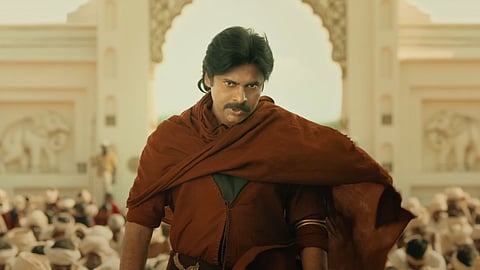


For much of the film, Veera Mallu (Pawan Kalyan) and his motley bunch of soldiers march on from Golconda to Delhi, to bring back the contested Koh-i-Noor from Aurangzeb's peacock throne. Whether this group veers off course or not — promiscuously-staged songs and fights with animals accompany this journey — Jyothi Krisna and Krish Jagarlamudi’s Hari Hara Veera Mallu veers plenty, and often right into bigoted territory.
Veera Mallu is a glorified thief who steals for the poor in 17th-century India. A thief who has an eye for India’s most prominent gems. So belief is suspended, and so are laws of physics as Kalyan swerves from one corner to the other, seamlessly nicking the jewels from white men and obstinate small kings. When he’s offered a proposition he can’t refuse, he sets off to Delhi.
While Hari Hara Veera Mallu expectedly brings in the characteristic Mughal-bashing tone that films of these tenors so often do, it does start on a half-interesting note. Pawan Kalyan does what he does best, providing the role with all the mirth that he can. A story about Qutub Shah, the fifth sultan of the Sultanate of Golconda and founder of the city of Hyderabad, enlisting a brave thief to retrieve Golconda’s crown jewel, isn’t entirely inventive, but is also not entirely stripped of fun.
But this folk hero’s heist is brashly cut off for what the film thinks is a more noble quest: dharma. A Dharma that only Veera Mallu can reinstate from the clutches of the kohl-eyed Mughals. Islamophobia is not a blatant display in Hari Hara Veera Mallu, but sneaks its way into the film’s lines and its context: so for every scene of religious discrimination and plundering of temples, we have a few scenes of Veera helping innocent Muslims — either from drought or from caustic invaders. These token displays of stock good Muslim characters, instead of having a balancing effect, evoke a bitter, false taste.
The film isn’t interested in giving history lessons; it’s instead keen on pulling out select episodes from India’s syncretic past and oversimplifying the consequences of the Mughal era. Composer Keeravani does his best to salvage the loud and often jarring second act with operatic music, but the film lacks any kind of vision or finesse for us to take it seriously. None of the secondary characters are particularly noteworthy (even if the film features actors of the calibre of Kota Srinivasa Rao, Nassar, Bobby Deol and Sathyaraj). At one point in the film, we almost overlook the shoddy VFX work because its wearied writing proves as an equal distraction.