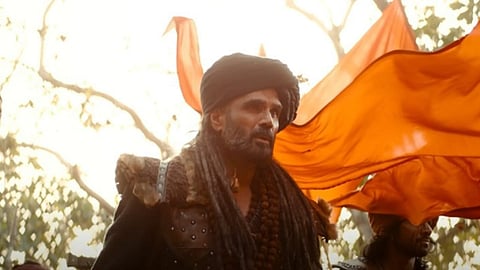


I suspect this is going to be a short review. Not just because Kesari Veer is unwatchable in so many different ways that one is spoiled for choice. But also because I’m tired of writing the same thing about multiple Hindi period dramas — if one can call them that — over the last few years. As a critic, I’ve gotten to a point where I robotically tick off a mental checklist. Provocative? Of course. Islamophobic? Certainly. Hate-mongering? Obviously. Misinformation parading as creative license? Sure. Kesari Veer is a 162-minute inspired-by-true-events slog about a Rajput warrior who tries to defend the Somnath temple against the Tughlaq Empire in the 14th century, but it’s also another 21st-century excuse to demonise Muslims in a communally sensitive country through the elastic medium of history. In another era, it would’ve been banned. All of this goes without saying. It’s the starting point. Tell me something new.
What I like about Kesari Veer, though, is that its incompetence is diverse. It leaves no stone unturned to suggest that it’s only pretending to be a film. The acting makes it hard to distinguish humans from their Windows-1997-screensaver-style backgrounds. Every other character looks and sounds like they’re gatecrashers whose cell-phones have been confiscated at a medieval cosplay ball. Sooraj Pancholi stars as long-haired prince and Lord Shiva devotee Hamirji Gohil, and his meet-cute with Akanksha Sharma’s influencer-coded warrior princess in Gir forest involves an injured lioness who’s so embarrassed by the special effects that she keeps trying to escape the set piece. Most battle scenes seem to unfold in the same visually arid patch of jungle and beach, where one can almost see the assistant directors frantically operating the wind machines and manually throwing dry leaves into the frames. Even the leaves look tired.
Most establishing shots belong to a Saurashtra tourism ad on a post-production strike. The VFX in combat and action sequences often reaches Jaani Dushman: Ek Anokhi Kahani (2002) levels, not least when characters are leaping through the air and gravity suddenly forgets to exist. I’ve seen panels in Amar Chitra Katha pages that are less static. Sometimes, when a scene runs out of imagination (or budget), the screen cuts to black and implies that our modern-ancient hero survived the chaos. At one point, Hamirji Gohil finally confronts the kohl-eyed villain, but instead of a buildup, what we get is a faux-reality-show moment where Gohil must race a horse to the finish line. He wins through a buffet of incoherent stunts and logic-defying leaps, and I could only feel sorry for the horse whose Bollywood descendant may or may not be the protagonist of Abhishek Kapoor’s Azaad.
The writing remains determined to out-Chhaava its competition. When a valiant (is there any other kind?) Rajput character is beheaded during battle, his headless body continues to fend off attackers and swing wildly, and all the enemy can do is look on in shock and admiration. When someone is on the brink of dying, he sees visions of his dead mother, who starts off her speech with some sweet passive aggression: “Tired already?” I mean, that’s only a sword sticking out of his guts. Trust Hindi cinema to fetishize defeat in the absence of victories to glorify.
Vivek Oberoi plays the sinister Tughlaq psychopath named Zafar Khan, who spends much of his time grinning, taunting, posing for non-existent cameras, and saying variations of “why are you Hindus so stubborn?” or “what do you people call that?”. He is even addressed as ‘Bhaijaan’ and ‘Sultan’ (and there’s ‘Veer’ in the title) so that there’s no doubt about the sly-tweet-level intelligence of the character. The semi-Urdu-spewing Zafar thinks he’s Ranveer Singh in Padmaavat or, during his more delusional bouts of swag, Brad Pitt in Troy. But the man’s aura can’t be all that neat because when he vows revenge for his brother’s death, the young hero and his hair-gel have the bandwidth to get sidetracked and get married in a lavish ceremony bang in the middle of his quest to protect the temple. I’ve seen Manchester United teams that are less distracted in defense.
I’ve run out of humour now. Songs randomly begin and end, fire and flames resemble malfunctioning sunsets, veterans arrive and perform in vibes, chants of “Har Har Mahadev” replace full-throated dialogue after a point, and a gory climax is followed by a textbook voice-over that feels longer than the wounded lioness’ whiskers. Not even crimson-faced big cats can beef with a story that victimises faith. All in all, such movies tend to be a therapeutic experience. After all, they force some of us to be patient and reflect on all the life decisions that lead up to the screening. Needless to mention, I walked home. Traffic knows no religion. And flying did not seem prudent.