

You can see why Lord Curzon Ki Haveli sounds attractive on paper. Regardless of the budget, it’s an “independent-minded” Hindi film, the kind that used to be conceived, crowd-funded and exhibited in the pre-streaming age by film-makers like Sandeep Mohan, Q and Sudhish Kamath. The title is intriguing if one knows their history. It’s a chamber drama, shot largely in the living room of a British manor. It’s a lean production; the main score is Beethoven, the sound design is a co-writer, the suspense is supposed to be Hitchcockian. There are only four, sometimes five, characters in the house. It’s fully conversational, an introvert’s nightmare. There’s enough room for the lens to lurk around. The performers have worked in an indie setup before. The mood — where actors have the freedom to put on strange accents and do strange things — is a front for social commentary.
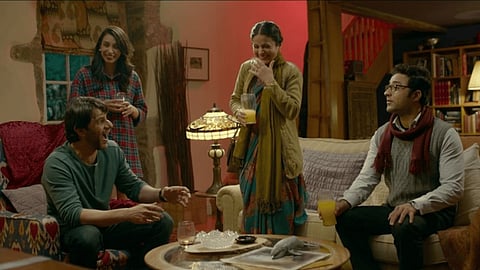
You can also see why Lord Curzon Ki Haveli blows it. It’s indulgent, clumsy, randomly provocative, choppy, and seems to reverse-engineer its idea of cultural conceit. The overwritten screenplay revolves around two South Asian couples meeting at a countryside manor in England: a loved-up Rohit (Arjun Mathur) and Sanya (Zoha Rahman) play hosts to a newly married Ira (Rasika Dugal) and her snooty husband, Doctor Basukinath (Paresh Pahuja). How they know each other remains a puzzle; a half-hearted flashback barely explains it. As a viewer who thinks they’re watching a whodunnit or a whydunnit, the tension is derived more from having to see an awkwardly staged and directionless dinner than being immersed in an awkward and unpredictable dinner. I’ve pledged to be kinder to smaller films (especially debuts) and cinephile-coded efforts, but this one makes my kindness go through an existential crisis.
A clumsy sound transition early on — featuring a hammer and a nail — sets the stage for this bristling night of knowing nothing. One of the problems with the film-making is just this: it’s overenthusiastic and too visible, you sense when the camera is moving and shaking, and the craft makes its presence felt in a story that keeps losing its shape. Ira is the timid, mangalsutra-wearing ‘desi’ wife who’s moved to London after marrying Basu, an NRI (Non-Resident Indian) and a MCP (Male Chauvinist Pig) with anger issues. They arrive at the residence of Rohit and Sanya, who at first seem to be a randy twosome looking for new swinging candidates. Basu immediately dislikes them because Ira feels enabled; Rohit is amused by just how entitled and ‘white’ Basu behaves; Basu speaks like he’s imitating Parambrata Chatterjee’s character from Mumbai Diaries 2; sultry Sanya is unsure of what her role is; a joke about an imaginary body in a trunk mutates into a series of uncivilised face-offs interspersed with lulls of courteous exchanges (including a truth-or-dare game with the pizza-delivery guy?).
There is very little emotional continuity, feelings (and faces) are hurt, but things return to normal in the blink of an eye. Anything flies, but not in a good way. Basu spends half the film demanding to know what is in the trunk. The others spend half the film teasing and laughing at him. Ira slowly goes unhinged, and at some point, two characters start making out violently in front of the others because why not? The stillness and frustration in every argument are milked until they turn into narrative inertia. There are times when it feels like the camera is waiting for the characters to do something. The plot has more in common with a particular Ram Gopal Varma thriller than Hitchcock, so the layers of commentary about immigrant trauma and racism (the title is a hint) feel like a gimmick to legitimize the twist. I like the concept of an edgy black comedy that subverts the glossy NRI gaze of mainstream Bollywood, but the genre itself undoes the message. It’s uncomfortable to watch, because the mystery of what the film is about dissolves into an onslaught of escalating clashes where everyone acts insufferable. Empathy is not a motive, but this is a film that summons its understanding of the world from cinema rather than life itself.
The actors try, but the writing gets away from them. There’s about 30 minutes worth of short-story material that is squeezed and inflated into a feature-length thriller. In terms of setting out to work with friends and limited resources, there’s no better blueprint than last year’s Fairy Folk or Kshay (2011), both of which starred Rasika Dugal trapped in a dysfunctional urban marriage. Dugal’s Ira here is probably the most watchable of the lot, yet you can tell that the film simply freewheels into a climax to flaunt its actor instead of exploring the character. I still can’t get over the fact that whenever Dr. Basu gets hostile, it’s all chill in the next scene; the de-escalation is so abrupt that it’s creepy. The fate of characters seems to reflect a playful metaphor about conflicting breeds of immigrants in pursuit of belonging and identity. But you know the storytelling flounders if this metaphor feels like a fortune cookie at the end of a microwaved fusion meal. Safe to say the trunk in the living room did contain a corpse — of my patience.