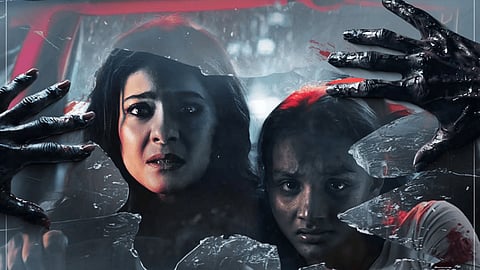


Coming-of-age enthusiasts used to accuse Imtiaz Ali of telling one story over and over again. Lapsed horror enthusiasts like myself might accuse director Vishal Furia of being in the same boat. His latest, Maa (“mother”), is supposed to share a universe with Vikas Bahl’s Shaitaan (2024), but it’s actually Furia’s Chhorii 2 (which released in April) on a backpacking trip across West Bengal. Both movies feature a single mom from a city having to defy the demonic forces of an ancestral village to protect her girl-child. The daughter’s sacrifice (and first period) holds the key to uncurse the place. If the supernatural offender was a Tumbbad-coded prehistoric creature in Chhori 2, Maa’s baddie is a needy tree monster who looks a lot like Groot from Guardians of the Galaxy.
I could swear that the haunted Banyan tree in Maa — beset with the cries of slaughtered babies — is the one from last month’s The Bhootnii. The visual effects are better, but I’m not sure that’s a good thing anymore. Maa stars Kajol as the titular parent who must transform into Goddess Kali to defeat the sinister descendant of the Raktabija. It takes two hours to set up this face-off, becoming yet another notch in the belt of a film industry that keeps staging supernatural tales about feminism and empowerment (the Hindi titles have exhausted all variations of “woman,” “mother,” “daughter” and “girl”) to offset the performative ironies of the natural world — in this case, a country notoriously unsafe for the female form. Maa overcompensates to a point where it’s hard to tell fantasy from reality.
The first half is slow and predictable. Following the gory death of her husband (Indraneil Sengupta) that’s a ‘Smoking Kills’ disclaimer unto itself, Ambika (Kajol) and 12-year-old daughter Shweta (Kherin Sharma) find themselves in Chandarpur, the creepy hometown he had abandoned in search of an urban and evolved life. Their grief is quickly resolved with a montage. Ambika needs to sell his family home, the shady-looking Sarpanch (Ronit Roy) assists her, and Shweta befriends the daughter of the caretaker (Gopal Singh). As expected, strange things start happening. Girls are abducted by the mysterious jungle on the day of their first period, a mad old man and a mad old woman take turns to go boo, and a perfectly sensible cop (Jitin Gulati) arrives to investigate these disappearances. The jumpscares are more like slump-scares; even the zombified versions of these girls look like they’re tired of being mined by male storytellers.
The second half is relatively more urgent. The only decent set-piece revolves around a moving car being attacked by flying child-demons who are desperate to separate mother and daughter. You can tell that even the film knows this is a technically slick sequence, so it stretches the action into a revelation moment and a twist at the end. The deepest Maa gets is with its colour palette — like shades of blue to denote the rot of patriarchy. The climax contains some strong imagery, but the constant cutaways to an idol in a temple evoke those 1990s Bollywood edits of bells ringing and the camera violently swaying towards holy statues when the script paints itself into a corner. When in doubt, use divine intervention.
Which brings me to my pressing issue with Maa and most entries in this new ‘mytho-horror’ category. One might argue that a majority of Indian horror movies use mythology as a crutch, but that’s an argument for another day. Much like Shaitaan and Chhorii 2, Maa becomes an uncomfortable film to watch — not because it’s spooky (it’s not), but because it uses horror as a medium to legitimise the fictions of mythology. The mother very seriously explains a story of gods and demons to her daughter so that she understands the stakes. There is a suggestion that every social evil — female infanticide, misogyny, honour killings — stems from folklore, thereby absolving a male-dominated society of its own complicity. It validates a world (and an audience) that has no place for skeptics and atheists; those who don’t believe in superstition pay the price. The husband dies for daring to leave behind the regressive customs of his childhood; a doctor says she’s at a loss when her science cannot explain the erasure of menstrual cycles; the cop is punished for scoffing at the presence of other-worldly beings.
Usually, it’s humanity that overcomes the threat of occult mysticism; here, it’s the other way around. It almost implies that one must buy into the intricacies of mythology to be progressive. Even motherhood is sacrificed at the altar of devotion: Ambika’s identity is limited to her transformation. She is depicted as ignorant when she wonders what the locals fret about; enlightenment only arrives when she accepts their fears. The practices of the village are reinforced rather than questioned. In other words, the subtext of a film like Kahaani becomes the text in Maa. It’s a dangerous precedent to set at a time when the boundaries between escapism and faith are blurred. It left me a bit uneasy, a feeling I associate with propaganda thrillers where the horrors are metaphorical. It’s a thin line, though.
One of the best shows this year, Khauf (“fear”), pits the everyday horrors of being an Indian woman with the cinematic excesses of possession and revenge. Maa starts off in this lane, but succumbs to the empty mainstream gaze of gender-based violence. The result is loud, crafty and traditional. But at least mytho-horror sounds more like a cold Greek beverage than an ominous movie genre.