

One would imagine gender-based violence is the ‘safest’ way to be critical these days. It’s the most acceptable method to scrutinise a country without offending the world and its father(s). But some of the most potent takes on Indian patriarchy come from the voices shaping contemporary Gujarati cinema. It’s not as simple as “the region is full of repressed masculinity and casual sexism”. Given how tricky it is to be politically expressive in the state, there’s an overt sense that the patriarchy in these stories is not isolated from the society that breeds it. The genre itself is political. The characters and craft work harder to catch our eye because they stem from a culture where misogyny and moral policing are normalised as rhetoric by leaders and campaigns.
After the supernatural horror of Krishnadev Yagnik’s Vash and Vash Level 2, there is the social suspense of Abhishek Jain’s Maaran (The Hunt). Jain is perhaps the most significant director of Gujarat’s New Wave, and his film-making plays a key role in the ideological identity of Maaran. The film opens and closes with National Crime Records Bureau (NCRB) statistics about missing women, which is never a good sign for a visual medium. It often means that the script doesn’t trust itself to deliver the message. But Maaran isn’t your usual villainous-traffickers-and-spirited-girls story. It is more concerned with the why than the what: the permanence of the rot rather than the darkness of the plot. It unfolds across three settings that look dystopian but feel current.
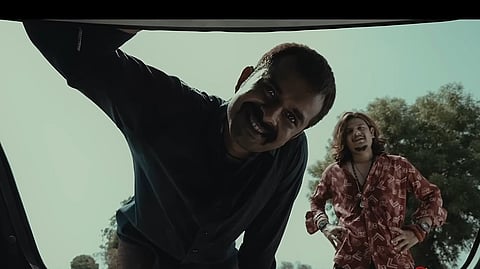
There’s an ominous little village, where abducted young women are drugged, reduced to bodies and sold to sweet-talking pimps. A 20-year-old named Birwa (Deeksha Joshi) lives with her light-eyed captor Ratan (Yash Soni). It’s been five years, but their twisted little arrangement reaches a reckoning when a defiant new girl, Urmi (Prachi Thaker), is brought in by Ratan’s associate Babu (Shruhad Goswami). Traffickers Ratan and Babu share a bond similar to the Ranga-Billa-inspired duo from the series Raakh (2026), while the Stockholm-Syndrome-ish equation between Ratan and Birwa brings to mind Imtiaz Ali’s Highway (2014). Then there’s Ratan’s night job as a creepy security guard at an upscale Ahmedabad colony, where he has his eye on its latest resident, Tara (Druma Mehta); this segment feels like its own horror movie, with the predator slowly closing in on his wilting prey. The third track features Birva’s sister, Purva (Tarjanee Bhadla), who begins to track her and trail Ratan after finding their video on a porn site.
Maaran has its issues. For one, the connective tissue between the three settings is weak. They feel like separate films clunkily merged on the edit table. Even if that’s the motive, the presence of Ratan across these tracks turns it into more of an anthology series (until the climax). Secondly, the film veers dangerously close to fetishising the two traffickers as tragedies of an unforgiving system. Each of them has monologues about masculinity, as well as ornamental moments of toxic love with the girls. Ratan’s personality in the city — where he’s a sinister guard (Soni does a Fahadh Faasil here) or a crook who knows he’s being tracked — is almost unrelated to his character in the village. Some of the film-making aims for shock value (do psychopaths get a raise if they slaughter stray dogs?), particularly when Ratan has to act ominous and Bollywood-baddie tropes kick in. The spy-story parts of Birwa’s sister are a bit of an afterthought; you know it’s leading to a face-off with Ratan, but it always feels like her scenes are randomly inserted into the primary narrative.
The execution might be prone to an excessive tone, but in theory, much of Maaran exists between the lines. I like that Birwa’s conflict isn’t her inability to escape, but her reluctance to leave. She chooses a relationship and phantom future with her abuser over the stigma of returning to a slut-shaming society, where survivors are often treated as damaged goods. The film doesn’t explain the cage that she’s turned into a home, and until the exposition towards the end, it dares the viewer to notice the psychological framework of her circumstances. Some of her moments with Ratan play out as atmospheric love-story riffs, almost as if both of them are trying to locate a moody BDSM romance in the debris of captivity.
Just as she gaslights herself into being a partner (opting for the devil over the deep sea), he looks for a shot at an ordinary and filmy life through these scenes; their performance becomes their reality. Ditto for Babu, who doesn’t have the poisonous swagger of his friend, but wills himself to feel for Urmi as a last-ditch escape from the ‘pressures’ of being a cold-blooded man. The second we start sympathising with them, the film slips in one of the other tracks, where the same Ratan returns to his default mode as a beast bereft of his beauty-coded fantasy. It’s as if he is also reminding himself to stay a monster and not get carried away by the temptations of being human. The soundtrack is haunting and clever. The score and a few ballads are composed to heighten and reflect the mental state of the characters rather than the mechanisms of the narrative.
The writing is largely effective. Like the callbacks of a village kid who is doomed to follow in the hellish footsteps of the place; the uncertainty of the sister’s chase; striking traces of a former tenant in the new apartment; and the sinking tension of seeing an upscale resident — who would normally be introduced as a feminist and independent career woman in most movies — getting conscious of the male gaze. The cast does a good job of hitting the sweet spot between movie characters and real people. Each of them has to play multiple roles within the same person. Yash Soni’s Ratan is a heady mix of campy and cold, but it’s Deeksha Joshi’s Birwa that reframes the damsel in distress as a complicated survivor who finds comfort in victimhood. It’s a skillful performance of contradictions and greys. As a result, the film’s commentary comes through effectively, because it remains pragmatic about the endless loop of their stories. There is no actual resolution, winning or losing — just the circularity of truth that seeks refuge in fiction. After all, hope is what happens when social constructs meet personal illusions.