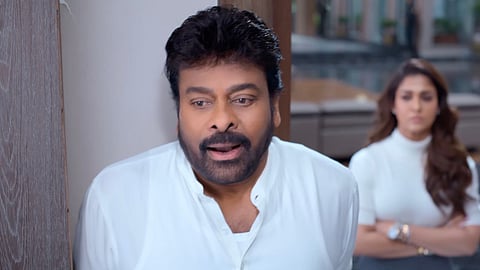


It’s always a treat to see young directors contour big-screen icons in exciting ways. In Mana Shankara Vara Prasad Garu, Chiranjeevi, at 70, still breaks into a random song here and there, hammers the bad guys, and makes a stylish entrance in an impeccable Ferrari. But he also doesn’t mind large doses of self-effacing humour — in fact, relishes it — in a film that is written around his character’s silliness. We see it in the way most of the jokes are written at the expense of Shankara Vara Prasad (Chiranjeevi), who, despite being an NIA agent, relinquishes all control to being nutty instead. For a film that revolves around an intelligent officer, it doesn’t take itself too seriously. But it’s not just a drama of situational comedy, but a modern marriage — a marriage that fails. And in this regard, Mana Shankara Vara Prasad Garu takes several steps back.
Shankara Vara Prasad is a big shot intelligence dignitary who guards and protects the lives and secrets of various big leagues in the country. But he plays the role of a family man better; a softie, who loves to whip up a quick meal and keep track of household expenses like an accomplished calculator. He maintains the same personality when he meets and gets his heart struck by Sasirekha (Nayanthara) at a wedding. Their courtship, which is captured quite sweetly in a flashback to the tunes of Ilaiyaraaja’s ‘Sundari’ wafting along in various languages, gently softens the machismo of the hero we saw thrashing a bunch of thugs with a pinkie. Chiranjeevi and Nayanthara play the roles of a middle-class man and a rich woman to perfection, their range adding freshness to familiarity.
The power equations in their relationships are initially endearing when it’s written with a light hand. When Prasad is asked why he agreed to go live with Sasirekha as a house husband, he immediately says, “She has given up many things for me, so why can’t I?” He rides off to her house while she resumes racking up top business awards. But what is an on-screen (or real) marriage without conflict? Two children, two ego trips and one divorce later, Prasad vows to win back his family.
Chiranjeevi comes alive as the goofy father who embarks on a mission much more deadly than his intelligence operations. His sidekicks (played by Catherine Tresa and Harsha Vardhan), with their continuous ‘team meetings’, keep things light. The writing remains slaphappy and nostalgic, evocative of films that represented good family fun. Ravipudi, however, applies the same logic for the marriage portions too, but the effect isn’t as pleasant. Sexist wife jokes slowly begin to erode conversations. “Funny” sermons about wives trapping husbands in legal cases are casually let out. All the while, women are softly blamed for having “egos."
And then it slowly occurs to us. Under the facade of a deceptively progressive comedy, the film still bats for conventional gender roles. A man slaps his wife and repents his act, but he still does everything but apologise to her. A mother-in-law appears like a cool parent, declaring how she would never interfere in her kid’s marriage, only to give bad, free advice a few moments later.
Venkatesh Daggubati appears in a fun cameo, and the entire film wraps up everything conveniently — along with a terribly forgettable plot about Sasirekha being in danger — to give it a storybook ending. But it leaves us wondering: how terrible would it be for comedies like this to leave gender tropes behind? And finally vanquish the wife jokes once and for all.