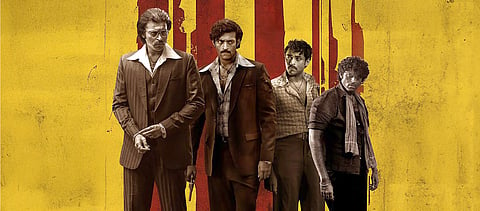

Karuna Kumar’s Matka begins with a tribute to filmmakers across the world, one of them being Brian De Palma. It isn’t evident how the film has been influenced by some of the other names, such as Martin Scorsese, but the inclusion of De Palma sets the stage pretty well. The year is 1982 and a brooding cop (Naveen Chandra) starts to recount the story of a gangster he is en route to apprehend. The clock then dials back to 1958 when a teenage boy arrives on the shores of Visakhapatnam, along with his mother and countless other destitute refugees. The kid is special, says the cop, because he has almost single-handedly changed the landscape of gambling in independent India, and this is the story of his unbridled audacity. The cop makes it seem like a cautionary tale, but he is actually hyping up that kid.
Apart from the protagonist being referred to in the third person, Matka is every bit an homage to De Palma’s 1983 cult classic Scarface and this single stretch alone confirms why he was brought up earlier. Everything about the Telugu film has echoes of the Tony Montana underdog story, from his feistiness to self-belief, but with the awareness that this is rendered for a completely different audience. You have the narrative beats of Oliver Stone’s script, the flashiness of the ‘vintage’ era and a central character whose rollercoaster of a life boasts the capacity to engross and enthrall. Even then, Matka misses out on one important aspect — having a personality of its own.
For starters, the film fails to recognise its protagonist’s core character. We meet Vasu as a turbulent young boy who loves a good fight and wants to make something of himself, preferably as a guy leading a national-level illegal operation. The film isn't clear about any such operation in particular. It's all very vague. Vasu, just like Tony Montana, doesn’t mind being a bit amoral to get to where he wants but the film also wants him to have a bleeding heart of some sort. He cares for sex workers, a trait that leads him to his future wife Sujatha (Meenakshi Chaudhary), during a visit to the city’s red-light area. While Tony doted on his sister, what really defined him wasn’t his sentimentality but his maniacal, singular pursuit of success. Both Stone and De Palma saw their leading man as a punk with a taste for showmanship, someone who didn’t mind being labelled a ‘wacko’ by the rest of the world, and his demeanour remained consistent throughout. But Karuna Kumar is too afraid to lend Vasu any kind of eccentricity, instead making him a mishmash of an Indian movie ‘hero’ whose identity is never fully realised.
The same confusion dictates how the majority of the screenplay plays out. The first half of Matka unfolds as a highlights reel that simply tells you what happened instead of drawing you into the action. Almost everything in Matka - from the characters to the setpieces - feels etched out with a hint of artifice and this is further pronounced by Kishore Kumar’s cinematography, which simply sweeps across the world instead of visually expounding it. He is ably supported by G.V. Prakash Kumar, whose background score, along with a smattering of passable songs, is used lavishly to embellish the film’s peaks. The problem, though, is that neither of the two technicians manage to conceal the considerable lack of drama or conflict in the material that's simply interested in dispensing information from a world built on cliches. There’s a retro nightclub, its famed dancer (Nora Fatehi), a handful of business rivals, a slew of bell bottoms-clad gangsters who twirl their moustaches and snarl frequently, a mother who could die and a child who must be saved, but none of these devices matter at any point.
Matka is advertised as being loosely based on the real-life Matka King Ratan Khatri but the film takes many creative liberties. Khatri, a Sindhi migrant from Pakistan, was said to have borrowed the essentials of matka gambling from his boss Kalyanji Bhagat, only to revolutionise it and make it his own in Mumbai. The betting game, which came to be ingrained within the pulse of a bustling city, highlighted how gambling evolved in a post-independent, financially unstable India. Karuna Kumar, though, isn’t as nearly interested in the history of it all as much as he is in the frills of a period film. His film is never sincerely concerned with the highs, the lows and the general idiosyncrasies of a gambler’s world, and eventually buckles under the lack of a clear gaze. How Vasu, a young entrepreneur looking to venture into the textile business, decides to suddenly take on matka gambling (without any real knowledge of the game) isn’t portrayed convincingly either.
Varun Tej, as Vasu, is made to elevate the lacklustre writing with his onscreen charisma, and he digs deep here. Among the few bright aspects of the film is the arc that his character undergoes, from a boyish brute to a snazzy gangster, and the 34-year-old actor puts his best foot forward. He briefly shares good camaraderie with Kishore (as Nani Babu). The scenes involving Naveen Chandra in the second half introduce a much-needed antagonistic tension into the scheme of things, dispensing a few thrills. It is a pity that Matka begins to find a semblance of its mojo only as it approaches the climax because the film had a lot of potential to entwine Indian archival material with a strong dose of movie masala and flamboyance. The end result is a bit of all flash and no bang.
