

After straying far and wide into the golden fields of mediocrity, the 8-year-old Mirzapur franchise returns to the comforting folds of its past like an ex-lover aching to rekindle a lost romance. Mirzapur: The Movie erases memories of the doomed third season, doing a factory reset of a cinematic universe that had reached its natural demise. It places us bang in the middle of the famous Season 1 — back when all the primary characters were alive and perverse; back when the narrative was yet to become a pale imitation of itself; back when guns, gore, profanity and sex were the law of the land; back when emasculated men were still desperate for validation from toxic fathers and brothers; back when the heartland-porn-coded vibes of the Tripathi mansion was yet to be hijacked by multiple storylines and half-hearted wokeness.
It’s normal to be wary of any greatest-hits rehash of a legacy, but in some cases, going back is the only way to move forward. Mirzapur: The Movie is the only logical choice in an age of commercial opportunism. It’s also a smart one. The 197-minute film unfolds like four extra episodes of the bullet-proof first season. The world expands sideways, almost nostalgically, with an eye on our relationship with the franchise. A lot of it is designed under the assumption that we know the future of these faces, so there’s an added layer of context; it plays with our perception of all those impending tragedies, betrayals and rivalries. Forget aura-farming, this is aura-milking until there’s not a drop left. There is, however, a misty-eyed affection for this debauched assortment of players; you can tell that the makers are just as enthusiastic to go back as the viewers.
The reigning king of Mirzapur, Kaleen Bhaiya (Pankaj Tripathi), in the good old days of shaming his trigger-happy son Munna Tripathi (Divyenndu), while praising his new right and left hands: the brainy Bablu Pandit (Jitendra Kumar, replacing Vikrant Massey) and his brawny bro Guddu (Ali Fazal). Mercurial nepo-kid Munna is jealous of mercurial outsider Guddu, Guddu and Bablu crush on a still-alive Sweety and a still-nerdy Golu, the lady of the Tripathi household Beena (Rasika Dugal) continues to seduce anything that moves, Munna’s bestie Compounder bolsters his ego, and Kaleen’s colleagues-cum-rivals — Jaunpur king Shukla, and the Chief Minister’s sad-sack brother JP Yadav — scheme to take over the throne. The empire needs a drug-deal, so enter the wild card, Jaisalmer’s Babban Yadav. He is of course played by India’s current internet boss Ravi Kishan, who infuses the already-viral landscape of Mirzapur with even more virality; he unleashes a few dance moves too, though they’re not the ones we crave to see. Babban pitches to be the new supplier of ‘barfi’ to Kaleen and gang, but being a retrospective entry into this game of thrones, this strangely romantic druglord (he dotes on his own Mumtaz) has his own two-faced plans.
The thing about Mirzapur: The Movie is that it seems to know that it’s a film wooing its OTT loyalists to the big screen. It arrives in a landscape that suffers from the very genre fatigue it kickstarted; every second show now uses the testosterone-dominated excesses of Mirzapur as a blueprint. Initially, it straddles the awkward bridge between the induction of new fans and the service of old ones (if that sounds like a cheap innuendo, blame the movie). There are plenty of clunky expository exchanges and ‘intro’ moments — you know, where either Kaleen or the two brothers or Babban are carrying out gruesome executions on traitors; where power struggles are spelt out; where everyone is not as edgy as they should be. But the movie comes into its own only as a tribute to itself: when Munna is being the OG heir yearning for papa’s love before Ranbir Kapoor in Animal; when the colourful language (the b-words and c-words) makes a hero-style comeback on the right lips; and when misogynistic gangsters face off against moral gangsters. It leans into the fan service, treating gestures and threats and abuses as musical cameos from a bygone era.
There’s also a sense that the film knows it’s critic-proof. The indulgence is off the charts. It does everything in its long-form-infected power to inflate the running time under the guise of an immersive experience. For instance, there are not one but two road-trip pieces to Jaisalmer featuring the Tripathi clan driving into enemy territory. When I say road-trip tropes, I mean it; they unfurl like isolated mini-films of their own, even including petrol-pump stops (“it’s cheaper before we cross the border”) so that an engine-oil brand can be advertised ‘organically’. There are random diversions, a belated inter-caste love story, an item song, the foreshadowing of a death that can be seen coming from outer space, and a truckload of Rajasthan-tourism-fuelled sand dune sequences to diversify the UP-centric grammar of the series. The movie keeps coming up with lateral excuses to continue its lifetime-achievement-award-like run without losing the vitality of the original. The bullets, like in Season 3, continue to be incompetent and biased; they refuse to hit the main cast during shootouts, regardless of how close-range the shots are. The action pieces look tired after all these years, but the film somewhat remembers that the real kinetic energy is in the verbal exchanges.
Despite the obvious greed, though, there’s much to appreciate about the mainstream beats of the writing. I like how the many threads and conflicts — clumsy when introduced — are tied up with proper payoffs. Because of the timeline, we know that there will be no main-character deaths, yet the theatricality is effective. Guddu’s hulk-smash rage issues and steroid addiction are put to good use with a horse-injection subplot that elevates the climax. The fate of a wristwatch belonging to his family comes full circle, too. The newer characters and equations are given complete arcs. A spunky mechanic in Jaisalmer joins the ride, but he isn’t reduced to comic relief. Babban’s small entourage — his lover Mumtaz, a former business partner, and especially his loyal henchman Birju — supplies the narrative. The small touches work: like Birju jousting with his counterpart (Kaleen’s iconic henchman Maqbool), the villains’ weakness being love, or Beena’s identity finding fruition in a solid post-credits sequence. Babban himself is a compelling-enough baddie, because it feels like he’s the protagonist of his own underdog tale.
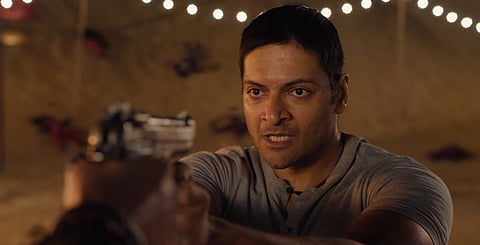
The large cast does the job. Pankaj Tripathi savours the Kaleen-isms, the wry looks of daddy-disappointment, and the deadpan insults that made him a household name; Kaleen is not the cleverest cookie, but Tripathi captures the vibe of a performative leader who inspires trust rather than confidence. Ali Fazal’s strong year is bolstered by his return as the scene-stealing Guddu: a throwback to the loose cannon he was before grief forced him to grow up (whatever that means within the framework of Mirzapur). It’s nice to see Divyenndu retain that madness in Munna’s eyes, even though the film visibly strips him off the star-making unpredictability that defined the series. But this is also a necessary change. Because the strength of this film is that it draws on the traditional tensions and unites these internal factions against one external threat. Ironically, it feels like the reflection of a nation where all antiheroes and politicians and ideologies are urged to come on the same page when faced with serious outside dangers (sometimes manufactured).
Everyone is bad, but it’s about the survival of the baddest; in fact, the enemies here are more ‘human’ than each of the primary Mirzapur veterans. The film makes this unlikely alliance feel rewarding, because it plays out like a feel-good dysfunctional-family flashback before everything went to hell: a twisted version of a Barjatya melodrama from the 1990s. It doesn’t change the course of the series, but it does flirt with what-if and alt-reality scenarios — the sort of fanfic capsules that are hard to resist. At one point towards the end, the background music disappears when a character is shot dead and the screen goes silent. But this pause is less for dramatic effect, and more to welcome the hoots of an audience that’s waited hours and years to be satiated. The giggles that once met Munna’s cussing are replaced by the cheers for bloodlusty punchlines. The film thrives on being this racy conductor of Gangs-of-Wasseypur-for-the-masses reactions. It twirls the baton on stage, holding the audience in its palms and creating the illusion that a populist medley is more satisfying than a classical composition. Who’s to tell the sound of applause from the sound of apprehension anymore?