
In Odela Railway Station (2022), a man’s sexual dysfunction finds a deviant outlet. Tirupati (Vasishta N. Simha) becomes a serial killer, channeling his rage—fueled by his wife Radha’s (Hebah Patel) mockery of his impotence—into a spree of brutality, targeting young women on their wedding nights. Written by Sampath Nandi and directed by Ashok Teja, Odela Railway Station is a passable, routine thriller that uses a trigger-happy idea of justice to offer a resolution: Tirupati is ultimately killed by Radha as a symbolic (yet simplistic) gesture towards feminism.
Odela 2, the sequel, then comes as the follow-up to the thought that a man’s lust and lechery don’t exist in his body, but deep inside his spirit or aatma. When the folk of Odela decide that Tirupati must not be cremated and instead be given a samadhi shiksha (restricted to a grave as punishment), little do they anticipate that his condemned soul is going to continue tormenting their young daughters (with the same modus operandi). If the previous instalment showed how human resilience overcomes a sinister force, Odela 2 says that the air can be purged of that evil only through divine intervention.

At first glance, the concept feels sophisticated—even if somewhat conveniently mounted. The sequel is significantly more ambitious than the 2022 film, and the combination of Sampath Nandi (credited extensively as the story-screenplay-dialogue writer and also with ‘direction supervision’) and Ashok Teja pronounces the scale of the project in every frame. Soundararajan’s cinematography is a lot more lavish with Kantara music composer B Ajaneesh Loknath infusing a fieriness into the narrative, and art director Rajeev Nayar creating visibly expensive set pieces that are further underlined by some imaginative VFX work.
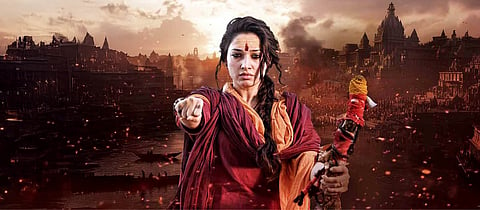
The scope is broader, too. From the familiar bylanes of the Telangana village, the story reaches out to the ghats of Varanasi and even to Mount Kailash, where austere Naga Sadhus quote Hindu scriptures and oversee how Tirupati’s spirit can be exorcised. Tamannaah Bhatia, as one such Naga Sadhu named Bhairavi, enters the fray to see the end of Tirupati following a good amount of build-up and sets up an intriguing contest between genders, between faith and contempt.
Yet, Odela 2 barely scratches the surface while exploring the tensions between its two central characters. The film has strong echoes of Kodi Ramakrishna’s Arundhati in that Bhairavi and Tirupati match wit-to-wit in a supernatural clash, but sans any suspense or depth. The writing reveals a considerable lack of focus when it becomes apparent that the film is not interested in extending the argument around gender imbalance as much as it wants to showcase its aesthetic sense. More so, Odela 2 gets lost in positioning Hindu symbolism at the centre of its narrative, and a majority of the film, as a result, becomes an unabashed, loud, and repetitive display of devotion. Nothing feels horrifying about the film, even with the inclusion of elements like occult and exorcism.
In terms of its temperament, too, the sequel feels no different to the first instalment. It prefers to titillate and exploit its female characters under the garb of exposing the male gaze, and several scenes reek of sleaze that defeats the entire purpose of the film. Even the main plot device between the protagonist and the antagonist is made to be a sexual exchange that carries little to no significance. Both Tamannaah and Vasishta Simha put their best foot forward but the writing only allows them to posture heavily and mouth long and clunky monologues—if the former is made a spiritual embodiment of Lord Shiva, the latter knows no better than spewing empty threats with his booming voice.
At the end of it all, Odela 2 feels like a project that exists because of an overzealous writer, who only wants to package and flaunt his extensive research and knowledge. The film lacks purpose: it forgets the issue of sexual crimes against women very early into the film and slips into a dense speech about faith and divinity. The filmmaking is devoid of nuance in that it employs most characters to react and not have personalities of their own, which Odela Railway Station managed to a fair extent. A few positives—such as Tirupati's demonic displays of power and the presence of an unconventional female lead—crop up occasionally to hint at the film that Odela 2 could have been. This is a spectacle, no doubt, but a hollow and outdated one.